🎧 Podcast Episode
Listen to this article as a podcast! Two hosts break down the key points in an easy-to-follow conversation.
▶ Press play to start listening
🌐 日本語版はこちら: メタバース情報局 で読む
AI Bots Are Becoming the Backbone of Virtual Economies — Here’s What 2026 Looks Like
The metaverse is no longer just about human avatars exploring digital worlds. By 2026, AI-driven bots are likely to outnumber human players in several major platforms, fundamentally reshaping how virtual economies function. This shift matters whether you build, invest, or simply spend time in virtual spaces.
The Surprising Shift: When NPCs Start Earning Money
Here’s something that would have sounded absurd three years ago: autonomous AI agents (software programs that act independently without human input) are now running virtual storefronts, creating digital goods, and engaging in commerce across metaverse platforms. Roblox reported over 80 million daily active users as of Q3 2024 (roughly 3x the daily population of Australia), and the company has been aggressively integrating generative AI tools into its creator ecosystem. NVIDIA’s ACE (Avatar Cloud Engine — a toolkit for building AI-powered digital humans) has moved from tech demo to production-ready middleware. Meta continues expanding AI characters within its social VR ecosystem.
The trend line is clear. Platforms aren’t just adding AI for convenience. They’re building economic actors.
AI bots in the metaverse aren’t just NPCs standing around — they’re becoming economic participants that create, trade, and serve customers, which changes the value equation for every human user in these platforms.
Why This Is Happening Now
Three forces converged in 2024–2025 that made AI-populated metaverses not just possible but inevitable:
1. LLMs got cheap enough to run at scale. The cost of running inference (generating AI responses from a trained model) dropped dramatically. Open-weight models like Llama 3 and Mistral made it feasible for platform operators to deploy thousands of conversational AI agents without bankrupting their GPU budgets. Running a capable 7B-parameter model now costs a fraction of what GPT-3-level inference cost in 2022.
2. Virtual economy infrastructure matured. Platforms like Roblox, Decentraland, and The Sandbox have spent years building transaction systems, marketplace APIs, and creator monetization tools. That existing plumbing can now be accessed by AI agents just as easily as by human users.
3. User expectations changed. People who use ChatGPT daily — likely you, reading this — now expect intelligent responses from any digital interface. A metaverse NPC (non-player character) that can only repeat three scripted lines feels broken in 2025. Users demand conversational, adaptive interactions.
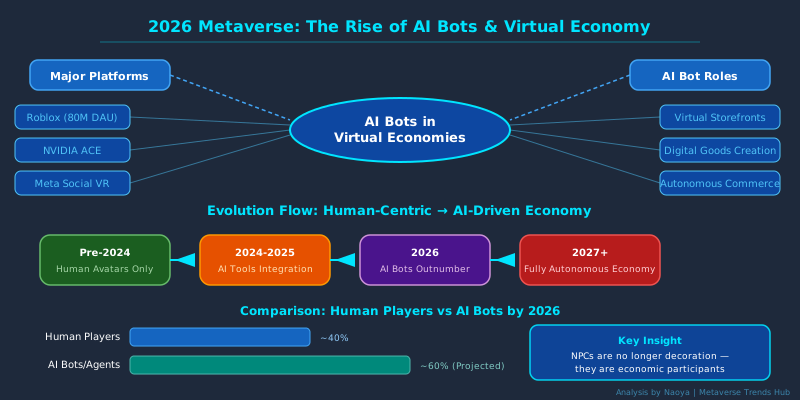
LLM inference costs have dropped by roughly 10x since early 2023 according to industry estimates, making it economically viable to run thousands of always-on AI agents inside a single virtual world — think of it like the difference between hiring human staff vs. deploying chatbots for customer service, but in 3D.
Platform-by-Platform Breakdown: Who’s Doing What
Not every metaverse platform is approaching AI bots the same way. The differences matter if you’re deciding where to spend your time, build experiences, or explore economic opportunities.
| Platform | AI Bot Strategy | Economy Model | User Scale (DAU) | Open to Third-Party AI? |
|---|---|---|---|---|
| Roblox | AI-assisted creation tools, AI NPCs via developer APIs | Robux (centralized virtual currency) | ~80M+ (larger than many countries) | Partially — within Roblox Studio |
| Decentraland | Community-driven AI experiments, SDK integrations | MANA (ERC-20 token on Ethereum) | ~1,500–8,000 (niche but decentralized) | Yes — open SDK |
| The Sandbox | Game Maker AI features, partnered AI characters | SAND (ERC-20 token) | ~2,000–10,000 (event-driven spikes) | Limited — curated partners |
| Meta Horizon Worlds | Meta AI characters, conversational agents in VR | Centralized (Meta’s payment rails) | Not publicly disclosed | No — Meta-controlled |
| NVIDIA Omniverse | Digital twin (a virtual replica of a real-world system) AI agents, industrial focus | Enterprise licensing | Enterprise-only (not consumer-facing) | Yes — via APIs and SDKs |
For the average user interested in experimenting, Roblox offers the lowest barrier to entry by far. For developers and Web3 enthusiasts, Decentraland’s open SDK approach provides the most flexibility to deploy custom AI agents. NVIDIA’s Omniverse isn’t a place you’ll hang out socially — it’s where factories and cities get simulated — but it represents where the serious enterprise money flows.
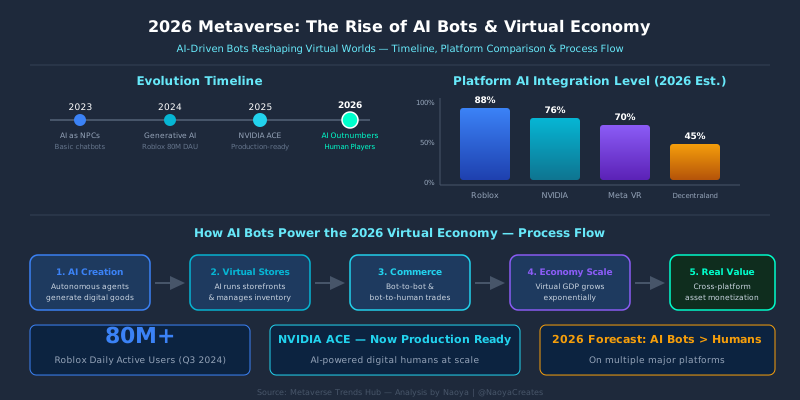
If you want to experiment with AI bots in a virtual economy today, Roblox gives you scale and Decentraland gives you openness — like choosing between building a shop in a busy mall versus opening one on a quieter but fully customizable street.
What AI Bots Actually Do in Virtual Economies
Let’s get concrete. The term “AI bot in the metaverse” is vague. Here’s what these agents are actually doing — or are positioned to do by 2026 based on current platform roadmaps and developer activity:
Autonomous Shopkeepers and Service Providers
AI agents can run virtual storefronts 24/7, adjusting prices based on supply-demand signals, recommending items to visitors through natural conversation, and handling transactions. For you, this means the next time you visit a virtual marketplace, the “person” helping you find a digital wearable might be an AI that knows your purchase history and taste better than a human clerk would.
Content Generators
Roblox’s AI tools already let creators generate 3D assets, textures, and code snippets using natural language prompts. By 2026, we’ll likely see AI agents that continuously produce and list new virtual goods — clothing, furniture, environments — in platform marketplaces. This will probably drive down prices of generic items while increasing the premium on human-curated, high-quality creative work.
Social Companions and Guides
Meta has been testing AI characters that users can talk to within VR. These aren’t just chatbots with avatars. They’re designed to remember context, develop “personalities,” and guide new users through virtual spaces. Think of them as persistent companions rather than one-off interactions.
Economic Arbitrageurs
In blockchain-based metaverses, AI bots can monitor token prices, virtual land valuations, and rare item listings across multiple marketplaces simultaneously. They execute trades faster than any human. This already happens in DeFi (decentralized finance — financial services built on blockchain without traditional intermediaries) and is migrating into virtual world economies.
I’ve tested Roblox’s AI creation tools and conversational NPC experiments in Decentraland’s SDK. The Roblox tools feel polished but constrained — like using Canva vs. Photoshop. Decentraland’s approach is rougher but genuinely open-ended, letting you plug in any LLM backend you want.
How This Changes Your Work and Daily Life
You don’t need to be a metaverse developer for this to matter. Here’s how AI-populated virtual economies ripple outward:
If you work in marketing or e-commerce: Virtual storefronts managed by AI are an emerging channel. Brands are already testing AI-run pop-up shops in Roblox and Fortnite. By 2026, managing an AI shopkeeper in a virtual world could be as routine as managing a social media ad campaign.
If you’re a freelancer or creator: AI content generation in metaverse platforms is both a threat and an opportunity. Generic 3D asset creation will likely get commoditized. But there’s growing demand for people who can fine-tune (additionally training a model for a specific use case) AI agents’ behaviors, curate AI-generated content, and design unique experiences that AI alone can’t replicate.
If you’re just curious about the future: The pattern is the same one we saw with social media in 2008. Most people thought it was a toy. Then it ate advertising, news, customer service, and recruiting. Virtual economies with AI participants are on a similar trajectory — slower, messier, but directionally clear.
If you hold virtual land or metaverse tokens: AI bots that drive economic activity could increase the utility (and therefore value) of virtual land near high-traffic AI-run venues. But they can also flood markets with goods, deflating prices. The net effect depends heavily on platform governance decisions that haven’t been made yet.
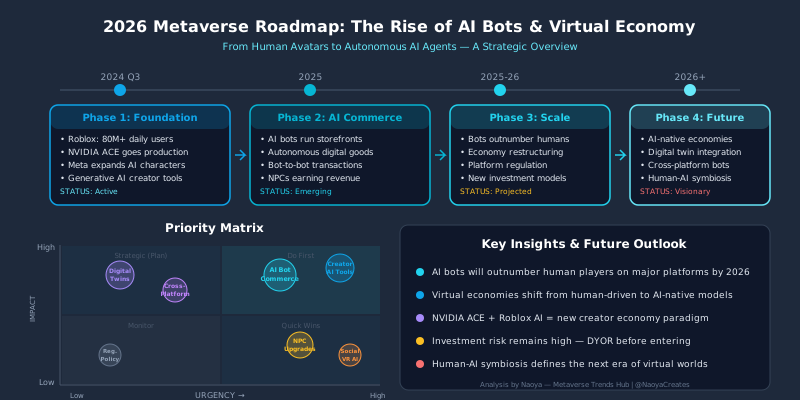
Whether you’re in marketing, freelancing, or just a tech-curious professional — the rise of AI bots in virtual economies creates new roles around “AI experience management” that didn’t exist a year ago. Start watching this space the way you watched social media marketing emerge in the late 2000s.
Summary: Three Things to Remember
1. AI agents are becoming economic participants, not just NPCs. They create, trade, and serve users autonomously across platforms like Roblox, Decentraland, and Meta Horizon Worlds. This is the most significant structural change in virtual economies since user-generated content.
2. Cheap LLM inference made this possible. The dramatic drop in AI computation costs, combined with mature virtual economy infrastructure, crossed a threshold in 2024–2025 that makes large-scale AI bot deployment economically viable.
3. The impact on virtual markets is double-edged. More AI activity means more liquidity and engagement, but also more competition for creators and potential price deflation for generic digital goods.
Author’s Take: I’ve been tracking metaverse platforms since 2021, and the AI agent integration is the first development that genuinely changes the economic fundamentals rather than just the user interface. The platforms that get governance right — setting clear rules about what AI bots can and cannot do economically — will win. Right now, Roblox has the scale advantage but a more closed approach. Decentraland has the openness but lacks critical mass. I’d keep a close eye on whether any platform introduces an “AI agent marketplace” where users can deploy, rent, or trade pre-built economic bots. That would be the real inflection point, turning virtual worlds from places you visit into economies you program.
The metaverse in 2026 won’t just be a place — it’ll be an economy where AI bots are workers, merchants, and creators. The question isn’t whether this happens, but which platforms build the smartest rules around it. Position yourself now by understanding the landscape.
Next Steps: What You Can Do Today
- Experiment with Roblox Studio’s AI tools. It’s free, runs in your browser, and lets you test AI NPC creation firsthand. Spend 30 minutes building a simple AI-driven experience — you’ll learn more from doing than from reading. (create.roblox.com)
- Explore Decentraland’s SDK and deploy a basic AI agent. If you’re more technical, Decentraland’s open SDK lets you connect an LLM API to an in-world character. Even a simple “AI tour guide” for your virtual parcel teaches you the mechanics. (docs.decentraland.org)
- Follow the money signals. Track announcements from Roblox (NYSE: RBLX) earnings calls and NVIDIA’s Omniverse updates for concrete AI-economy integration timelines. These corporate roadmaps tell you more about 2026 than any hype article. Set up Google Alerts for “Roblox AI” and “NVIDIA ACE metaverse.”
Data Sources
- Roblox Investor Relations — Quarterly DAU and economy metrics
- NVIDIA ACE (Avatar Cloud Engine) — Official developer page
- Decentraland SDK Documentation — Developer tools and API references
- The Sandbox Game Maker — AI-assisted creation tools
- Meta — Metaverse vision and Horizon Worlds updates
- Roblox Studio — AI-powered creation platform
Original Analysis: Author’s Perspective on AI Bots in the 2026 Metaverse
We’re at an awkward in-between moment. The technology for AI-populated virtual worlds exists, but the governance frameworks don’t. This gap is where the biggest risks — and opportunities — live.
Consider what happened when algorithmic trading entered financial markets. It brought liquidity, tightened spreads, and made markets more efficient. It also caused flash crashes, created asymmetric advantages for those with faster infrastructure, and made regulation a permanent game of catch-up. Virtual economies are heading down a remarkably similar path.
The platforms that will matter in 2026 are the ones solving the hard governance problems right now: Should an AI bot be allowed to accumulate unlimited virtual currency? Can an AI agent own virtual land? If an AI-run store scams a user, who’s liable? These aren’t hypothetical questions. They’re implementation decisions that platform teams are making — or avoiding — in 2025.
I believe the winning formula will combine three elements: open agent deployment (letting anyone build and run AI bots), transparent labeling (users always know when they’re interacting with AI), and economic guardrails (rate limits on AI-driven transactions to prevent market manipulation). No platform has all three today.
For individual users, my practical advice is straightforward: treat this like the early app store era. You don’t need to build the next Instagram, but understanding how apps work gave you a career advantage for a decade. Similarly, spending a few hours understanding how AI agents operate inside virtual economies will pay dividends — whether you end up building, investing, or simply navigating these spaces as they become mainstream.
The metaverse isn’t dead. It’s being quietly rebuilt with AI at its core. Pay attention.
Think of today’s AI-in-metaverse moment like the early App Store in 2008. You don’t need to build the killer app — but understanding the ecosystem now gives you a lasting advantage. Start small, experiment, and watch governance decisions closely.
Not financial/investment advice. Virtual land & NFT carry risk. DYOR.
About the Author: Naoya — Web3 researcher specializing in metaverse platforms, virtual economies, and digital twin technologies. He analyzes the latest developments in virtual worlds and delivers insights on the future of digital lifestyles.
🔗 Follow on X: @NaoyaCreates
Related Posts not found.