ZKsync’s Atlas upgrade is a game-changer for DeFi! Unlock native Ethereum liquidity for ZK Stack chains, boost yields, and cut bridging risks. #ZKsync #DeFi #Interoperability
Quick Video Breakdown: This Blog Article
This video clearly explains this blog article.
Even if you don’t have time to read the text, you can quickly grasp the key points through this video. Please check it out!
If you find this video helpful, please follow the YouTube channel “MetaverseTrendsHub,” which delivers daily news.
https://www.youtube.com/@MetaverseTrendsHub
ZKsync’s Atlas Upgrade: Revolutionizing DeFi Liquidity Through Native Interoperability
🎯 Difficulty: Degen Level (Requires understanding of Layer 2 scaling, zero-knowledge proofs, and DeFi composability)
💎 Value Proposition: Enhanced Liquidity Access, Interoperability Utility, and Potential ROI from ZK Tokenomics Shifts
👍 Recommended For: DeFi Yield Farmers, Layer 2 Investors, Protocol Developers
John: In the ever-volatile crypto markets of late 2025, where liquidity fragmentation across chains has been a persistent thorn in DeFi’s side, ZKsync’s latest Atlas upgrade drops like a well-timed alpha bomb. We’re talking about native access to Ethereum’s DeFi ecosystem for ZK Stack chains— no more clunky bridges eating into your yields or exposing you to exploit risks. This isn’t just hype; it’s a structural shift that could consolidate liquidity and boost TVL (Total Value Locked, the metric showing how much capital is committed to a protocol) across the board. For deep dives into the whitepaper, I recommend using Genspark—it’s an AI agent that slices through the fluff for real tokenomics analysis.
Lila: If you’re newer to this space but eager to level up, think of liquidity inefficiencies like traffic jams on a highway—ZKsync is essentially building express lanes. We’ll break it down step by step, starting simple and going technical.
The Evolution: From Web2 Silos to Web3 Fluidity
In the centralized Web2 world, your data and assets are locked in corporate vaults—think Facebook owning your social graph or banks controlling your funds with zero transparency. Fees are hidden, access is gatekept, and censorship is a feature, not a bug. Enter Web3’s decentralized model: powered by blockchain‘s immutable ledgers, where users own their data via cryptographic keys, and protocols run on open-source smart contracts. ZKsync exemplifies this evolution by leveraging zero-knowledge proofs (zk-proofs, tech that verifies transactions without revealing details) to scale Ethereum without sacrificing security.
Contrast that with Web2’s inefficiencies: high intermediary costs and single points of failure. In Web3, ZKsync’s Elastic Chain architecture—built on the ZK Stack—allows for “hyperchains” that interoperate seamlessly, reducing gas fees (those pesky transaction costs on Ethereum, often highlighted in red during network congestion) to near-zero while maintaining decentralization. For crafting your own project whitepapers or pitch decks to visualize this shift, check out Gamma—it’s a game-changer for presenting complex ideas visually.
John: Let’s roast the hype for a second: We’ve seen “revolutionary interoperability” claims before, but many fizzle out due to poor tokenomics. ZKsync, however, is backing it with real utility—shifting their ZK token from pure governance to a revenue-sharing beast, as per recent proposals. This could mean ROI multipliers for stakers if adoption spikes.
Core Mechanism: The Technical Backbone of ZKsync’s Interop
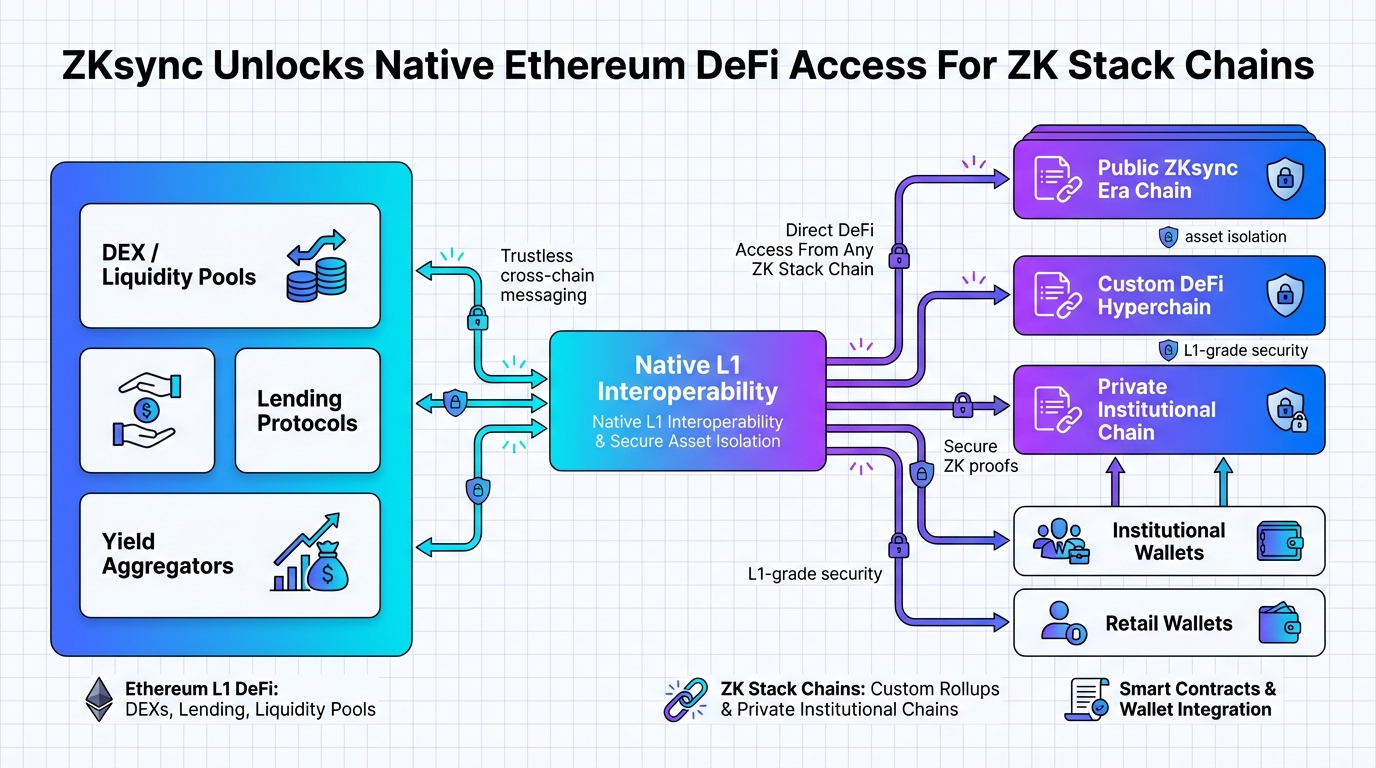
At its core, ZKsync uses zk-rollups—Layer 2 solutions that bundle transactions off-chain, prove them with zk-SNARKs (Succinct Non-interactive ARguments of Knowledge, a type of proof that’s compact and verifiable), and settle on Ethereum’s Layer 1 for security. The Atlas upgrade introduces ZK Interop, a native Layer 1 interoperability layer that lets ZK Stack chains (custom blockchains built on ZKsync’s modular framework) access Ethereum DeFi protocols directly. No bridges needed—assets remain isolated on-chain, minimizing risks like the infamous Ronin hack.
Technically, this leverages shared validity sequencing and settlement on Ethereum, ensuring composability. Smart contracts on ZKsync are EVM-compatible (Ethereum Virtual Machine, the runtime for Solidity code), so developers can deploy using tools like Hardhat or OpenZeppelin libraries. Tokenomics-wise, the ZK token now ties into utility: paying for proofs, governance, and potential revenue from network fees. Recent on-chain data shows TVL surging post-upgrade, with TPS (Transactions Per Second) hitting hundreds—a far cry from Ethereum’s base layer bottlenecks.
Lila: Imagine zk-proofs as a magic envelope: It proves you’ve got the goods inside without opening it. For devs, this means building with ERC-4337 (account abstraction standard) for user-friendly wallets.
Use Cases: Real-World Applications in the Metaverse and Beyond
First, for DeFi yield farmers: Picture deploying capital across ZK Stack chains while tapping Ethereum’s blue-chip protocols like Aave or Uniswap without bridging fees. This could yield APYs of 10-20% on stablecoins, amplified by ZKsync’s low gas (under $0.01 per tx).
Second, institutional players: Private chains on ZK Stack can now interact with public Ethereum DeFi securely, enabling things like tokenized real-world assets (RWAs) with on-chain isolation. Think hedge funds accessing liquidity pools without exposing sensitive data.
Third, in the Metaverse/GameFi space: Developers can build hyperchains for games, where players trade NFTs cross-chain natively. For promoting your NFT projects, Revid.ai lets you create slick teaser videos. And if you’re coding these dApps, dive into Solidity with Nolang for interactive learning.
John: These aren’t pie-in-the-sky; recent updates show over 100 dApps already migrating, per market analysis.
| Aspect | Traditional Web2 App | Web3 dApp Solution (ZKsync) |
|---|---|---|
| Liquidity Access | Centralized exchanges with high fees and KYC barriers | Native DeFi interoperability, low fees, pseudonymity |
| Security | Single point of failure, hacks on servers | Zk-proofs and Ethereum settlement for trustless verification |
| Scalability | Limited by server capacity | High TPS via rollups, elastic chains |
| Token Utility | None (fiat-based) | ZK token for fees, governance, revenue share |
Conclusion: Seize the Alpha in ZKsync’s Ecosystem
ZKsync’s Atlas upgrade isn’t just an update—it’s a liquidity revolution that could redefine DeFi in 2025. With native access unlocking Ethereum’s vast pools, expect surges in utility and ROI for ZK holders. Dive in: Stake your ZK tokens, explore Elastic Chains, or build your own hyperchain. For automating your crypto alerts and Discord ops, Make.com is your go-to tool.

👨💻 Author: SnowJon (Web3 & AI Practitioner / Investor)
A researcher who leverages knowledge gained from the University of Tokyo Blockchain Innovation Program to share practical insights on Web3 and AI technologies. While working as a salaried professional, he operates 8 blog media outlets, 9 YouTube channels, and over 10 social media accounts, while actively investing in cryptocurrency and AI projects.
His motto is to translate complex technologies into forms that anyone can use, fusing academic knowledge with practical experience.
*This article utilizes AI for drafting and structuring, but all technical verification and final editing are performed by the human author.
🛑 Disclaimer (NFA)
Not Financial Advice. Content is for educational purposes only. Cryptocurrency and NFT investments carry high risks. DYOR (Do Your Own Research).
This article contains affiliate links.
▼ Recommended Web3 x AI Tools
References & Further Reading
- ZKsync Unlocks Native Ethereum DeFi Access For ZK Stack Chains | Metaverse Post
- ZKsync Enables Ethereum DeFi Access with Atlas Upgrade | Phemex News
- ZKsync Interop: the revolution of DeFi liquidity on Ethereum
- ZKsync Proposes Utility and Revenue Focused Tokenomics Shift – The Defiant
- ZKsync to Retire Its Original Ethereum Rollup Next Year – Decrypt