
Tired of complex crypto-fiat conversions? TON Foundation & OpenPayd are building seamless, trust-minimized bridges for Web3.#TONFoundation #Web3Payments #CryptoFiat
Quick Video Breakdown: This Blog Article
This video clearly explains this blog article.
Even if you don’t have time to read the text, you can quickly grasp the key points through this video. Please check it out!
If you find this video helpful, please follow the YouTube channel “MetaverseTrendsHub,” which delivers daily news.
https://www.youtube.com/@MetaverseTrendsHub
Read this article in your native language (10+ supported) 👉
[Read in your language]
TON Foundation’s Partnership with OpenPayd: Revolutionizing Crypto-to-Fiat Bridges in Web3
🎯 Difficulty: Advanced
💎 Core Value: Interoperability
👍 Recommended For: Web3 developers building payment systems, Crypto ecosystem analysts, Traditional finance professionals exploring blockchain integration
Lila: Jon, with all the macro trends in Web3 like increasing regulatory scrutiny and the push for seamless financial interoperability, how does the TON Foundation’s recent partnership with OpenPayd fit into the broader picture of decentralization and trust minimization in crypto infrastructures?
Jon: Excellent question, Lila. This partnership is a prime example of how Web3 ecosystems are evolving to minimize trust dependencies while integrating with traditional finance. TON, or The Open Network, is a layer-1 blockchain designed for high scalability, using a proof-of-stake consensus with sharding for efficient transaction processing. OpenPayd, a regulated banking-as-a-service provider, brings fiat infrastructure expertise. Together, they’re enhancing crypto-to-fiat ramps, which essentially means streamlining conversions between digital assets like TON’s native token and traditional currencies. This reduces reliance on centralized exchanges by providing decentralized protocols with direct fiat gateways, aligning with Web3’s core ethos of trust minimization—where users control their assets without intermediaries holding custody.
Lila: That makes sense on a high level, but can you break down how this compares to the evolution from Web2 to Web3 systems, especially in terms of ownership and censorship resistance?
Jon: Absolutely. In Web2, financial services are centralized—think banks or payment processors like PayPal, where user data and funds are controlled by the platform, vulnerable to censorship or single points of failure. Web3 flips this with decentralized ledgers; ownership is enforced via cryptographic keys, ensuring users have true sovereignty over their assets. This partnership bolsters composability too—TON’s smart contracts can now interoperate more fluidly with fiat systems, allowing developers to build apps that seamlessly blend on-chain tokens with off-chain banking. Censorship resistance comes from blockchain’s immutable nature; once a transaction is confirmed on TON’s network, it’s resistant to reversal without consensus, unlike Web2 where a central authority could freeze accounts.
Understanding the Core Mechanisms
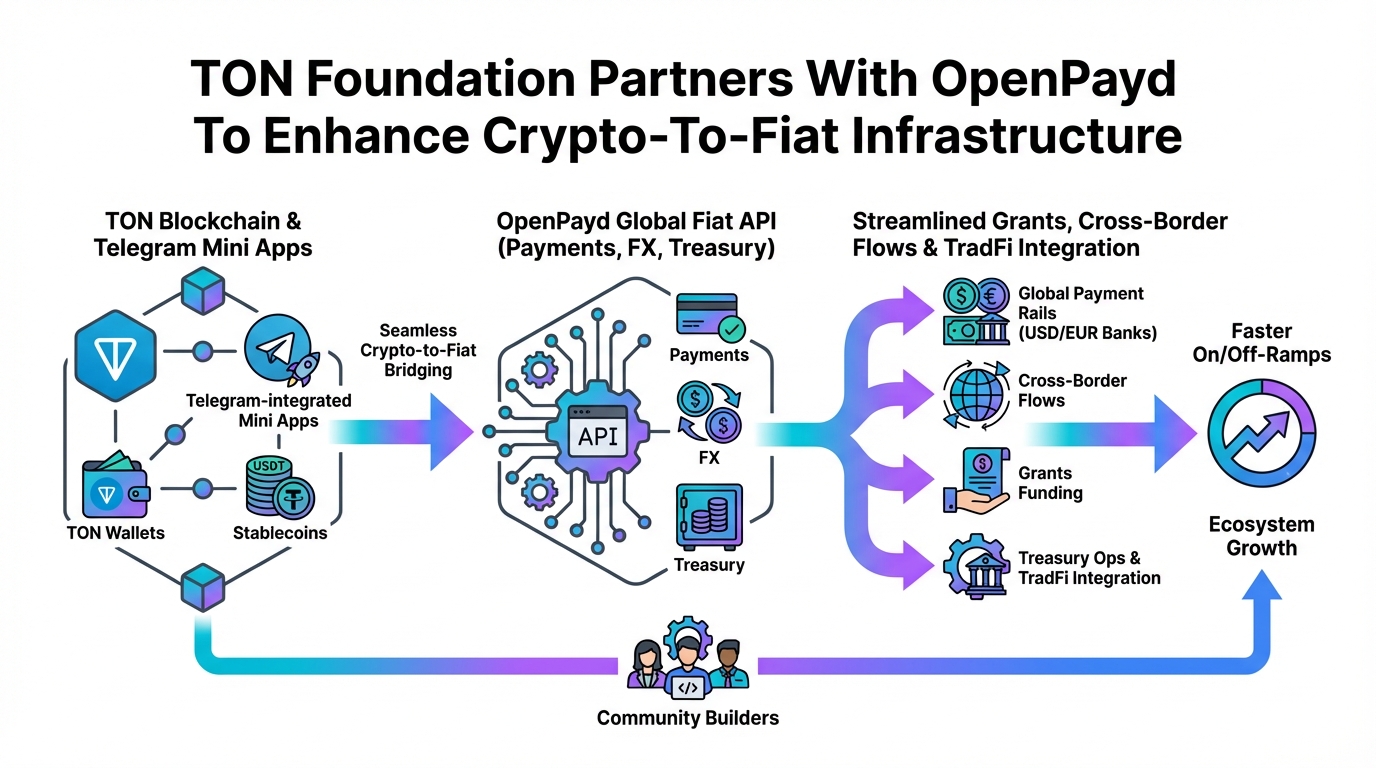
Lila: Looking at that diagram, it shows layers of protocols and interactions. For advanced readers, how does this partnership delve into technical architecture, like token design or decentralization logic?
Jon: Let’s dive in. TON’s token design centers on Toncoin (TON), which serves as gas for transactions and staking in its proof-of-stake model. The partnership with OpenPayd integrates this with fiat via APIs that handle compliance like KYC/AML, without compromising decentralization. Architecturally, it’s about building a hybrid system: TON’s sharded blockchain ensures scalability (handling millions of TPS theoretically), while OpenPayd provides the off-ramp to fiat currencies across borders. Decentralization logic here involves trust-minimized bridges—using smart contracts to escrow crypto assets during conversion, reducing counterparty risk. This is akin to how cross-chain protocols like LayerZero or Axelar use relayers and oracles, but tailored for fiat integration. The result is a more robust ecosystem where TON’s Telegram-integrated mini-apps can facilitate real-time payments without users leaving the decentralized environment.
Lila: Interesting. What about the composability aspect? How does this enable new ecosystem roles?
Jon: Composability is key in Web3—protocols act like Lego bricks. With OpenPayd powering TON’s fiat operations, developers can compose services where, say, a DeFi app on TON automatically converts yields to fiat and deposits them into a user’s bank account. Ecosystem roles expand: validators secure the network, developers build dApps, and now regulated entities like OpenPayd handle fiat rails, creating a permissionless yet compliant stack. This minimizes trust by distributing roles— no single entity controls the full flow, aligning with Web3’s modular architecture.
Lila: Can you elaborate on some concrete use cases where this partnership could shine?
Jon: Certainly. First, in decentralized finance (DeFi), this enables seamless on/off-ramps for TON-based lending protocols. Users could stake TON, earn yields, and convert directly to fiat without centralized exchanges, reducing fees and slippage. Second, for gaming in the metaverse, Telegram’s vast user base (integrated with TON) could see in-game economies where virtual assets are bought/sold with fiat conversions handled instantly—think purchasing NFTs or virtual land with a bank transfer, settled on-chain. Third, in cross-border remittances, the infrastructure supports low-cost, fast transfers; a user in one country sends TON, which OpenPayd converts to local fiat, bypassing traditional remittance giants like Western Union. These applications leverage TON’s high throughput and OpenPayd’s global banking network for practical, scalable Web3 adoption.
Lila: To make the differences clearer, how would you compare traditional Web2 services to these Web3 solutions enabled by such partnerships?
Jon: A comparison highlights the shifts effectively. Here’s a table outlining key aspects:
| Web2 | Web3 / Metaverse |
|---|---|
| Centralized payment processors (e.g., Visa) control transactions, with high fees and potential censorship. | Decentralized protocols like TON handle peer-to-peer transfers, with fiat integration via partners like OpenPayd for efficiency and compliance. |
| User data owned by platforms, vulnerable to breaches. | Self-sovereign identity and assets via cryptographic wallets, enhancing privacy. |
| Limited interoperability; siloed ecosystems. | Composable smart contracts allow seamless integration across chains and fiat systems. |
| Slow cross-border settlements (days). | Near-instant on-chain confirmations with fiat off-ramps in minutes. |
| Trust in central authorities for security. | Trust-minimized through consensus mechanisms and audits. |
Lila: This partnership seems promising, but what risks or challenges remain unresolved in this setup?
Jon: In summary, it enables scalable, interoperable financial systems in Web3, empowering users with true ownership and reducing intermediary dependencies. However, risks include regulatory changes—fiat integrations must navigate varying global laws—and potential smart contract vulnerabilities, which require rigorous audits. Oracle dependencies for fiat pricing could introduce points of failure, so ongoing decentralization efforts are crucial. Overall, it advances Web3’s maturity, but users should stay informed about protocol updates and security best practices.
Lila: Reflecting on this, how should readers approach learning more about such developments without getting lost in the hype?
Jon: Focus on understanding the underlying architectures through reputable sources, experiment with open-source tools, and observe ecosystem evolutions critically. It’s about building literacy for informed participation, not chasing trends.
References & Further Reading
- TON Foundation Partners With OpenPayd To Enhance Crypto-To-Fiat Infrastructure
- TON Foundation’s OpenPayd Alliance Targets Improved Crypto-to-Fiat Ramps
- TON Foundation Selects OpenPayd to Power its Global Fiat Infrastructure