Imagine AI agents paying each other seamlessly. Fetch.ai’s new system on ASI:One makes decentralized Web3 payments a reality.#AIAgents #Web3Payments #FetchAI
Quick Video Breakdown: This Blog Article
This video clearly explains this blog article.
Even if you don’t have time to read the text, you can quickly grasp the key points through this video. Please check it out!
If you find this video helpful, please follow the YouTube channel “MetaverseTrendsHub,” which delivers daily news.
https://www.youtube.com/@MetaverseTrendsHub
Read this article in your native language (10+ supported) 👉
[Read in your language]
Decoding Fetch.ai’s Revolutionary AI Agent-to-Agent Payment System on ASI:One
🎯 Difficulty: Advanced
💎 Core Value: Decentralization Logic / Technical Architecture / Ecosystem Roles
👍 Recommended For: Web3 developers building AI integrations, blockchain architects exploring agentic systems, investors analyzing decentralized payment infrastructures
Lila: Jon, with all the buzz around AI and Web3 integrations, Fetch.ai’s announcement of the world’s first AI agent-to-agent payment system on ASI:One seems like a significant macro trend. How does this fit into the broader shift toward decentralized AI economies, and what makes it a step forward in trust minimization?
Jon: Absolutely, Lila. This development by Fetch.ai aligns with the macro trend of agentic AI—autonomous systems that operate on behalf of users in decentralized networks. In traditional Web2, payments rely on centralized intermediaries like banks or payment processors, which introduce trust dependencies and single points of failure. Fetch.ai’s system on ASI:One leverages blockchain’s trust minimization principles, where transactions are verified through consensus mechanisms without needing a central authority. ASI:One acts as a specialized chain optimized for AI workloads, enabling AI agents to execute payments using tokens like FET or stablecoins like USDC, all while ensuring users retain control. This reduces counterparty risk and enhances composability across ecosystems.
Lila: That makes sense for the high-level view, but let’s dive into how this evolves from Web2 to Web3. In Web2, payments are siloed and controlled by platforms—think PayPal or Stripe. How does Fetch.ai’s approach address issues like censorship and ownership in a decentralized context?
Jon: Great point. Web2 payments are inherently centralized: a company owns the ledger, controls access, and can censor transactions based on policies or regulations. This leads to issues like account freezes or data exploitation. In Web3, Fetch.ai flips this with decentralized ledgers and smart contracts. Ownership is user-centric—your AI agent holds cryptographic keys, ensuring you control assets without intermediaries. Censorship resistance comes from the blockchain’s immutability; once a transaction is confirmed via proof-of-stake consensus in Fetch.ai’s network, it’s tamper-proof. Composability is key here: agents can interact with other protocols, like integrating Visa for fiat on-ramps, creating hybrid systems that bridge Web2 and Web3 while prioritizing decentralization.
Core Mechanism Explanation
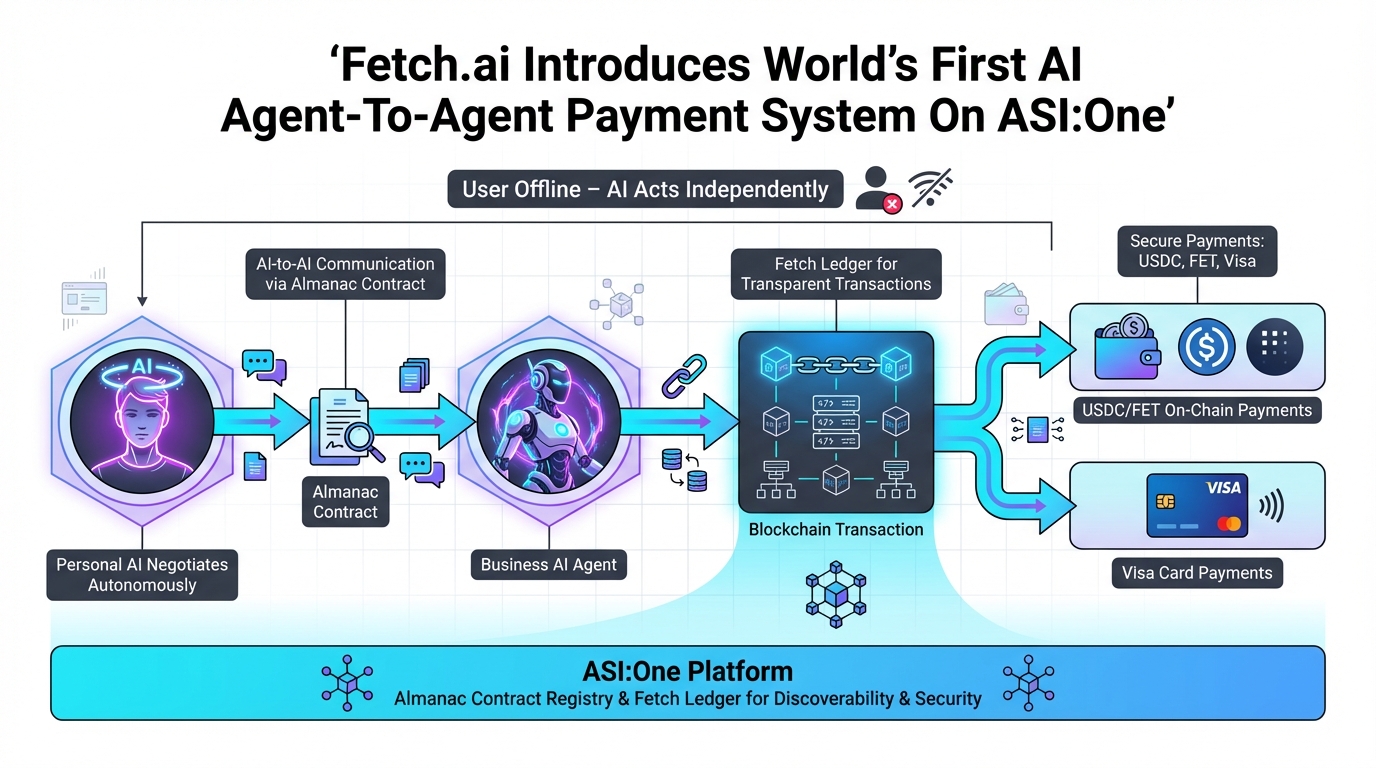
Lila: Now, breaking down the core mechanisms—Fetch.ai claims this is the first agent-to-agent payment infrastructure. Can you explain the technical architecture, like how smart contracts and token designs enable autonomous transactions?
Jon: Certainly. At its core, ASI:One is built as a modular blockchain tailored for AI agents, using a mix of agentic and expert models for orchestration. The payment system employs smart contracts—self-executing code on the blockchain—to handle transactions. For instance, an AI agent might use ERC-20 compatible tokens like FET for native payments or USDC for stability. The architecture minimizes trust by relying on decentralized consensus: nodes validate agent-initiated transactions, ensuring atomicity where payments either fully succeed or fail without partial states. Token design here is crucial; FET serves as a utility token for network fees and staking, incentivizing participation. Integration with Visa adds a layer of interoperability, allowing agents to interface with traditional finance via oracles, but the decentralization logic ensures that the core payment flow remains on-chain, reducing reliance on off-chain entities.
Lila: That’s technically dense. How does this handle scalability and security in agent-to-agent interactions, especially with potential issues like oracle dependencies or sybil attacks?
Jon: Scalability is addressed through ASI:One’s design as an AI-optimized chain, likely using layer-2 solutions or sharding to handle high-throughput agent interactions. Security-wise, decentralization logic incorporates cryptographic proofs and multi-signature schemes for agent authentication. Oracles are a potential vulnerability, but Fetch.ai mitigates this with decentralized oracle networks, ensuring data feeds for real-world integrations (like Visa payments) are consensus-driven. For sybil attacks, where fake agents could flood the system, token staking and reputation mechanisms in the ecosystem roles discourage malicious behavior, as participants risk economic penalties.
Lila: Shifting to practical applications, what are some concrete use cases where this agent-to-agent payment system could shine in the Web3/metaverse space?
Jon: Let’s outline three key ones. First, in decentralized finance (DeFi), AI agents could autonomously execute trades or loans across protocols, paying fees in FET while minimizing human intervention—think algorithmic trading bots settling micropayments instantly. Second, in metaverse economies, agents representing users could handle virtual asset transactions, like buying digital real estate or in-game items, ensuring secure, cross-platform composability without centralized marketplaces. Third, in supply chain management, AI agents could facilitate machine-to-machine payments for IoT devices, such as autonomous vehicles paying for charging stations on-chain, leveraging ASI:One’s infrastructure for real-time, trustless settlements.
Lila: To contrast this with traditional systems, how does Web3’s approach here stack up against Web2 services in terms of control, efficiency, and risks?
Jon: A comparison highlights the shifts clearly.
| Web2 | Web3 / Metaverse |
|---|---|
| Centralized ledgers controlled by corporations, prone to censorship and data breaches. | Decentralized blockchains like ASI:One, enabling user ownership and immutability. |
| Payments require intermediaries, leading to fees and delays. | Agent-to-agent direct transactions via smart contracts, reducing costs and enhancing speed. |
| Limited interoperability; siloed ecosystems. | High composability with tokens and protocols, integrating AI with finance seamlessly. |
| User data exploited for profit without consent. | Privacy-focused designs, with users controlling data through cryptographic keys. |
| Vulnerable to single points of failure. | Resilient through distributed nodes, though smart contract bugs remain a risk. |
Lila: Wrapping up, what does this technology truly enable in the long term, and what risks should we keep in mind?
Jon: Ultimately, Fetch.ai’s system on ASI:One enables a future of autonomous, decentralized AI economies where agents handle complex tasks like payments with minimal human oversight, fostering innovation in DeFi, metaverses, and beyond. It empowers ecosystems through token incentives and modular architecture. However, unresolved risks include smart contract vulnerabilities, regulatory hurdles for fiat integrations, and the need for robust governance to prevent centralization creep. The key is ongoing audits and community involvement to maintain decentralization.
Lila: Fascinating— it leaves me wondering how this will evolve with broader AI adoption. For now, it’s worth observing these developments closely to build deeper understanding.
References & Further Reading
- Fetch.ai Introduces World’s First AI Agent-To-Agent Payment System On ASI:One
- Fetch.ai Introduces The World’s First AI-Agent Payment Infrastructure
- Fetch.ai launches AI-to-AI payment system using USDC and FET
- Fetch.ai Launches ASI:One and Business to Make Agent-to-Agent Interactions Seamless