
Why is Ethereum prioritizing security over speed? Unpack the zkEVM 2026 roadmap and its impact on Web3 decentralization.
—#Ethereum #zkEVM #Web3Security
—
Quick Video Breakdown: This Blog Article
This video clearly explains this blog article.
Even if you don’t have time to read the text, you can quickly grasp the key points through this video. Please check it out!
If you find this video helpful, please follow the YouTube channel “MetaverseTrendsHub,” which delivers daily news.
https://www.youtube.com/@MetaverseTrendsHub
Read this article in your native language (10+ supported) 👉
[Read in your language]
Decoding Ethereum’s zkEVM Roadmap: Security Over Speed in the Push to 2026
🎯 Difficulty: Advanced
💎 Core Value: Decentralization Logic / Technical Architecture / Ecosystem Scalability
👍 Recommended For: Blockchain Developers, Web3 Researchers, Protocol Architects
Lila: Jon, I’ve been following the latest from the Ethereum Foundation on their zkEVM advances and the 2026 roadmap. As someone deeply embedded in Web3 trends, what macro shifts do you see this signaling in the broader decentralization landscape?
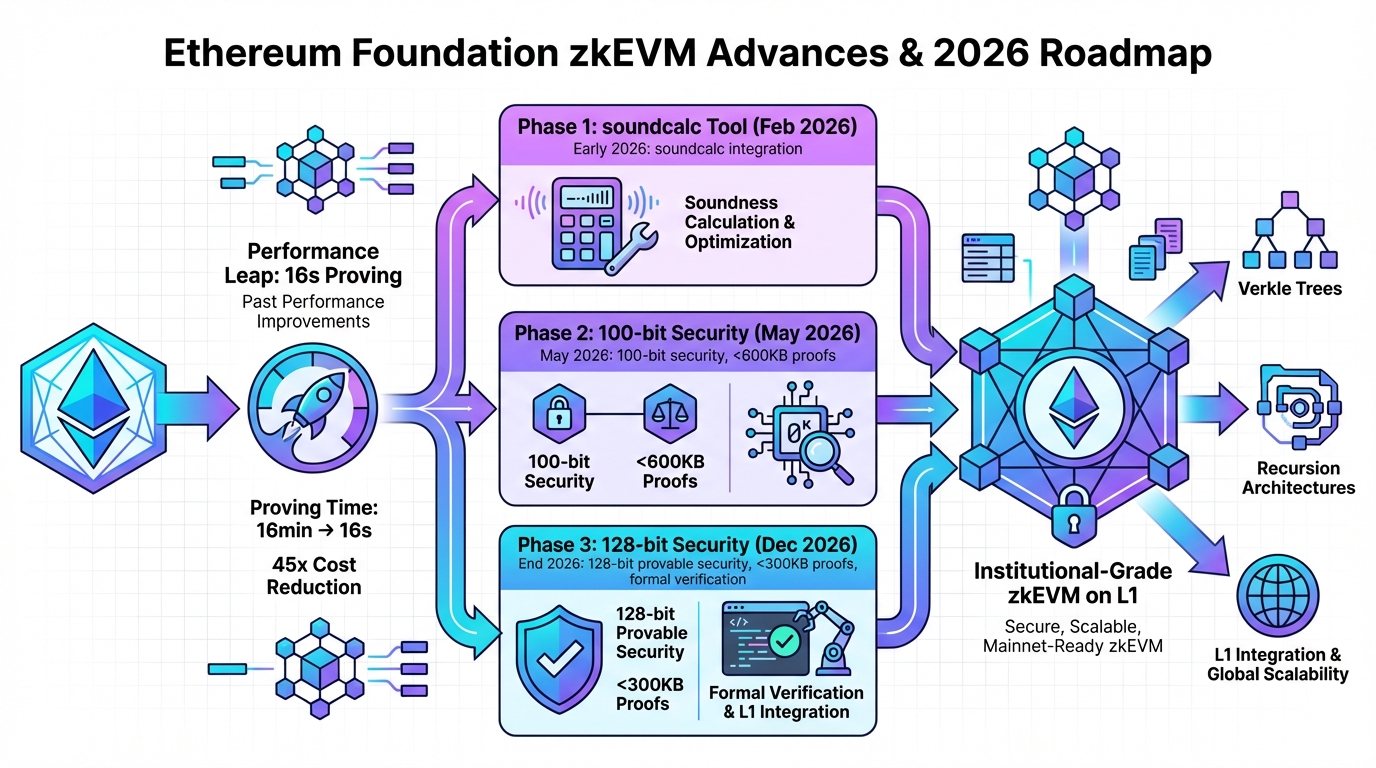
Jon: Absolutely, Lila. This announcement marks a pivotal macro trend in Ethereum’s evolution: a deliberate pivot from raw performance optimization to robust trust minimization and cryptographic security. In decentralized systems, trust minimization is foundational—it’s about designing protocols where users don’t need to rely on centralized intermediaries. Ethereum’s zkEVM roadmap emphasizes this by targeting 128-bit security standards by 2026, shifting away from speed-focused improvements to ensure long-term resilience against emerging threats like quantum computing risks. This aligns with broader ecosystem goals of making Ethereum a secure base layer for global finance and applications, reducing protocol risks through formal verification and stricter proof systems.
Lila: That makes sense on a high level, but let’s dig into the evolution from Web2 to Web3. How does this zkEVM focus highlight the differences in centralized versus decentralized systems, especially regarding ownership and resistance to censorship?
Jon: Great question. In Web2, systems are centralized, with data and control vested in platform owners—like how social media giants can alter or censor content at will. Web3, powered by blockchains like Ethereum, flips this: ownership is user-centric via cryptographic keys, ensuring censorship resistance through distributed consensus. zkEVMs enhance this by enabling zero-knowledge proofs, which allow transaction validation without revealing sensitive data, boosting privacy and composability. For instance, in Ethereum’s roadmap, this means phasing out weaker proof systems to enforce 128-bit security, making the network more resistant to attacks and fostering interoperable ecosystems where dApps can compose securely across layers.
Lila: I see the structural advantages, but can you break down the core mechanisms of zkEVMs in this context? How do they fit into Ethereum’s technical architecture?
Jon: Sure. zkEVMs are zero-knowledge Ethereum Virtual Machines, essentially rollup-compatible versions of the EVM that use zero-knowledge proofs for scalability. The architecture involves generating succinct proofs for Ethereum transactions, verifiable on the mainnet without re-executing computations. Ethereum’s 2026 roadmap outlines three stages: first, achieving baseline security; second, formal verification of proof systems; and third, reaching 128-bit security to counter advanced threats. This integrates with Ethereum’s decentralization logic—using standards like ERC-4337 for account abstraction and rollups for layer-2 scaling—minimizing trust in operators while enabling ecosystem roles like provers and verifiers to operate permissionlessly.
Lila: Fascinating. Now, considering use cases, how might this security-focused zkEVM roadmap apply in real-world scenarios within the Web3 ecosystem?
Jon: Let’s examine three concrete applications. First, in decentralized finance (DeFi), zkEVMs enable secure, scalable lending protocols by proving transaction validity without exposing user positions, reducing risks in high-value ecosystems like those on Arbitrum or Optimism. Second, for on-chain identity systems, the enhanced security supports verifiable credentials with privacy—think self-sovereign IDs where users control data sharing via zero-knowledge attestations. Third, in gaming and metaverses, zkEVMs facilitate interoperable asset ownership, allowing seamless transfers across virtual worlds with provable scarcity, all while maintaining Ethereum’s base-layer decentralization.
| Web2 | Web3 / Metaverse |
|---|---|
| Centralized servers control data, vulnerable to single-point failures and censorship. | Decentralized ledgers ensure data persistence and user sovereignty via consensus mechanisms. |
| Scalability through vertical upgrades, but with high costs and downtime risks. | Horizontal scaling via rollups and zk-proofs, as in Ethereum’s zkEVM, for efficient, secure throughput. |
| User data monetized by platforms without consent. | Privacy-preserving computations, like zero-knowledge, empower users with control over data exposure. |
| Interoperability limited by proprietary APIs. | Composability through open standards, enabling cross-chain and cross-dApp interactions. |
| Security reliant on corporate firewalls, prone to breaches. | Cryptographic security with formal proofs, targeting 128-bit standards for long-term resilience. |
Lila: The comparison really underscores the paradigm shift. With this roadmap prioritizing security, what does it enable for the future of Ethereum, and what risks remain unresolved?
Jon: In summary, this enables Ethereum to become a hardened foundation for institutional adoption, with zkEVMs providing provable security that supports complex applications in finance, identity, and beyond. It minimizes trust in the ecosystem by enforcing rigorous standards, potentially catalyzing broader Web3 interoperability. However, unresolved risks include the complexity of implementing these proofs without introducing new vulnerabilities, the need for ongoing audits, and external factors like regulatory pressures. The focus on 128-bit security by 2026 is a strategic move, but it requires community vigilance to balance innovation with robustness.
Lila: Thanks, Jon. It leaves me wondering: how can researchers and developers stay ahead in this evolving space without getting lost in the technical weeds?
Jon: A fair reflection. I encourage diving into primary sources, experimenting with testnets, and observing protocol evolutions critically. Focus on understanding the architecture first—it’s the key to meaningful contributions, not chasing trends.
References & Further Reading
- Ethereum Foundation Details zkEVM Advances And Roadmap For 2026
- Ethereum Official Roadmap
- zkSync Documentation on zkEVM
- Polygon zkEVM Overview