
Personally, the focus on utility stands out. Web3 startups are building safer digital tools.#Web3 #AI
Quick Video Breakdown: This Blog Article
This video clearly explains this blog article.
Even if you don’t have time to read the text, you can quickly grasp the key points through this video. Please check it out!
If you find this video helpful, please follow the YouTube channel “MetaverseTrendsHub,” which delivers daily news.
https://www.youtube.com/@MetaverseTrendsHub
Read this article in your native language (10+ supported) 👉
[Read in your language]
Pivot Teams Up With Mpost: Shining a Light on Web3 and AI Startups at the Second Open Demo Day
🎯 Difficulty: Beginner Friendly
💎 Core Value: Digital Ownership / Interoperability / Community Building
👍 Recommended For: Newcomers curious about Web3 events, aspiring startup founders in AI and blockchain, investors exploring decentralized tech opportunities
Lila: I’ve been hearing a lot about Web3 and AI lately, especially with events like this Pivot and Mpost partnership for their Second Open Demo Day. But as someone new to this, I’m wondering: what are the limitations of the regular internet—Web2—that make something like Web3 necessary? It all sounds a bit overwhelming.
Jon: That’s a great starting point, Lila. Let’s break it down simply. Imagine Web2 as a big apartment building where you rent a unit. The landlord (think big tech companies like Facebook or Google) owns everything, sets the rules, and can kick you out or change things anytime. You don’t truly own your space or your stuff inside it. Web3 is like buying your own house in a neighborhood where everyone agrees on shared rules through a community vote. It’s about giving you real ownership and control. This Pivot-Mpost event is spotlighting startups that build on that idea, combining Web3’s decentralized tech with AI to create smarter, user-owned systems.
Lila: Okay, that metaphor helps. So, how does this event fit into the bigger picture? Is it just hype, or is there real value here for beginners like me?
Jon: Not hype at all—it’s a practical step toward accessibility. The Second Open Demo Day, as covered in the article from Metaverse Post, lets early-stage Web3 and AI startups pitch their ideas to investors. It’s like a talent show for tech innovators, focusing on real-world applications. For beginners, it’s an entry point to see how Web3 isn’t just abstract; it’s about tools that solve everyday problems with better privacy and ownership.
Understanding the Web3 Ecosystem
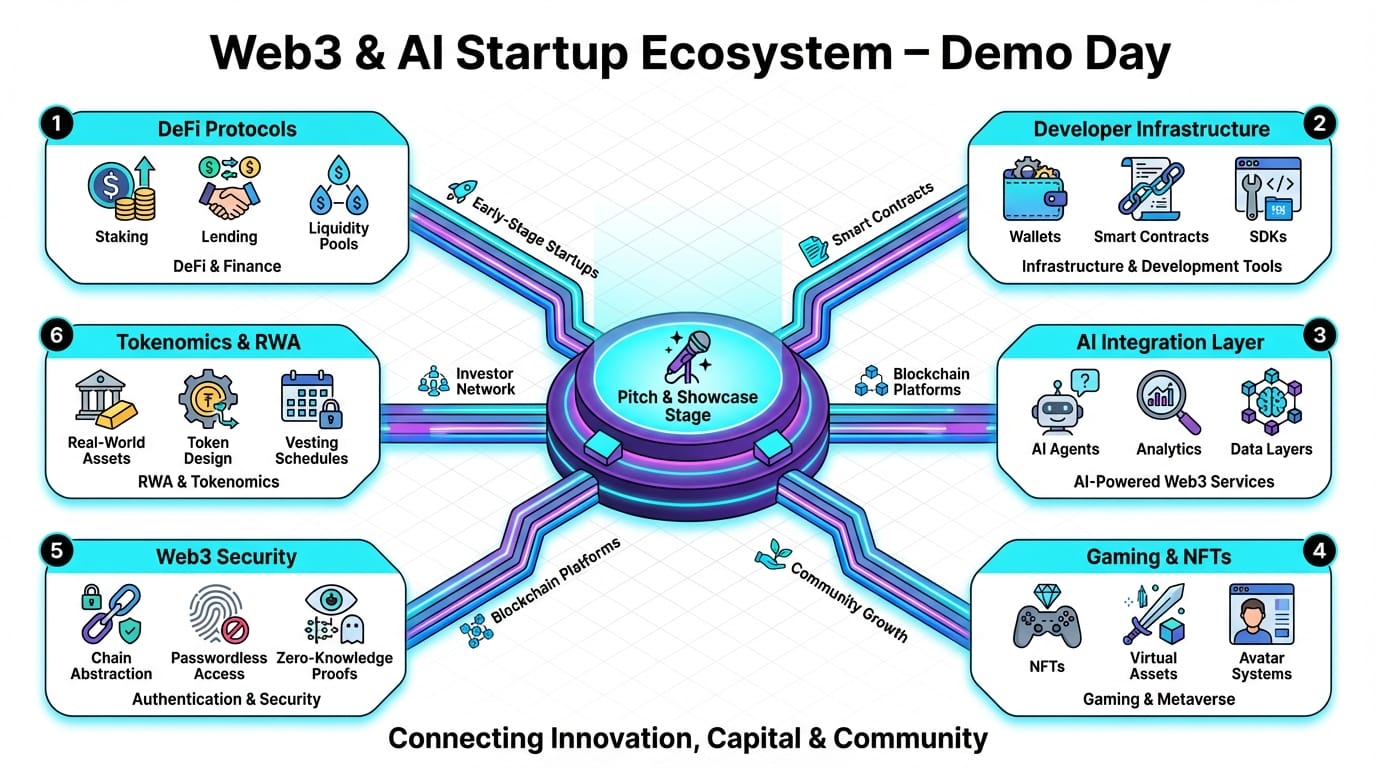
Lila: Looking at that diagram, it shows all these connected layers. Can you explain how Web3 evolves from Web2? I worry about things like data privacy—I’ve had my info leaked before on social media.
Jon: Absolutely, privacy is a key driver. In Web2, your data is centralized on company servers, making it a target for hacks or misuse. Web3 flips this with decentralized systems, where data is spread across a network of computers, like a shared notebook that no single person controls. This resists censorship— no one entity can erase your info—and promotes ownership. You control your digital assets, not a corporation. Composability means these systems can snap together like LEGO bricks, allowing startups at events like this Demo Day to build innovative combos of Web3 and AI.
Lila: That sounds empowering, but how do I even start? Wallets and stuff seem scary—what if I lose everything?
Jon: Safety first, always. Think of a digital wallet as your personal backpack for the internet. It holds your keys to Web3—private codes that prove ownership. Never share them, and use secure practices like hardware wallets for extrasafety. For NFTs, imagine them as digital deeds to unique items, like owning a one-of-a-kind painting online. The Pivot-Mpost event highlights startups using these basics to create safe, user-friendly experiences in AI-driven Web3.
Lila: Got it. So, what are some real-world examples? How does this apply to everyday life?
Jon: Let’s dive into three concrete use cases. First, in gaming: Web3 lets you truly own in-game items as NFTs. Unlike Web2 games where the company can shut down and erase your progress, here your sword or character is yours forever, tradable across games. Second, decentralized identity: Instead of logging in with Google, you use a self-sovereign ID that’s private and portable, reducing tracking. Third, community governance: DAOs (decentralized autonomous organizations) are like digital co-ops where members vote on decisions using tokens. Startups at the Demo Day are pitching AI tools that enhance these, like smart agents for automated voting or fraud detection.
Lila: Those examples make sense. But how does it compare directly to what I’m used to?
| Web2 | Web3 / Metaverse |
|---|---|
| Centralized servers controlled by companies, vulnerable to shutdowns or data breaches. | Decentralized networks run by users, resistant to single-point failures. |
| User data owned and monetized by platforms (e.g., targeted ads without consent). | User-owned data with privacy controls, enabling true digital sovereignty. |
| Limited interoperability—apps don’t easily connect or share data. | High composability, where protocols stack like building blocks for innovative apps. |
| Censorship possible by gatekeepers (e.g., account bans). | Censorship-resistant, with community-driven rules. |
| AI often biased or opaque, controlled by corporations. | AI integrated with Web3 for transparent, decentralized models (e.g., community-trained agents). |
Jon: As you can see from the table, Web3 addresses many Web2 pain points. Events like Pivot’s Demo Day showcase how AI amps this up—think AI helping manage decentralized finances or predict trends in metaverse communities— all while keeping users in control.
Lila: This is eye-opening, but are there risks? I don’t want to jump in blindly.
Jon: Risks are real, and we prioritize literacy over blind enthusiasm. Volatility in crypto markets, potential scams, and the learning curve for security are big ones. Always double-check sources, start small, and focus on understanding. This technology enables true ownership and innovation, but it’s not perfect—scalability issues and environmental concerns with some blockchains persist. The key is observation and education.
Lila: So, where do I go from here? Any final thoughts on this Demo Day event?
Jon: Summing up, Pivot teaming up with Mpost for this event empowers startups to bridge Web3 and AI, fostering a more inclusive digital future. It enables real ownership, smarter communities, and resistant systems. But remember, explore with curiosity, not haste. What aspect intrigues you most for further learning?
References & Further Reading
- Pivot Teams Up With Mpost To Spotlight Web3 And AI Startups At Second Open Demo Day
- Ethereum Glossary: Basic Web3 Terms
- Web3 University: Educational Resources on Decentralized Tech