Personally, the rise of AI forgers makes verifying Web3 identity harder than ever before.#Web3 #Cybersecurity
Quick Video Breakdown: This Blog Article
This video clearly explains this blog article.
Even if you don’t have time to read the text, you can quickly grasp the key points through this video. Please check it out!
If you find this video helpful, please follow the YouTube channel “MetaverseTrendsHub,” which delivers daily news.
https://www.youtube.com/@MetaverseTrendsHub
Read this article in your native language (10+ supported) 👉
[Read in your language]
Decoding AI-Driven Identity Scams in the Web3 Metaverse: Lessons from 2025
🎯 Difficulty: Advanced
💎 Core Value: Decentralized Identity / Trust Minimization / Interoperability
👍 Recommended For: Web3 developers, security researchers, Metaverse ecosystem builders
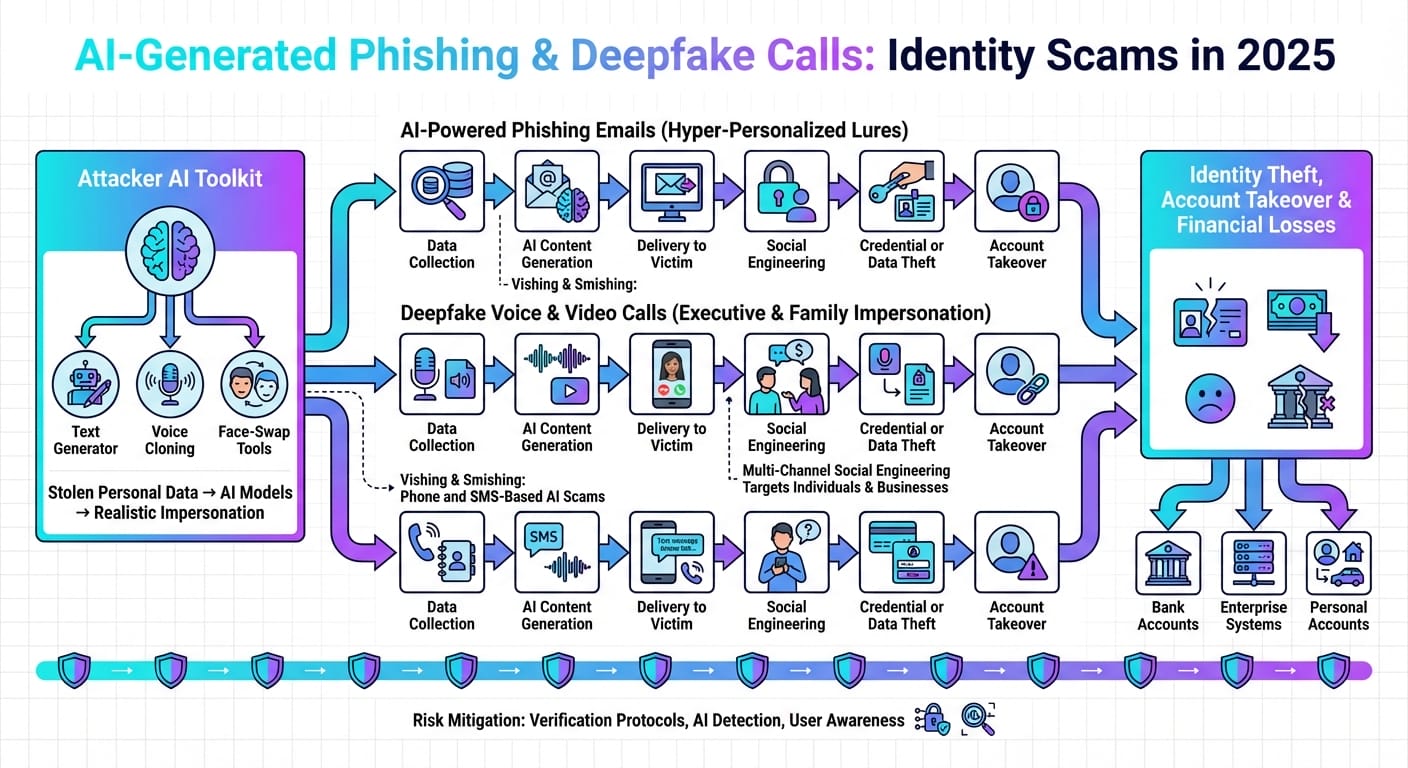
Lila: Jon, the 2025 surge in AI-generated phishing and deepfake calls has highlighted major identity scams, especially in Web3 and Metaverse spaces. From a macro perspective, how do these threats intersect with broader trends in decentralization and trust minimization?
Jon: Absolutely, Lila. In 2025, we saw AI tools democratize sophisticated attacks, but in Web3 and Metaverse ecosystems, these scams exploit the very principles of decentralization. Macro trends show a shift from centralized trust models—where entities like banks or social platforms verify identities—to decentralized ones relying on cryptographic proofs and blockchain consensus. Trust minimization, a core tenet here, means reducing reliance on intermediaries through mechanisms like zero-knowledge proofs (ZKPs) and self-sovereign identities (SSIs). However, this opens vectors for AI-driven impersonation, as deepfakes can mimic wallet signatures or on-chain behaviors without centralized gatekeepers to flag anomalies.
Lila: That makes sense, but how does this evolution from Web2 to Web3 change the landscape for these scams? In Web2, centralized systems at least have some oversight—what’s the trade-off?
Jon: The evolution is profound. In Web2, centralized systems control user data, enabling quick scam detection via proprietary algorithms but at the cost of privacy and censorship risks. Web3 emphasizes user ownership through blockchain-based assets, censorship resistance via distributed ledgers, and composability where protocols interoperate seamlessly via standards like ERC-721 for NFTs or ERC-20 for tokens. Yet, this decentralization amplifies scam risks: AI phishing can target decentralized identities without a central authority to intervene. For instance, deepfake calls could trick users into approving smart contract transactions, transferring ownership of digital assets irrevocably on-chain.
Lila: Let’s dive deeper into the core mechanisms. How do technical architectures in Web3 handle or exacerbate these identity threats?
Jon: At the architectural level, Web3 relies on blockchain layers for consensus—think Proof-of-Stake in Ethereum or rollups for scalability—and smart contracts for automated execution. Decentralized identity protocols like DID (Decentralized Identifiers) use verifiable credentials to prove attributes without revealing underlying data, leveraging ZKPs for privacy. However, AI deepfakes challenge this by forging audio-visual proofs that mimic human interactions in Metaverse environments, potentially bypassing multi-factor authentication if not integrated with on-chain verifiers. Ecosystem roles, such as oracles for real-world data feeds, become weak points if AI manipulates inputs, leading to flawed consensus.
Lila: Can you elaborate on specific use cases where these scams manifested in Web3 and Metaverse in 2025, and how technical designs played a role?
Jon: Certainly. First, in decentralized finance (DeFi), AI-generated phishing emails mimicked wallet interfaces, tricking users into connecting to malicious dApps that drain funds via approved smart contracts. The architecture here involves token standards like ERC-20, where decentralization allows permissionless interactions but lacks built-in revocation for scams. Second, in Metaverse gaming, deepfake calls impersonated community moderators to solicit private keys, exploiting interoperable NFTs across virtual worlds—composability enables asset portability but also scam propagation. Third, in decentralized autonomous organizations (DAOs), AI-driven social engineering targeted governance tokens, where voting power is tied to holdings; forged identities could sway proposals, undermining trust in snapshot-based voting mechanisms.
| Web2 | Web3 / Metaverse |
|---|---|
| Centralized identity verification (e.g., email/password with platform oversight) | Decentralized identities via DIDs and ZKPs, user-controlled but vulnerable to AI forgery |
| Scam detection by central algorithms, quick takedowns | Community-driven moderation, slower but censorship-resistant; relies on on-chain analytics |
| Data siloed, limited interoperability | Composability via standards (e.g., ERC-1155), enables cross-chain scams |
| Reversible transactions via intermediaries | Irreversible on-chain transfers, heightening scam impact |
| Platform liability for breaches | User responsibility, with DAOs for collective recovery |
Lila: The comparison highlights stark differences. Given these insights, what unresolved risks remain in Web3 architectures, and how might we approach them?
Jon: In summary, Web3 and Metaverse enable true digital ownership and interoperable ecosystems through decentralized architectures, but 2025’s AI scams revealed risks like unverified interactions and scalable deepfakes. Unresolved challenges include scaling ZKP adoption for identity proofs and integrating AI-resistant oracles. The key is evolving protocols toward hybrid models—combining decentralization with optional trust layers—while prioritizing education on wallet security and transaction verification.
Lila: Reflecting on this, how can readers stay informed without falling into hype, especially as these threats evolve?
Jon: Focus on observing protocol developments and contributing to open-source security audits. Engage with communities like Ethereum’s research forums to build literacy, always questioning architectural trade-offs rather than chasing trends.
References & Further Reading
- AI-Generated Phishing And Deepfake Calls Drove A Wave Of Identity Scams In 2025
- Deepfakes, AI Agents Will Expose Identities to More Threats in 2026
- VIPRE warns of AI-native malware & deepfake fraud in 2026
- Ethereum Glossary: Decentralized Identity
- W3C Decentralized Identifiers (DIDs) Specification