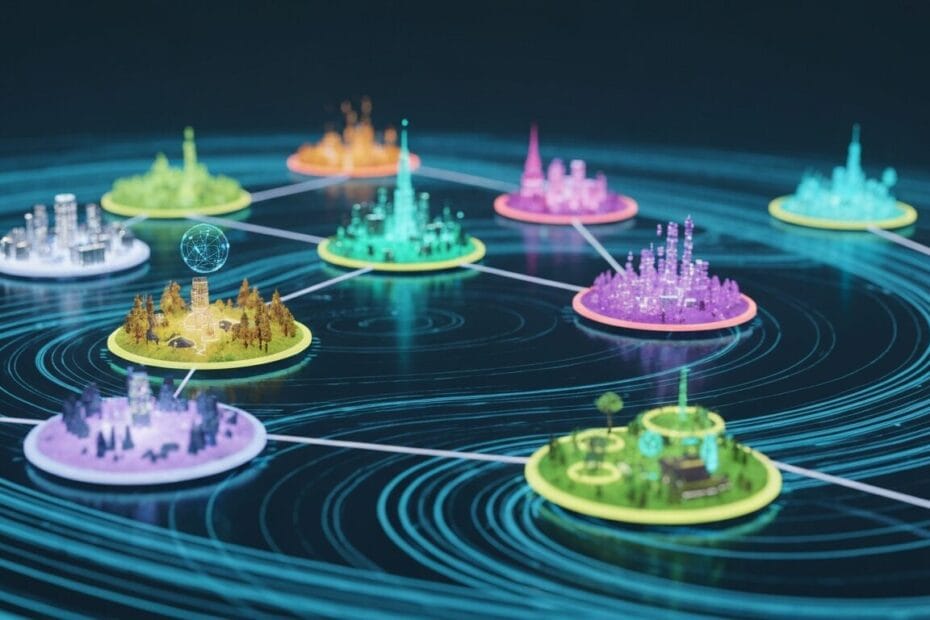
Personally, the rise in OpenSim shows people want real ownership of their digital spaces.#OpenSim #Metaverse
Quick Video Breakdown: This Blog Article
This video clearly explains this blog article.
Even if you don’t have time to read the text, you can quickly grasp the key points through this video. Please check it out!
If you find this video helpful, please follow the YouTube channel “MetaverseTrendsHub,” which delivers daily news.
https://www.youtube.com/@MetaverseTrendsHub
Read this article in your native language (10+ supported) 👉
[Read in your language]
Exploring OpenSim: A Gateway to Decentralized Virtual Worlds in the New Year
🎯 Difficulty: Beginner Friendly
💎 Core Value: Digital Ownership / Interoperability
👍 Recommended For: Newcomers to virtual worlds, educators interested in immersive learning, and hobbyists exploring decentralized communities
Lila: Jon, I’ve been reading about this uptick in OpenSim activity as we head into 2025. The blog title “OpenSim activity up with the new year” suggests virtual worlds are buzzing again. But as someone new to Web3 and metaverses, I’m confused—aren’t these just like old online games? What’s the real difference from the centralized platforms I know, like social media apps?
Jon: That’s a great starting point, Lila. OpenSim, short for OpenSimulator, is an open-source platform that lets users create and manage their own virtual worlds, much like a decentralized version of Second Life. The recent surge in activity, as reported in sources like Hypergrid Business, points to growing interest in user-controlled environments. To address your question on Web2 limitations: Think of traditional Web2 platforms as rented apartments. You can decorate, invite friends, but the landlord (the company) sets the rules, can evict you anytime, and owns everything. If the platform shuts down, poof—your digital life vanishes. Web3 and metaverses like those built on OpenSim aim to flip this by giving you true ownership, like owning your own house. It’s about building resilience against censorship and central control.
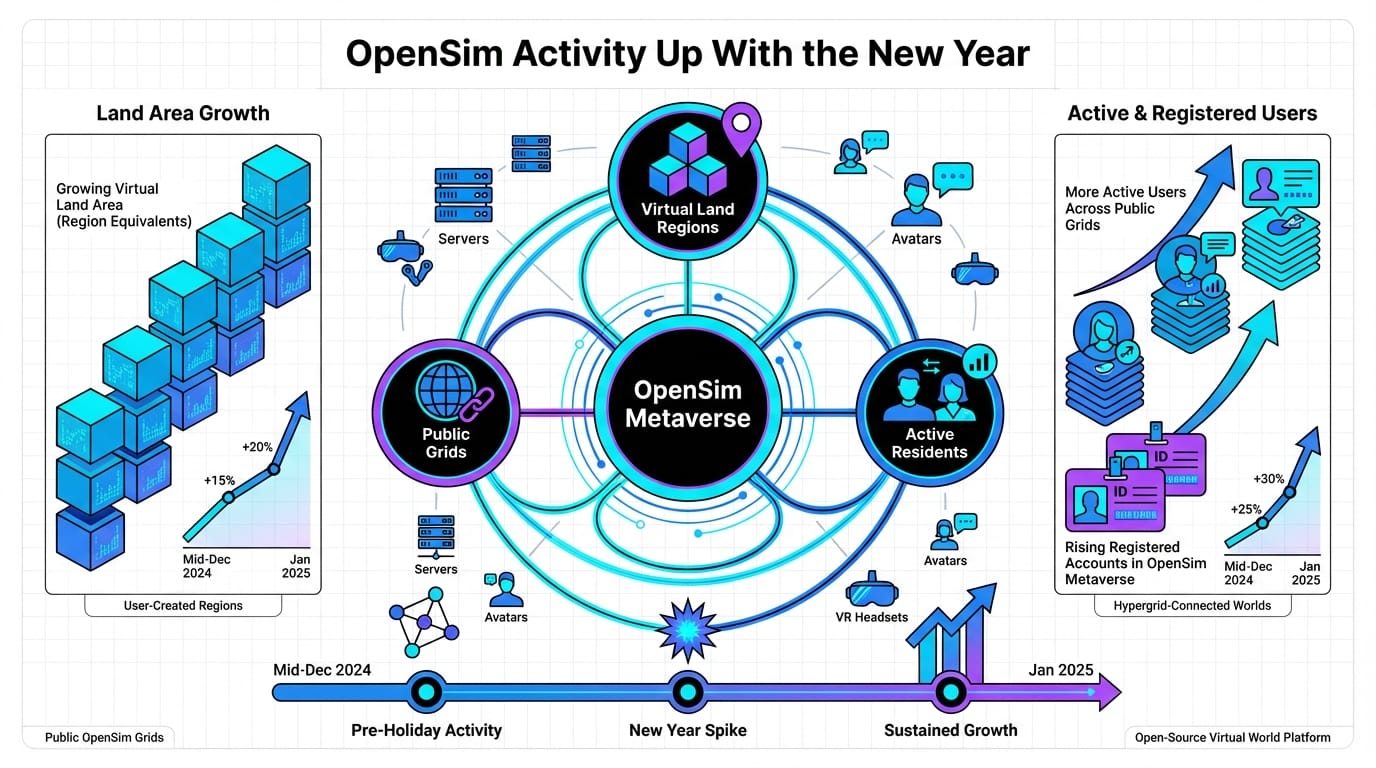
Lila: Okay, that metaphor helps. So, how does this evolution from Web2 to Web3 actually work in something like OpenSim? Is it really decentralized, or just another buzzword?
Jon: Excellent question—let’s break it down. In Web2, centralized systems rely on a single company’s servers; everything funnels through them, making it efficient but vulnerable to failures or manipulation. Web3, including metaverse platforms inspired by OpenSim, evolves this by emphasizing decentralization, where no single entity controls the whole show. Ownership means you control your digital assets—think of them as items in a backpack you carry across worlds, not locked in one app. Censorship resistance ensures no one can arbitrarily boot you out, and composability allows these worlds to interconnect seamlessly, like puzzle pieces fitting together. OpenSim’s open-source nature already embodies this, allowing anyone to host their own grid, and we’re seeing trends toward integrating blockchain for even stronger decentralization.
Lila: I get the big picture, but can you explain the core mechanisms simply? Like, how do I even start in a metaverse without getting overwhelmed or scammed?
Jon: Absolutely, safety first. Imagine your digital wallet as a secure backpack for your virtual belongings. In OpenSim or similar metaverses, you don’t always need blockchain right away—it’s more about creating avatars and exploring user-hosted regions. But for Web3 integration, a wallet holds your keys to assets like NFTs, which are like digital deeds proving ownership of virtual land or items. Start small: Download a viewer like Firestorm, connect to a public grid, and explore safely. Avoid sharing private info, and remember, true decentralization means you’re responsible—no central authority to bail you out if you lose your ‘keys.’ It’s empowering but requires caution, like learning to lock your real backpack.
Lila: That makes sense for beginners. Now, what are some real-world uses? I mean, beyond just playing around, how does this apply to everyday life?
Jon: Let’s dive into three concrete applications. First, in gaming: OpenSim allows for persistent virtual worlds where players own their creations, unlike Web2 games where progress can be wiped by updates. Users build economies, trade items, and even host events, fostering creativity without corporate gatekeepers. Second, for education and identity: Think virtual classrooms or conferences—educators use OpenSim for immersive learning, like simulating historical events. It supports self-sovereign identity, where you control your digital persona across platforms, not tied to one company’s database. Third, in community building: Decentralized finance (DeFi) elements can integrate, letting groups fund projects via shared treasuries, or create DAOs for governance. Recent stats show OpenSim active users rising, with over 44,000 reported in late 2024, signaling growth in these collaborative spaces.
Lila: Interesting—comparing this to traditional services might clarify things. How do Web2 and Web3 stack up side by side?
Jon: A comparison helps crystallize the differences. Here’s a table outlining key aspects:
| Web2 | Web3 / Metaverse |
|---|---|
| Centralized control by companies like Facebook or Google | Decentralized, user-governed networks like OpenSim grids |
| Data owned by platforms; users have limited rights | True digital ownership via assets like NFTs or virtual land |
| Prone to censorship and single points of failure | Censorship-resistant with distributed hosting |
| Isolated ecosystems; hard to move data between apps | Interoperable, allowing assets to flow between worlds |
| Monetization controlled by platform fees | User-driven economies with potential for direct peer-to-peer value |
Lila: This table really highlights the shifts. But with all this potential, what risks should newcomers watch out for in OpenSim or broader metaverses?
Jon: Risks are real and worth discussing. OpenSim’s decentralized nature means varying grid qualities—some might lack security, leading to data privacy issues. In Web3 metaverses, scams abound, like fake NFTs or phishing for wallet keys. There’s also the unresolved challenge of scalability; as activity surges, as seen in 2025 trends, networks can get congested. Energy consumption in blockchain-integrated versions is another concern. The key is education: Understand what you’re engaging with, start in safe public grids, and never invest more than you can afford to learn from. Overall, this technology enables user empowerment, global collaboration, and innovative virtual economies, but it’s not without growing pains.
Lila: Wrapping this up, Jon—what’s one thing readers should do next to explore this without jumping in blindly?
Jon: Observe and learn first. Read up on OpenSim basics, join a free grid to poke around, and follow neutral discussions. It’s about building literacy in decentralized systems, not rushing into anything. The rising activity in 2025 shows promise for more inclusive virtual worlds—stay curious, stay safe.
References & Further Reading
- OpenSim activity up with the new year
- OpenSim Statistics – September 2024
- OpenSim – Server Quick Start
▼ AI tools to streamline research and content production (free tiers may be available)
Free AI search & fact-checking
👉 Genspark
Recommended use: Quickly verify key claims and track down primary sources before publishing
Ultra-fast slides & pitch decks (free trial may be available)
👉 Gamma
Recommended use: Turn your article outline into a clean slide deck for sharing and repurposing
Auto-convert trending articles into short-form videos (free trial may be available)
👉 Revid.ai
Recommended use: Generate short-video scripts and visuals from your headline/section structure
Faceless explainer video generation (free creation may be available)
👉 Nolang
Recommended use: Create narrated explainer videos from bullet points or simple diagrams
Full task automation (start from a free plan)
👉 Make.com
Recommended use: Automate your workflow from publishing → social posting → logging → next-task creation
※Links may include affiliate tracking, and free tiers/features can change; please check each official site for the latest details.