Personally, this wipe shows why digital ownership matters more than platform promises.#metaverse #web3
Quick Video Breakdown: This Blog Article
This video clearly explains this blog article.
Even if you don’t have time to read the text, you can quickly grasp the key points through this video. Please check it out!
If you find this video helpful, please follow the YouTube channel “MetaverseTrendsHub,” which delivers daily news.
https://www.youtube.com/@MetaverseTrendsHub
Read this article in your native language (10+ supported) 👉
[Read in your language]
OSGrid’s Database Wipe: Lessons in Digital Ownership for the Metaverse Era
🎯 Difficulty: Beginner Friendly
💎 Core Value: Digital Ownership / Interoperability
👍 Recommended For: Newcomers to virtual worlds, metaverse enthusiasts curious about data safety, and anyone exploring decentralized alternatives to traditional online platforms
Lila: Jon, I’ve been reading about this OSGrid database wipe from last year. The title alone – “OSGrid wiping its database on March 21: You have five weeks to save your stuff” – sounds alarming. As someone new to metaverses and Web3, I’m wondering why something like this happens in virtual worlds. Doesn’t it expose the flaws in how we store digital stuff online? Can you explain this in simple terms?
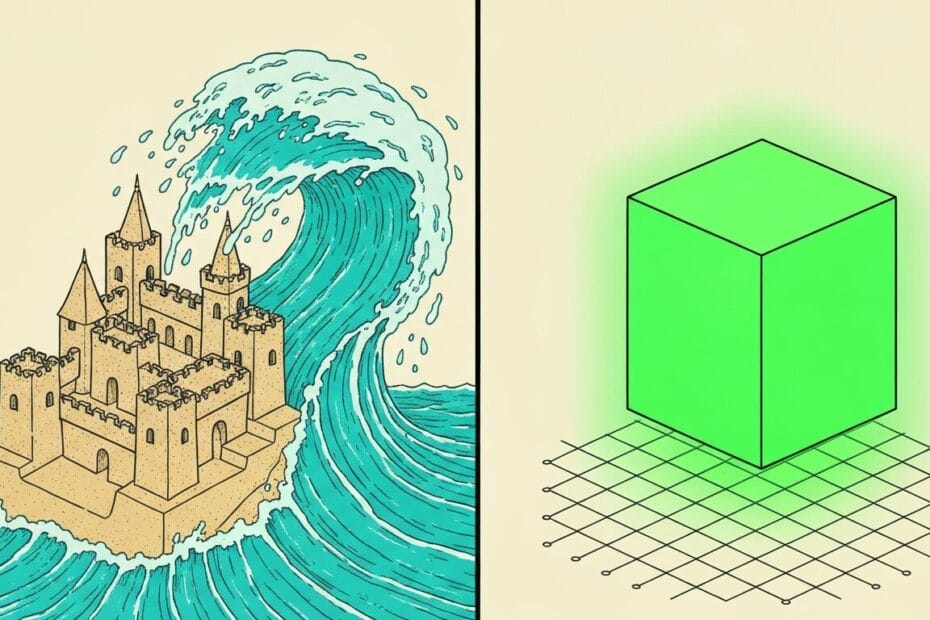
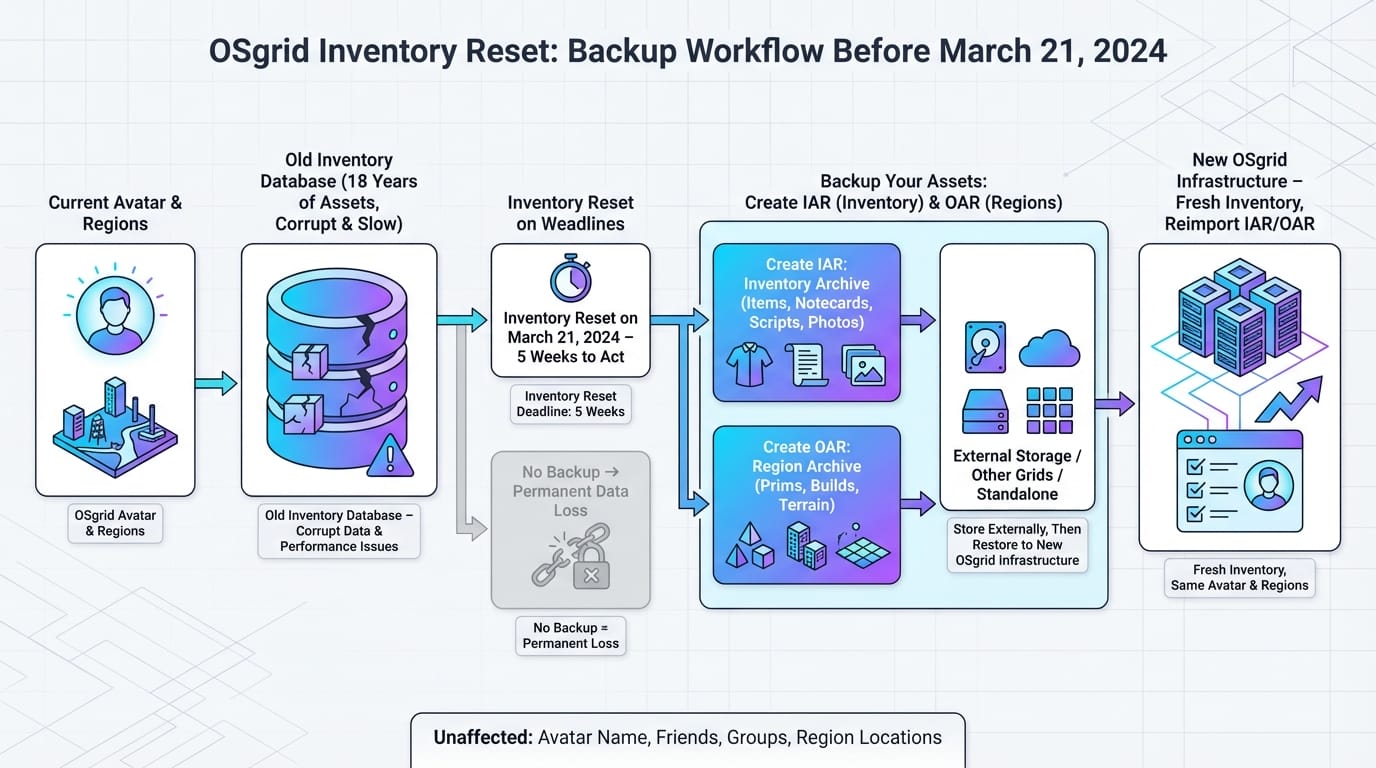
Jon: Absolutely, Lila. Let’s break it down like a story. Imagine you’re building a sandcastle on a beach owned by someone else. You’ve spent hours shaping towers and moats, but one day the owner decides to bulldoze the whole area for maintenance. That’s similar to what happened with OSGrid in 2025. OSGrid is an open-source virtual world platform based on OpenSim technology, where users create avatars, build regions, and store inventories of digital items. Due to severe database issues – problems that were too complex and time-consuming to fix – they announced a full reset of their asset and inventory databases on March 21, 2025. Users had about five weeks to export and save their creations, like regions and items, using tools like OAR files for regions or IAR files for inventories. This event highlights a key limitation in centralized systems, where one entity controls the data, much like that beach owner.
Lila: Okay, that metaphor helps. In everyday online life, like social media or games, we deal with centralized platforms all the time. But how does this tie into Web3 and metaverses? Are we just swapping one risky system for another?
Jon: Great question – this is where we evolve from Web2 to Web3. In Web2, platforms like Facebook or traditional MMOs own your data. You post photos or collect in-game items, but they’re stored on the company’s servers. If the company shuts down or wipes data, poof – it’s gone. Web3 flips this script with decentralization. Think of it as owning a plot of land in a communal park that no single person controls. Blockchain technology ensures your digital assets, like NFTs or virtual land, are stored on a distributed ledger that multiple computers verify. The OSGrid wipe underscores why metaverses are moving toward Web3: true ownership means your stuff isn’t at the mercy of one database admin. Censorship resistance is another perk – no central authority can arbitrarily delete your creations. And composability? That’s like Lego blocks; your assets can interoperate across different metaverses, unlike siloed Web2 worlds.
Lila: I get the ownership part now – it’s empowering. But for beginners like me, how does this actually work? What’s a wallet, and why is safety so important here?
Jon: Let’s use simple metaphors to explain the core mechanisms. A Web3 wallet is like a digital backpack you carry everywhere. It holds your keys to access blockchain networks, storing cryptocurrencies, NFTs, or virtual items securely. Unlike a bank account where the bank holds your money, here you control the keys – but lose them, and everything’s gone forever, so safety first: use hardware wallets and never share seeds. In the context of the OSGrid wipe, users had to manually export data because it was centralized. In a Web3 metaverse, your assets might be NFTs – like digital deeds proving ownership of a virtual house or avatar skin. These are minted on blockchains via smart contracts, which are self-executing code like vending machines: input conditions, output results, no middleman needed. This setup prevents wipes because data is replicated across nodes, not one fragile database.
Lila: That vending machine analogy makes smart contracts less intimidating. Can you give me some real-world examples of how this plays out in metaverses, especially after events like OSGrid’s?
Jon: Sure, let’s look at three concrete use cases. First, in gaming: Platforms like Decentraland let you own virtual land as NFTs. Unlike OSGrid, where a wipe could erase your builds, here your land persists on the blockchain. If the platform evolves, you can port it elsewhere – true interoperability. Second, digital identity: In Web3 metaverses, your avatar and profile are tied to a decentralized ID, like a soulbound token that’s yours forever. Post-OSGrid, users learned the hard way about backing up; Web3 encourages self-custody from the start. Third, community governance: DAOs (decentralized autonomous organizations) let users vote on platform changes. Imagine if OSGrid users could have collectively decided on the wipe – that’s the power of Web3, reducing single points of failure.
| Web2 | Web3 / Metaverse |
|---|---|
| Centralized servers control data; easy wipes like OSGrid’s 2025 reset. | Decentralized blockchains distribute data; user-owned assets resist arbitrary deletions. |
| Limited ownership – items belong to the platform (e.g., in traditional MMOs). | True digital ownership via NFTs and wallets; portable across ecosystems. |
| Siloed experiences; can’t move assets between games. | Interoperability; assets work in multiple metaverses, enhancing value. |
| Top-down decisions, like OSGrid’s maintenance mode. | Community governance via DAOs; users influence changes. |
| Vulnerable to outages or hacks on single points. | Resilient through consensus; harder to disrupt entirely. |
Lila: The table really clarifies the differences. Events like the OSGrid wipe make me appreciate Web3’s promises, but are there risks we should watch out for?
Jon: Spot on – Web3 enables real ownership and resilience, as seen in how OSGrid users scrambled to save data, while decentralized metaverses bake in portability. But unresolved risks include blockchain scalability issues, like high fees during congestion, or smart contract bugs that could lead to losses. Security is paramount; always verify sources and use multi-signature setups. The key is education: understand before diving in.
Lila: Thanks, Jon. This has me thinking – how can I start exploring these concepts safely without jumping into the deep end?
Jon: Start by reading reputable sources and experimenting with test networks. Observe how virtual worlds evolve post-events like OSGrid’s, focusing on learning the architecture rather than rushing in.
References & Further Reading
- OSgrid wiping its database on March 21: You have five weeks to save your stuff
- OSGrid Wiping Database On 21st March 2025 | Daniel Voyager
- Asset Reset – OSgrid News
- Ethereum Glossary for Web3 Basics
▼ AI tools to streamline research and content production (free tiers may be available)
Free AI search & fact-checking
👉 Genspark
Recommended use: Quickly verify key claims and track down primary sources before publishing
Ultra-fast slides & pitch decks (free trial may be available)
👉 Gamma
Recommended use: Turn your article outline into a clean slide deck for sharing and repurposing
Auto-convert trending articles into short-form videos (free trial may be available)
👉 Revid.ai
Recommended use: Generate short-video scripts and visuals from your headline/section structure
Faceless explainer video generation (free creation may be available)
👉 Nolang
Recommended use: Create narrated explainer videos from bullet points or simple diagrams
Full task automation (start from a free plan)
👉 Make.com
Recommended use: Automate your workflow from publishing → social posting → logging → next-task creation
※Links may include affiliate tracking, and free tiers/features can change; please check each official site for the latest details.