
In my view, Hedera is solving real scalability issues with this ticketing expansion.#Hedera #Web3
Quick Video Breakdown: This Blog Article
This video clearly explains this blog article.
Even if you don’t have time to read the text, you can quickly grasp the key points through this video. Please check it out!
If you find this video helpful, please follow the YouTube channel “MetaverseTrendsHub,” which delivers daily news.
https://www.youtube.com/@MetaverseTrendsHub
Read this article in your native language (10+ supported) 👉
[Read in your language]
Decoding Mingo’s Exclusive 54-Country Ticketing Deal on Hedera: A Deep Dive into Web3 Infrastructure
🎯 Difficulty: Advanced
💎 Core Value: Decentralization / Interoperability / Enterprise-Grade Scalability
👍 Recommended For: Blockchain developers, enterprise architects, Web3 investors seeking technical insights
Lila: Jon, I’ve been following macro trends in blockchain adoption, especially how networks like Hedera are attracting institutional interest. This recent news about Mingo securing an exclusive ticketing deal across 54 countries on Hedera caught my eye. Can you break down what this means in terms of decentralization and trust minimization? It seems like a pivotal move for real-world Web3 applications.
Jon: Absolutely, Lila. Let’s contextualize this. Hedera isn’t a traditional blockchain; it uses a directed acyclic graph (DAG) consensus mechanism called Hashgraph, which enables high throughput—up to 10,000 transactions per second—with low latency and fixed, predictable fees. This deal with Mingo, a Web3 wallet built on Hedera, exemplifies trust minimization by shifting ticketing from centralized databases to a decentralized ledger. In essence, it reduces reliance on single points of failure, like traditional ticketing platforms prone to scalping or fraud, by leveraging smart contracts for verifiable ownership and transfer of digital tickets as NFTs or tokens.
Lila: That makes sense on a high level, but how does this evolve from Web2 systems? Traditional ticketing giants like Ticketmaster control everything— from issuance to resale. What’s the architectural shift here?
Jon: Great question. In Web2, centralized systems own the data and enforce rules through proprietary servers, leading to issues like censorship, data silos, and high fees. Web3, via Hedera’s architecture, introduces decentralized governance through its council of enterprises (like Google, IBM) that validate the network without mining. This ensures censorship resistance—tickets can’t be arbitrarily revoked—and composability, where tickets could integrate with other dApps for experiences like virtual meetups. Ownership is user-centric; you hold the private keys, not a company database.
Visualizing the Architecture
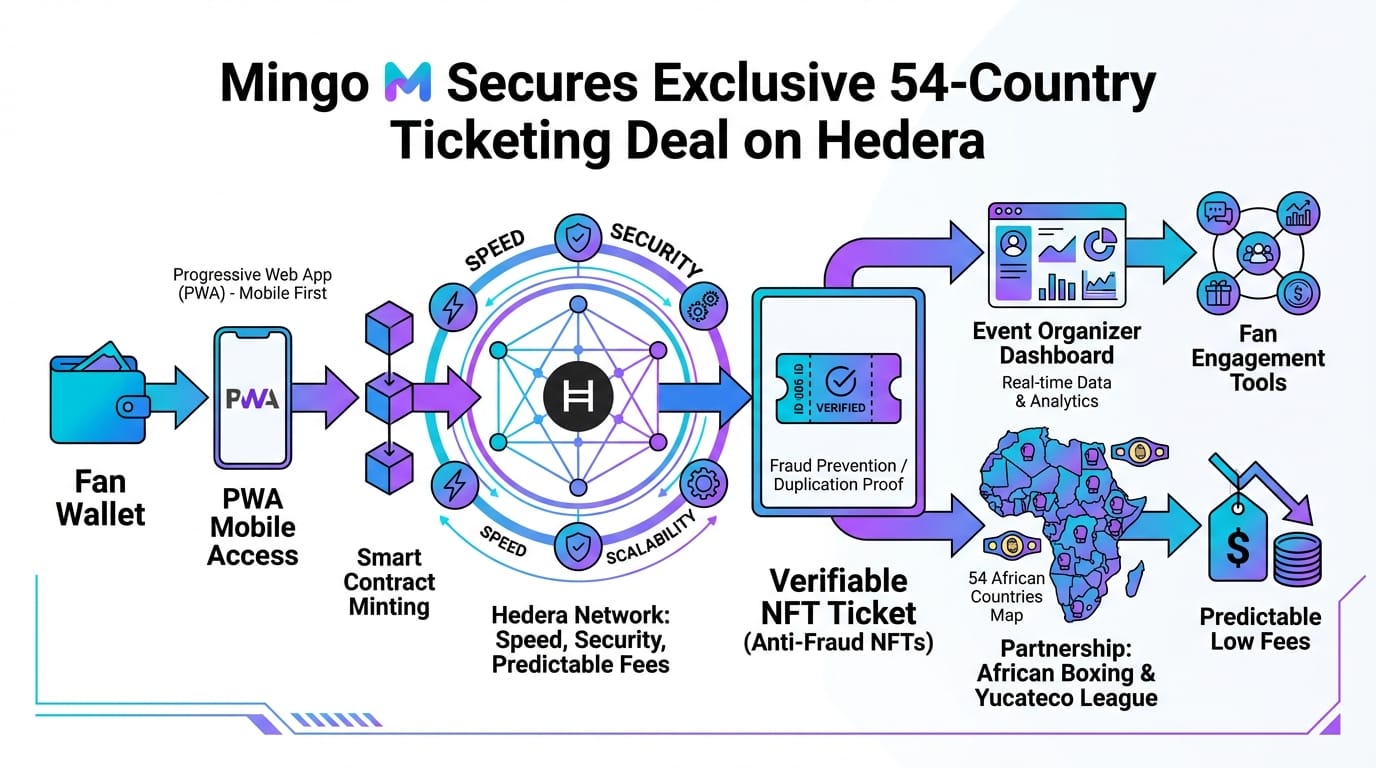
Lila: The diagram helps visualize the layers— from consensus to application. Diving deeper, what’s the core mechanism behind Mingo’s ticketing on Hedera? Is it just NFTs, or something more sophisticated?
Jon: It’s built on Hedera’s technical stack. Mingo likely uses the Hedera Token Service (HTS) for creating fungible or non-fungible tokens representing tickets. These are minted via smart contracts on Hedera’s EVM-compatible layer, ensuring interoperability with Ethereum tools while benefiting from Hashgraph’s asynchronous Byzantine Fault Tolerance (aBFT) for security. Decentralization logic here minimizes trust: consensus is achieved through gossip protocols, not energy-intensive proof-of-work, providing carbon-neutral operations certified by bodies like the Science Based Targets initiative. This setup allows for scalable ticketing without the bottlenecks of legacy blockchains.
Lila: Interesting— so it’s not just about tickets; it’s about ecosystem roles. How does this fit into broader Web3 trends, like interoperability across chains?
Jon: Precisely. Hedera’s architecture supports cross-chain bridges and standards like HIP-30 for token associations, enabling composability. In this deal, Mingo acts as a gateway wallet, integrating with Stripe for fiat on-ramps while handling on-chain transactions. This positions Hedera as a hub for real-world assets (RWAs), where ticketing tokens could be traded or used in DeFi protocols, all while maintaining regulatory compliance through features like account-based KYC on the ledger.
Lila: Let’s talk use cases. Beyond basic ticketing, what concrete applications could emerge from this?
Jon: First, in gaming and events: Tickets as NFTs allow secondary markets with royalty enforcement via smart contracts, ensuring creators get a cut without intermediaries. Second, in decentralized identity: Users could link tickets to self-sovereign identities on Hedera, verifying attendance for credentials or loyalty programs. Third, in community governance: Fan DAOs could vote on event details using Hedera’s consensus service, fostering participatory models where token holders influence outcomes, all secured by the network’s 99.99% uptime and low-cost micropayments.
Lila: To clarify the differences, could you compare traditional Web2 ticketing with this Web3 approach?
| Web2 | Web3 / Metaverse |
|---|---|
| Centralized databases controlled by companies like Ticketmaster, vulnerable to hacks and scalping. | Decentralized ledger on Hedera, with immutable records and smart contract-enforced anti-fraud rules. |
| High fees and limited resale options, with profits going to platforms. | Fixed low fees (e.g., $0.0001 per transaction on Hedera), programmable royalties for creators. |
| Data silos; user data owned by the platform. | User-owned data via wallets, with interoperability for cross-app experiences. |
| Single point of failure; outages disrupt services. | Distributed nodes ensure resilience, with aBFT consensus for fault tolerance. |
Lila: The table highlights the shifts clearly. Wrapping up, what does this enable long-term, and what risks remain unresolved?
Jon: This deal enables scalable, global Web3 adoption, particularly in emerging markets like the 54 African countries mentioned, by providing infrastructure for secure, sustainable ticketing. It showcases Hedera’s role in enterprise blockchain, driving interoperability and reducing trust dependencies. However, risks include regulatory uncertainties—varying laws on digital assets—and potential centralization in the governing council, though mitigated by its diverse makeup. Network congestion, while unlikely given Hedera’s design, could arise with mass adoption. Overall, it advances decentralized systems, but users should focus on understanding protocols rather than speculation.
Lila: Thanks, Jon. It leaves me wondering: as more deals like this emerge, how can readers stay informed without getting lost in the hype?
Jon: Observe protocol developments, engage with open-source communities, and prioritize education on consensus mechanisms. It’s about building literacy for a trust-minimized future, not chasing trends.
References & Further Reading
- Mingo Secures Exclusive 54-Country Ticketing Deal on Hedera
- Official Hedera Documentation
- Blockchain.com Learning Portal on Consensus Mechanisms
▼ AI tools to streamline research and content production (free tiers may be available)
Free AI search & fact-checking
👉 Genspark
Recommended use: Quickly verify key claims and track down primary sources before publishing
Ultra-fast slides & pitch decks (free trial may be available)
👉 Gamma
Recommended use: Turn your article outline into a clean slide deck for sharing and repurposing
Auto-convert trending articles into short-form videos (free trial may be available)
👉 Revid.ai
Recommended use: Generate short-video scripts and visuals from your headline/section structure
Faceless explainer video generation (free creation may be available)
👉 Nolang
Recommended use: Create narrated explainer videos from bullet points or simple diagrams
Full task automation (start from a free plan)
👉 Make.com
Recommended use: Automate your workflow from publishing → social posting → logging → next-task creation
※Links may include affiliate tracking, and free tiers/features can change; please check each official site for the latest details.