Personally, this move by Ondo Finance signals a major technical shift for on-chain assets.#Solana #RWA
Quick Video Breakdown: This Blog Article
This video clearly explains this blog article.
Even if you don’t have time to read the text, you can quickly grasp the key points through this video. Please check it out!
If you find this video helpful, please follow the YouTube channel “MetaverseTrendsHub,” which delivers daily news.
https://www.youtube.com/@MetaverseTrendsHub
Read this article in your native language (10+ supported) 👉
[Read in your language]
Ondo Finance Tokenizes US Stocks on Solana: Unpacking the Architecture of On-Chain TradFi
🎯 Difficulty: Advanced
💎 Core Value: Digital Ownership / Interoperability
👍 Recommended For: DeFi enthusiasts exploring RWAs, blockchain developers interested in Solana’s ecosystem, TradFi professionals bridging to decentralized finance
Lila: Jon, I’ve been following the news about Ondo Finance bringing over 200 tokenized US stocks and ETFs to Solana. As someone who’s dived deep into Web3 trends, what macro shifts in decentralization does this represent? Is this just another layer of hype, or is there real architectural substance here?
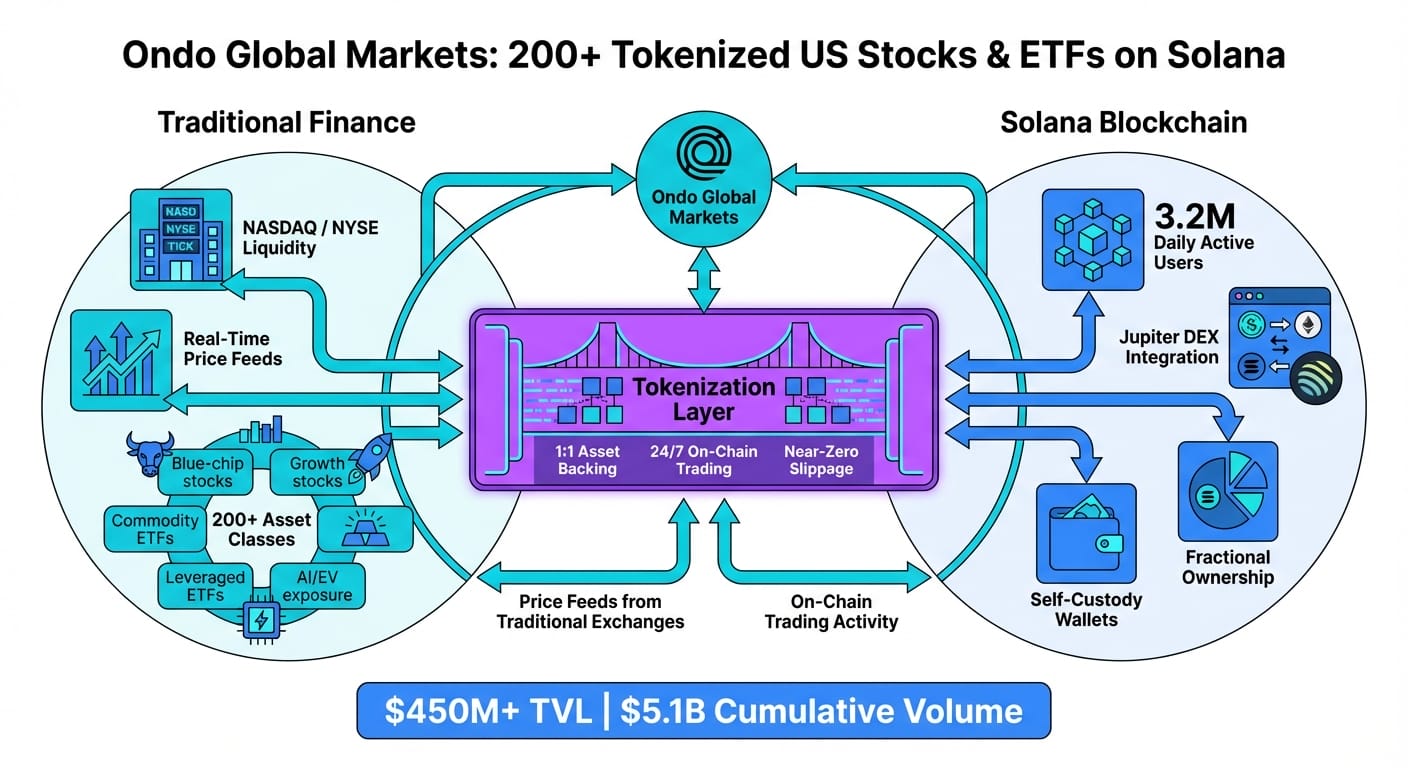
Jon: Lila, excellent question—this move by Ondo Finance exemplifies a broader macro trend in Web3: the tokenization of real-world assets (RWAs) to minimize trust in centralized intermediaries. At its core, decentralization logic here revolves around using blockchain to represent traditional financial instruments like stocks and ETFs as on-chain tokens. Solana’s high-throughput architecture, with its proof-of-history consensus and parallel transaction processing, enables this at scale. Unlike Ethereum’s congestion-prone model, Solana can handle the low-latency trading needed for assets mirroring US equities. This isn’t hype; it’s about trust minimization—investors hold cryptographic proofs of ownership without relying on brokers, reducing counterparty risk through smart contracts that enforce rules immutably.
Lila: That makes sense on a high level, but let’s contrast this with Web2 systems. How does tokenizing stocks on Solana evolve beyond centralized stock exchanges like NYSE, where everything is controlled by a single entity?
Jon: Precisely, Lila—the evolution from Web2 to Web3 here emphasizes true ownership, censorship resistance, and composability. In centralized Web2 systems, your stock holdings are entries in a broker’s database; you don’t own the asset outright but trust the intermediary. If the broker fails or censors access, you’re at risk. On Solana, tokenized stocks are represented as SPL (Solana Program Library) tokens, which are ERC-20-like but optimized for Solana’s runtime. This provides digital ownership—you control the private keys, making assets portable across DeFi protocols. Censorship resistance comes from the decentralized validator network; no single entity can halt trades. Composability means these tokens can integrate with other Solana dApps, like lending platforms or DEXes, creating programmable finance without permission.
Lila: Diving deeper into the core mechanisms, how does the token design work? For advanced readers, what’s the technical architecture enabling this on Solana specifically?
Jon: Let’s break it down structurally. Ondo’s tokenized assets likely use a custody-backed model, where real stocks are held by a regulated custodian, and on-chain tokens represent claims to those assets. On Solana, this involves deploying smart programs (Solana’s equivalent of smart contracts) using the Token Program, which supports minting, burning, and transferring SPL tokens. The architecture leverages Solana’s Tower BFT consensus for sub-second finality, crucial for trading with minimal slippage—recent tests showed $500,000 in tokenized shares trading with just 0.03% slippage. Decentralization logic minimizes trust by using oracles for price feeds and multi-signature schemes for custody, ensuring no single point of failure. Ecosystem roles include Ondo as the issuer, Solana validators for network security, and DEXes like Jupiter for liquidity provision.
Lila: Can you elaborate on practical use cases? Beyond trading, how might this architecture play out in real-world scenarios for finance, identity, or other areas?
Jon: Absolutely—let’s examine three concrete applications. First, in decentralized finance (DeFi), these tokenized stocks enable 24/7 global trading without geographic restrictions. Users can collateralize them in lending protocols like Marginfi on Solana, borrowing stablecoins against Apple stock tokens, enhancing liquidity without selling assets. Second, for cross-border access, it democratizes investment; someone in a developing economy can hold fractional US ETFs via a Solana wallet, bypassing traditional barriers like accreditation requirements—thanks to the interoperability of SPL tokens across wallets and dApps. Third, in composable ecosystems, these tokens integrate with yield-generating strategies, such as automated market makers (AMMs) or perpetual futures, allowing advanced hedging. This ties into broader Web3 roles, where tokens act as building blocks for permissionless innovation.
Lila: To make the differences clearer, how would you compare traditional Web2 services to these Web3 solutions in a structured way?
| Web2 | Web3 / Metaverse |
|---|---|
| Centralized stock exchanges (e.g., NYSE) control access, trading hours, and custody, with high fees and geographic limits. | Tokenized assets on Solana offer 24/7 peer-to-peer trading via DEXes, user-controlled custody, and global interoperability with low fees. |
| Ownership is indirect; assets can be frozen or seized by intermediaries. | Direct digital ownership via private keys ensures censorship resistance and portability across protocols. |
| Limited composability; assets siloed in broker apps without integration. | High composability; tokens usable in DeFi lending, yield farming, or NFTs, enabled by smart contract standards. |
| Trust reliant on institutions; single points of failure like hacks or failures (e.g., FTX collapse). | Trust minimized through decentralized consensus and audits; Solana’s validator network distributes risk. |
| Data and transaction privacy often compromised by central servers. | On-chain transparency with optional privacy via zk-proofs or shielded transactions in evolving protocols. |
Lila: This comparison highlights the advantages, but what about the risks? As we wrap up, how should readers approach this technology?
Jon: In summary, Ondo’s expansion to Solana enables seamless on-chain access to TradFi assets, fostering digital ownership, interoperability, and efficient ecosystems through Solana’s scalable architecture. However, unresolved risks include regulatory uncertainty—tokenized securities must comply with laws like SEC rules—and oracle vulnerabilities, where inaccurate price feeds could lead to exploits. Custody models still introduce some centralization. The key is understanding these trade-offs: Web3 empowers users but demands responsibility for key management and due diligence.
Lila: So, rather than jumping in blindly, what’s the best way for someone to learn more and observe these developments?
Jon: Observe protocol audits, track on-chain metrics like TVL on platforms like DefiLlama, and engage with technical docs on Solana’s developer portal. Focus on building literacy—experiment with testnets to grasp token mechanics without financial risk.
References & Further Reading
- Ondo Finance Brings Over 200 Tokenized US Stocks And ETFs To Solana
- Solana Documentation
- U.S. Securities and Exchange Commission (SEC) Resources
▼ AI tools to streamline research and content production (free tiers may be available)
Free AI search & fact-checking
👉 Genspark
Recommended use: Quickly verify key claims and track down primary sources before publishing
Ultra-fast slides & pitch decks (free trial may be available)
👉 Gamma
Recommended use: Turn your article outline into a clean slide deck for sharing and repurposing
Auto-convert trending articles into short-form videos (free trial may be available)
👉 Revid.ai
Recommended use: Generate short-video scripts and visuals from your headline/section structure
Faceless explainer video generation (free creation may be available)
👉 Nolang
Recommended use: Create narrated explainer videos from bullet points or simple diagrams
Full task automation (start from a free plan)
👉 Make.com
Recommended use: Automate your workflow from publishing → social posting → logging → next-task creation
※Links may include affiliate tracking, and free tiers/features can change; please check each official site for the latest details.