Read this article in your native language (10+ supported) 👉
[Read in your language]
One Month Into 2026: Ethereum’s Scaling Symphony, BNB’s Sub-Second Sprint, Avalanche’s Tokenization Triumph
🎯 Difficulty: Web3 Native – Requires familiarity with L1/L2 dynamics, EVM chains, and RWA primitives.
💎 Core Value: Scalability trade-offs, settlement finality, institutional tokenization infrastructure.
👍 Recommended For: Protocol engineers, DeFi architects, RWA analysts tracking L1 convergence.
Lila:
Isn’t this just hype? “Sub-second blocks” and “tokenized credit” sound like marketing buzz for the same old chains chasing Solana’s speed.
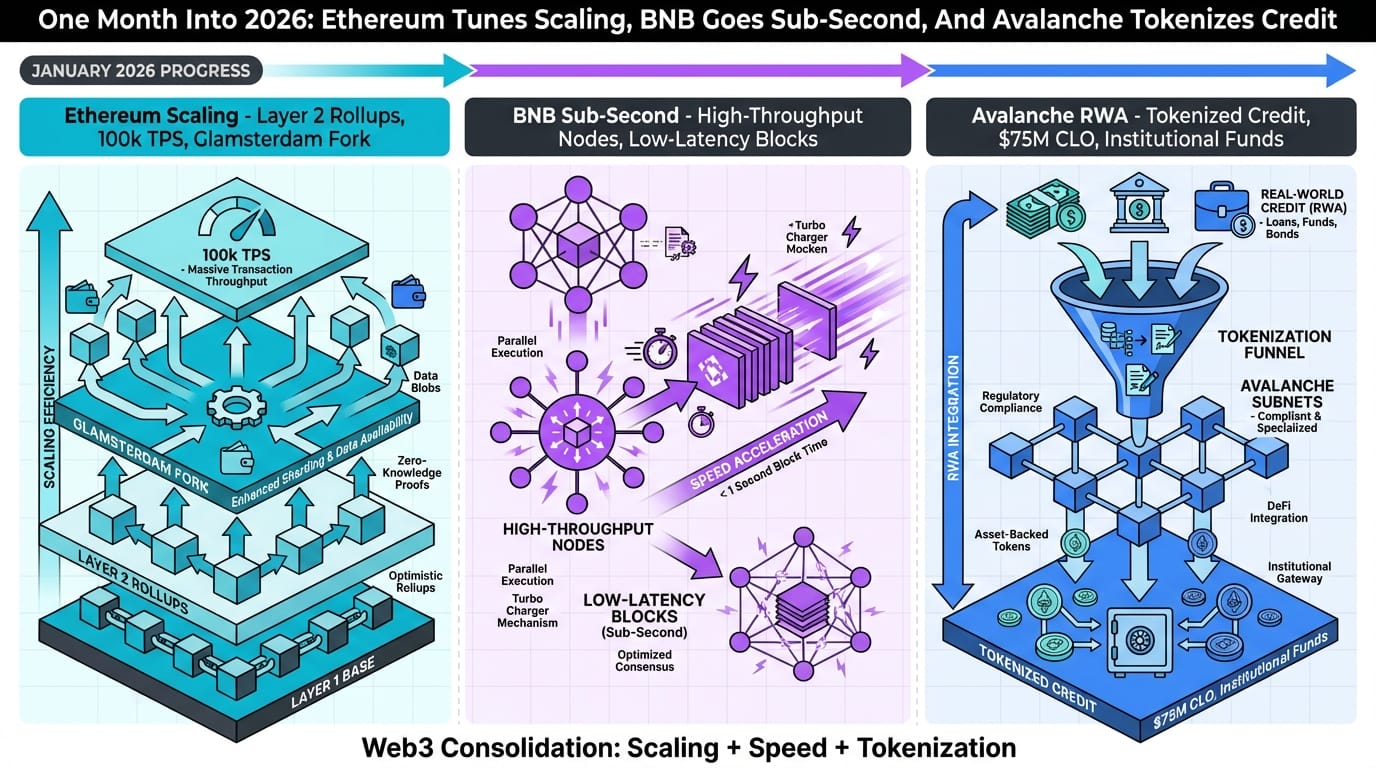
Jon:Fair skepticism, Lila – the space is littered with TPS promises that crumble under real load. But January 2026 delivers measurable protocol shifts: Ethereum’s Glamsterdam preps parallel execution and ZK validation for 10k TPS on L1[1][4][10], BNB Chain’s Fermi hard fork hits 0.45s blocks with 1.125s finality[2][8], and Avalanche tokenizes $75M+ in real credit via Galaxy’s CLO on low-fee C-Chain[3][6][9]. This isn’t vaporware; it’s converging on production-grade settlement layers. Key Insight: Finality & throughput now dictate L1 viability over raw TPS.
Lila:With Ethereum’s Pectra and Fusaka behind us in 2025[7], what’s the macro shift these 2026 forks signal for L1 competition?
Jon:We’re witnessing L1s prioritize trust-minimized settlement over monolithic execution. Ethereum’s roadmap – Glamsterdam (H1: gas limit to 200M, parallel tx processing, ZK proofs for validators[1][4]) then Heze-Bogota/Hegota (H2: censorship resistance, Verkle Trees for node sustainability[1][4]) – decouples execution to L2s while hardening L1 economics. BNB Fermi compresses blocks to 450ms via BEP-619, targeting 20k TPS with gigagas throughput[2][8][11]. Avalanche’s Avalanche9000/Octane slash fees 99.9%, fueling RWA TVL to $1.33B[3]. The architecture play: Ethereum bets on decentralized proof verification[10]; BNB on EVM speed; Avalanche on subnet composability for institutions.
Lila:How does Web2 finance break, and where do these upgrades fix the decentralization gaps?
Jon:Web2 centralizes custody, rules, and settlement in silos like JPMorgan’s ledgers – prone to black swan freezes (e.g., 2023 SVB). Web3 enforces composability via shared state: Ethereum’s enshrined PBS in Glamsterdam minimizes MEV extraction[4][10]; BNB’s sub-second finality enables HFT-grade DeFi without CEX intermediaries[2][8]; Avalanche’s tokenization turns illiquid credit into 24/7 tradable tranches with onchain transparency[3][6]. Breaks fixed: censorship via PoS finality, ownership via ERC-4626 vaults, but L2 fragmentation persists without EIL bridges[10].
**Scaling Reality Check:** Parallel execution boosts Ethereum TPS 500x[1], but validator hardware spikes to $100k rigs for ZK proving[10]. BNB’s 0.45s blocks risk state bloat without gas halving discipline[2][5]. Trade-off: Speed vs. node decentralization – low-spec validators get priced out first.
**RWA Interop Check:** Avalanche subnets enable isolated compliance zones, but cross-chain standards lag – glTF-like asset portability for tokenized RWAs remains manual via bridges. What fails: Secondary liquidity without atomic swaps.
Lila:Break down the core mechanisms – how do these forks actually work under the hood?
Jon:Ethereum Glamsterdam introduces parallel EVM execution (multi-threaded tx processing) + proposer-builder separation (ePBS), shifting validators to ZK proof verification over full re-execution[1][4][10]. Gas limit jumps 3x to 200M, targeting 10k TPS. BNB Fermi’s BEP-619 halves intervals to 450ms, with Reth client for 133M gas/s and extended voting (BEP-590) for congestion-proof finality[2][8]. Avalanche leverages Avalanche9000’s horizontal scaling + Octane fee cuts, executing ERC-20/721 tokens for CLO tranches with SOFR+570bps yields[3][6]. Consensus: All PoS, but Ethereum emphasizes data availability sampling (PeerDAS from Fusaka[7]).
Lila:What are real use cases? Give me three, with one deep dive.
Jon:1) DeFi HFT on BNB: Sub-second blocks enable 133 blocks/min bots[2]. 2) L2 rollup settlement on Ethereum: Glamsterdam’s ZK lowers L1 costs[1]. 3) RWA Tokenization Mini-Case (Avalanche Galaxy CLO): Goal: Tokenize $75M private credit for Arch Lending[6][9]. How: INX issues debt tranches as ERC-20s on C-Chain, backed by BTC/ETH collateral, listed on ATS with monthly SOFR+570 payouts, maturing Dec 2026[3][12]. Trade-offs: 99.9% fee cuts vs subnet isolation (no native L1 composability). Failure mode: Bridge exploits during secondary trading – mitigated by Grove’s $50M allocation for onchain execution[9].
Trade-off 1: Throughput vs. Decentralization
Ethereum’s ZK shift unlocks 10k TPS but demands specialized provers ($100k hardware[10]); BNB prioritizes speed (0.45s) at risk of centralization via fewer validators[2]. So the real question is: Can L1s sustain 1000+ node diversity at gigagas scale?
Trade-off 2: Finality vs. State Growth
BNB’s 1.125s finality excels for trading but halves gas limits to curb bloat[5][8]; Ethereum’s Verkle Trees defer this[4]. So the real question is: Will pruning keep archival nodes viable past 2027?
| Feature | Web2 (TradFi) | Web3 L1s (2026) |
|---|---|---|
| Identity/Login | Central DB (SSO silos) | EOA/AA wallets (Pectra[7]) |
| Asset Ownership | Custodial ledgers | Onchain ERC tokens (RWAs[3]) |
| Governance/Rules | Board/Regulators | Onchain forks (BEP-619[8]) |
| Payments/Fees | ACH/SWIFT (T+2) | Sub-second finality (Fermi[2]) |
| Moderation/Safety | Platform bans | PoS slashing + oracles |
| Portability/Interoperability | Vendor lock-in | Bridges/EIL (pending[10]) |
Mini Glossary
- Glamsterdam Fork: Ethereum’s H1 2026 upgrade for parallel tx execution and ZK validator proofs – like upgrading a single-lane highway to multi-lane with automated toll checks[1].
- Fermi Hard Fork: BNB Chain’s Jan 2026 block time slash to 0.45s – akin to shrinking traffic light cycles from 3s to under half a second[2].
- RWA Tokenization: Converting real-world assets like credit into onchain tokens – like digitizing property deeds for 24/7 trading[3].
Lila:So what does this enable long-term, and what risks linger?
Jon:Enables global settlement at TradFi speeds with crypto guarantees: 10k TPS Ethereum L1, instant DeFi on BNB, institutional RWAs on Avalanche. Risks: ZK centralization[10], state bloat[4], bridge vulnerabilities. Observe how node counts hold under load – that’s the decentralization litmus.
Lila:How do we builders verify these trade-offs ourselves?
Try This Next (No Finance, Just Literacy)
- Run a BNB validator post-Fermi: Measure 450ms block sync vs. Ethereum testnets to grok finality costs.
- Audit Avalanche C-Chain RWA contracts: Trace Galaxy CLO tranches for compliance vs. composability tensions.
- Simulate Glamsterdam ZK proofs: Use devnet to quantify hardware delta for low-spec decentralization.
References & Further Reading
- One Month Into 2026: Ethereum Tunes Scaling, BNB Goes Sub-Second, And Avalanche Tokenizes Credit
- Ethereum Roadmap: ethereum.org/roadmap[7]
- BNB Fermi Details: blockeden.xyz[2]
- Avalanche RWA: ainvest.com[3]
▼ AI tools to streamline research and content production (free tiers may be available)
Free AI search & fact-checking
👉 Genspark
Recommended use: Quickly verify key claims and track down primary sources before publishing
Ultra-fast slides & pitch decks (free trial may be available)
👉 Gamma
Recommended use: Turn your article outline into a clean slide deck for sharing and repurposing
Auto-convert trending articles into short-form videos (free trial may be available)
👉 Revid.ai
Recommended use: Generate short-video scripts and visuals from your headline/section structure
Faceless explainer video generation (free creation may be available)
👉 Nolang
Recommended use: Create narrated explainer videos from bullet points or simple diagrams
Full task automation (start from a free plan)
👉 Make.com
Recommended use: Automate your workflow from publishing → social posting → logging → next-task creation
※Links may include affiliate tracking, and free tiers/features can change; please check each official site for the latest details.