Read this article in your native language (10+ supported) 👉
[Read in your language]
Why the Next Evolution of Money Rides State and Blockchain Rails
Web3 Intel Snapshot
🎯 Difficulty: Web3 Native / Advanced – Assumes familiarity with blockchains, stablecoins, and DeFi primitives.
💎 Core Value: Trust minimization, 24/7 settlement, programmable money on shared ledgers.
👍 Recommended For: Builders auditing payment architectures; traders dissecting on-chain flows; policymakers mapping regulatory gaps.
Lila: Jon, everyone talks about blockchain as the future of money, but isn’t this just hype? Won’t governments always control the real rails?
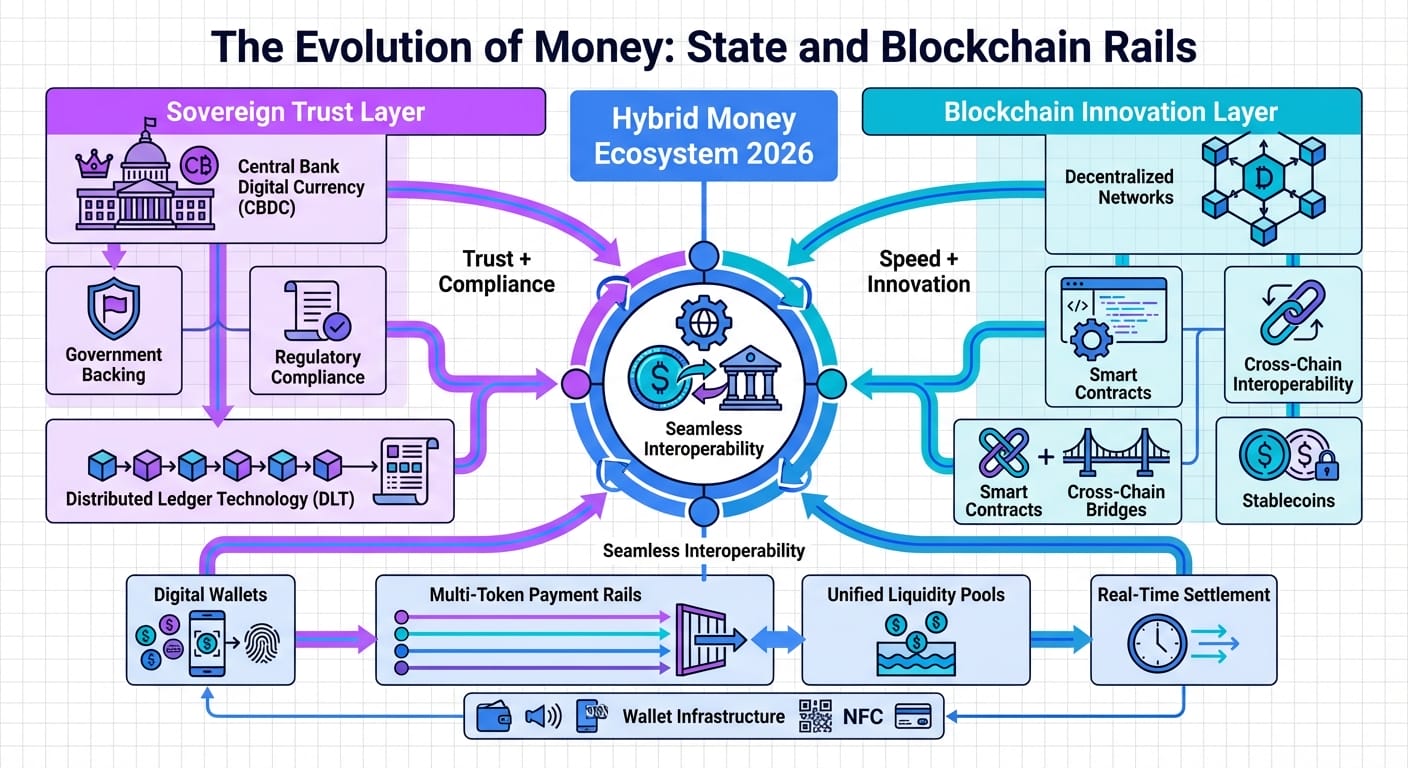
Jon: Classic myth – blockchain as some magical moonshot replacing banks overnight. Reality: it’s hybrid rails, state-backed systems like FedNow or RTP meshing with blockchain settlement layers via stablecoins. The article nails it: evolution means state and blockchain rails converging for 24/7 global liquidity, not revolution. [Important Insight: Stablecoins like USDC/USDT already process trillions on Ethereum/Tron L2s, settling faster than ACH at sub-cent fees]
Lila: That macro shift makes sense – macro trends like real-time payments exploding. But why state rails plus blockchain? What’s the architectural logic?
Jon: State rails (Fedwire, RTP, SEPA) handle fiat messaging and central bank settlement with ISO 20022 standards for instant domestic flows. Blockchain rails add trust-minimized global settlement: validators on Ethereum/Base/Arbitrum confirm stablecoin transfers in seconds via proof-of-stake consensus. Hybrid wins because state provides fiat on/off-ramps (issuance/redemption), blockchain enables composability – think smart contracts for escrow or streaming payments without intermediaries. Trade-off: state rails batch or delay (ACH 1-3 days), blockchain is 24/7 but volatile without pegged assets like USDT/USDC.
Lila: Web2 money feels locked in silos – banks, cards, wires. How does this Web3 evolution fix ownership and composability?
Jon: Web2: custodial, siloed – your PayPal balance is their liability, no portability. Web3: self-custodial via wallets (EOA or account abstraction per ERC-4337), assets on shared ledgers like ERC-20 stablecoins. Ownership is cryptographic (private keys control UTXOs or account balances), censorship-resistant (can’t freeze on-chain without forks), composable (DeFi protocols chain payments via hooks). Breaks when bridges fail or L1 congestion spikes – hence L2 rollups like Optimism for 100x throughput.
Security Note: State-Blockchain Hybrids
State rails inherit central bank trust but add KYC/AML friction. Blockchain minimizes trust via consensus but exposes MEV risks and oracle dependencies for peg stability. Watch for issuer centralization in stablecoins – USDC reserves audited, but Tether’s opacity lingers.
Lila: For payments in metaverses or high-throughput apps, what are the hard realities?
Jon: Reality check: latency/state sync kills realtime – L1 Ethereum ~12s blocks lag VR combat; L2s like Arbitrum cut to 250ms but sync requires indexers (The Graph). Interoperability standards nascent – glTF for assets, but cross-chain via bridges (Wormhole) risks $hundredsM exploits. Mitigation: state channels (Lightning Network) for off-chain instant micropayments, settling final state on-chain.
Lila: Walk me through core mechanics – how do these rails actually move value?
Jon: State rails: message passing (ISO 20022) → clearing → net settlement (T+1). Blockchain: wallet signs tx → mempool → validators sequence into block → consensus finality. State channels extend: parties lock funds in multisig smart contract, sign off-chain updates indefinitely, broadcast closure. Lightning: hub-spoke channels enable routing, near-zero fees for satoshis.
Lila: Real use cases? Beyond hype.
Jon: 1) Cross-border remittances: Stablecoins on Tron for $0.01 fees vs SWIFT 6%. 2) DeFi yield: Auto-compound via Aave on Ethereum L2s. 3) Mini Case Study: Micropayments in Content – Goal: Pay-per-view streams. Works: State channel opens, client signs micro-tx per second streamed, server contests fraud on-chain. Trade-offs: Instant/low-cost vs liveness requirement (watchtowers mitigate). Failure: User offline during dispute → funds stuck.
Design Trade-off 1: Speed vs Finality
Optimistic rollups (Base) assume tx valid for 7-day fraud window – fast/cheap but probabilistic. ZK-rollups (Polygon zkEVM) prove validity upfront – instant finality but compute-heavy. So the real question is… do you prioritize UX or ironclad guarantees?
Design Trade-off 2: Decentralization vs Throughput
Bitcoin/Lightning: Highly decentralized but ~7 TPS. Solana: 65k TPS via Gulf Stream but outages from sequencer centralization. So the real question is… can you scale without recentralizing trust?
| Feature | State/Traditional Rails | Blockchain Rails |
|---|---|---|
| Identity/Login | KYC via banks (custodial) | Self-sovereign (wallets, no ID required) |
| Asset Ownership | Account balances (revocable) | Private keys control tokens (irrevocable) |
| Governance/Rules | Central banks/regulators | On-chain (DAO votes, protocol upgrades) |
| Payments/Fees | $20+ wires, batch delays | <$0.01 stablecoin L2 tx |
| Moderation/Safety | Central freezes/blacklists | Immutable + social (watchtowers) |
| Portability/Interoperability | Siloed networks | Cross-chain bridges/standards |
Mini Glossary
- Payment Rails: Underlying networks for value transfer – like highways for money. Analogy: ACH is a slow freight train; blockchain is an instant global express lane.
- State Channels: Off-chain tx ledgers anchored by on-chain smart contracts. Analogy: Vending machine between two people – endless trades, settle once at end.
- Stablecoins: Pegged crypto (USDC to $1 USD) for programmable fiat. Analogy: Digital dollar in a blockchain backpack – stable value, borderless travel.
Jon: Bottom line: These rails enable programmable, global money with atomic settlement – but risks like regulatory flux, issuer centralization, and chain congestion persist. No silver bullet, just better primitives.
Lila: So we’re watching infrastructure evolve – what should readers observe next?
Try This Next (No Finance, Just Literacy)
- Trace a USDC tx on Etherscan – map wallet → sequencer → L2 bridge → settlement.
- Compare Lightning channel open/close costs vs on-chain – audit liveness assumptions.
- Read EIP-4337 for account abstraction – spot custody vs convenience trade-offs in wallets.
References & Further Reading
- Why The Next Evolution Of Money Will Be Built On State And Blockchain Rails
- Lightspark: State Channels Explained
- Arkham Research: Payment Rails Guide (Jan 2026)
- Ethereum.org: ERC-20 Stablecoins & L2 Scaling
▼ AI tools to streamline research and content production (free tiers may be available)
Free AI search & fact-checking
👉 Genspark
Recommended use: Quickly verify key claims and track down primary sources before publishing
Ultra-fast slides & pitch decks (free trial may be available)
👉 Gamma
Recommended use: Turn your article outline into a clean slide deck for sharing and repurposing
Auto-convert trending articles into short-form videos (free trial may be available)
👉 Revid.ai
Recommended use: Generate short-video scripts and visuals from your headline/section structure
Faceless explainer video generation (free creation may be available)
👉 Nolang
Recommended use: Create narrated explainer videos from bullet points or simple diagrams
Full task automation (start from a free plan)
👉 Make.com
Recommended use: Automate your workflow from publishing → social posting → logging → next-task creation
※Links may include affiliate tracking, and free tiers/features can change; please check each official site for the latest details.