Tired of inefficient DeFi liquidations? Aave V4’s new engine offers precision, stability, and variable bonuses for higher ROI.#AaveV4 #DeFi #CryptoLending
Quick Video Breakdown: This Blog Article
This video clearly explains this blog article.
Even if you don’t have time to read the text, you can quickly grasp the key points through this video. Please check it out!
If you find this video helpful, please follow the YouTube channel “MetaverseTrendsHub,” which delivers daily news.
https://www.youtube.com/@MetaverseTrendsHub
Read this article in your native language (10+ supported) 👉
[Read in your language]
Aave V4: Decoding the Advanced Liquidation Engine for DeFi Dominance
🎯 Difficulty: Degen Level
💎 Value Proposition: Enhanced DeFi Efficiency, Liquidation Rewards, Protocol Stability
👍 Recommended For: DeFi Lenders, Liquidity Providers, Token Investors
In the ever-evolving DeFi landscape, where liquidity crunches and market volatility can wipe out positions in seconds, Aave’s V4 upgrade emerges as a game-changer. Recent market trends show DeFi TVL (Total Value Locked—basically the capital committed to protocols) surging past $100 billion, yet inefficiencies in liquidation processes continue to plague lending platforms. Enter Aave V4’s advanced liquidation engine, featuring target health factors and a dynamic bonus system, designed to optimize debt repayment and boost protocol resilience. For investors eyeing ROI in lending, this isn’t just an update—it’s alpha. To dive deeper into the whitepaper, tools like Genspark can help analyze the technical specs without the fluff.
John: Alright, degens, let’s cut through the hype. Aave has processed over $3.3B in liquidations historically, and V4 isn’t messing around. This upgrade tackles the core pain point: inefficient liquidations that lead to cascading failures during market dips. Think of it as upgrading from a clunky Web2 banking system to a hyper-efficient, decentralized machine.
Lila: For those bridging from basics, liquidation in DeFi is like a repo man for crypto loans—when your collateral dips below a safe threshold (health factor), your assets get sold to cover the debt. V4 makes this smarter, not harsher.
The Evolution: From Centralized Bottlenecks to Decentralized Fluidity
In the Web2 world, lending is a centralized affair—banks control your funds, dictate terms, and liquidate at their whim, often with hidden fees and opacity. Remember the 2008 financial crisis? Centralized models amplified systemic risks through poor risk management. Web3 flips this script with decentralization: users own their assets via smart contracts on blockchains like Ethereum, ensuring transparency and composability.
John: Exactly. Aave V4 builds on this by refining liquidation mechanics, drawing from protocols like Compound but pushing boundaries with variable bonuses. For whitepaper enthusiasts, use Gamma to visualize these evolutions in a pitch deck—it’s a pro tool for mapping out tokenomics shifts.
Lila: The contrast is stark: Web2 relies on human oversight, prone to errors; Web3 automates via code, reducing bias and enabling global, 24/7 access.
Core Mechanism: Technical Breakdown of V4’s Liquidation Engine
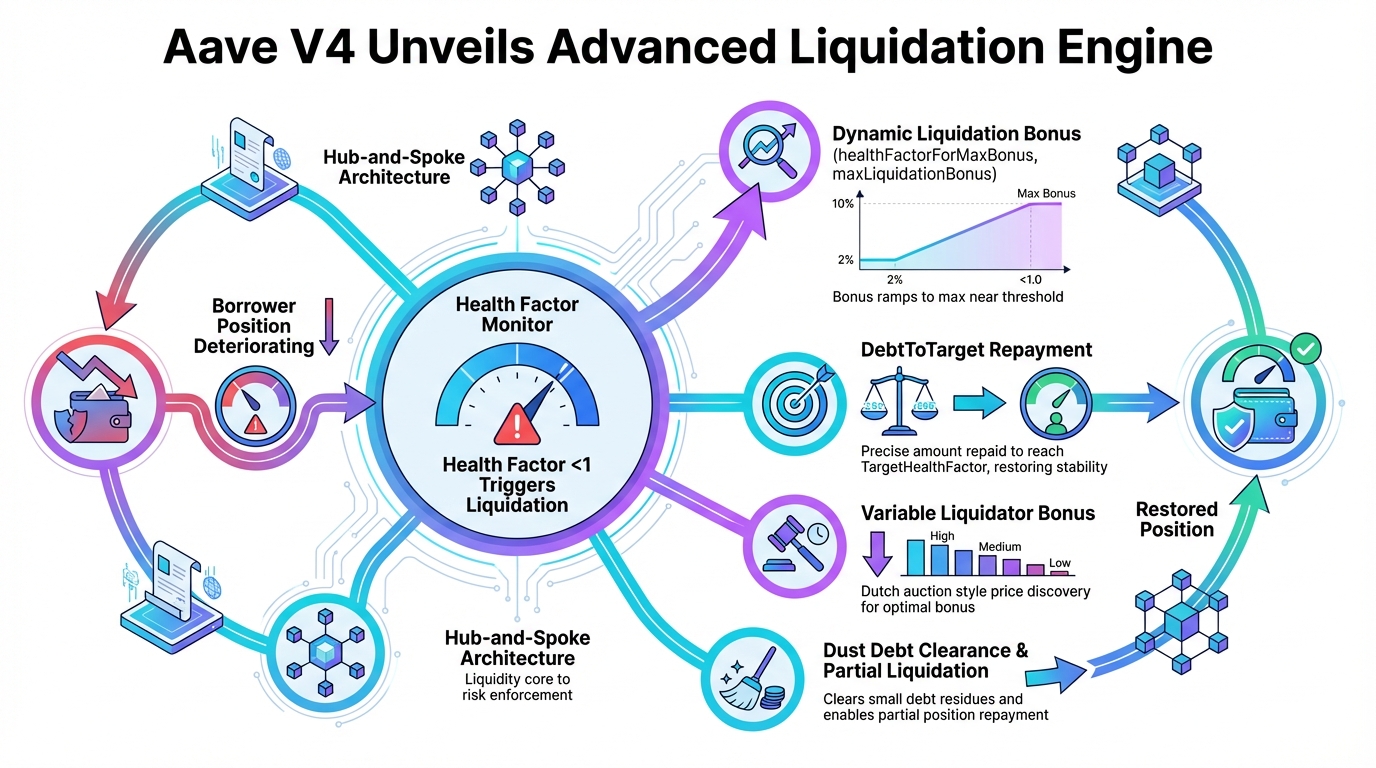
John: At its core, Aave V4’s liquidation engine introduces precision debt repayment. The “target health factor” allows liquidators to specify a post-liquidation health factor (e.g., 1.05), ensuring just enough collateral is sold to stabilize the position without over-liquidating. This is powered by smart contracts likely leveraging OpenZeppelin libraries for secure ERC-20 handling and EIP-2612 for permit-based approvals, minimizing gas fees.
The bonus system is the real alpha: variable rewards based on the liquidation size and market conditions, incentivizing quick interventions. Imagine a sliding scale where bonuses scale with risk—higher volatility means up to 10% bonuses on liquidated assets, per recent reports. It also clears “dust debt” (tiny leftover balances) automatically, boosting efficiency. Deployed on Ethereum L1 with potential L2 integrations like Arbitrum One, this reduces TPS bottlenecks during peaks.
Lila: Technically, it’s about composability: the engine integrates with Aave’s existing oracles (e.g., Chainlink for price feeds) to calculate health factors dynamically. If you’re coding this, Solidity devs can reference ERC-4626 for tokenized vaults to simulate these mechanics.
Use Cases: Real-World Applications in DeFi and Beyond
John: First, for yield farmers: Integrate V4 into a strategy where you supply assets like USDC, borrow against them, and let the bonus system reward you during liquidations. With Aave’s TVL at $20B+, this could yield 5-15% APY, amplified by bonuses.
Lila: Second, in GameFi: Picture a metaverse game where players collateralize NFTs for in-game loans. V4’s engine ensures fair liquidations, preventing total wipeouts. Promote your NFT project with videos via Revid.ai—it’s perfect for teasers.
John: Third, institutional adoption: Firms like Animoca Brands could use it for Bitcoin treasury management, liquidating positions efficiently without disrupting markets. Devs building on this? Learn Solidity with Nolang for hands-on smart contract coding.
| Aspect | Traditional Web2 App (e.g., Bank Loan System) | Web3 dApp Solution (Aave V4) |
|---|---|---|
| Liquidation Process | Manual, opaque, high fees | Automated, precise with target health factors |
| Incentives | None for participants; bank profits | Variable bonuses for liquidators |
| Efficiency | Slow, centralized | Dust debt clearing, low gas via optimizations |
| Risk Management | Systemic failures possible | Enhanced stability, decentralized oracles |
Conclusion: Gear Up for V4 and Seize the Alpha
John: Aave V4 isn’t just an upgrade—it’s a blueprint for resilient DeFi. With smarter liquidations and bonuses driving participation, expect tighter spreads and higher ROI for savvy investors. Jump in: Supply assets on Aave, monitor health factors, and automate alerts with Make.com to stay ahead of volatility.
Lila: Whether you’re lending or liquidating, this evolution empowers users. DYOR, start small, and build your DeFi stack.

👨💻 Author: SnowJon (Web3 & AI Practitioner / Investor)
A researcher who leverages knowledge gained from the University of Tokyo Blockchain Innovation Program to share practical insights on Web3 and AI technologies. While working as a salaried professional, he operates 8 blog media outlets, 9 YouTube channels, and over 10 social media accounts, while actively investing in cryptocurrency and AI projects.
His motto is to translate complex technologies into forms that anyone can use, fusing academic knowledge with practical experience.
*This article utilizes AI for drafting and structuring, but all technical verification and final editing are performed by the human author.
🛑 Disclaimer (NFA)
Not Financial Advice. Content is for educational purposes only. Cryptocurrency and NFT investments carry high risks. DYOR (Do Your Own Research).
This article contains affiliate links.
▼ Recommended Web3 x AI Tools
References & Further Reading
- Aave V4 Unveils Advanced Liquidation Engine With Target Health Factor And Bonus System | Metaverse Post
- Revolutionary Aave V4 Upgrade: Smarter Liquidations and Enhanced Safety for DeFi Lending | CryptoRank.io
- Aave Gains 8% on V4 Liquidation Engine News | CoinMarketCap
- Aave Coin Rises Past $200 on Whale Buying and New Yield Access | BanklessTimes