Read this article in your native language (10+ supported) 👉
[Read in your language]
🧬 Web3 Intel Snapshot: This isn’t Web3 or metaverse—it’s AI x Science convergence. Agentic AI tools amplify human researchers in biology, but raise questions on trust, verifiability, and decentralization parallels.
🎯 Difficulty: Advanced (PhD-level biology + AI architecture)
💎 Core Value: Interpretability / Multi-agent coordination / Researcher autonomy
👍 Recommended For: AI builders, bio researchers, Web3 architects eyeing decentralized science (DeSci)
Lila: “Jon, everyone says AI is about to ‘solve biology overnight’ like AlphaFold did proteins— is this Anthropic partnership just more hype for instant Nobel Prizes?”
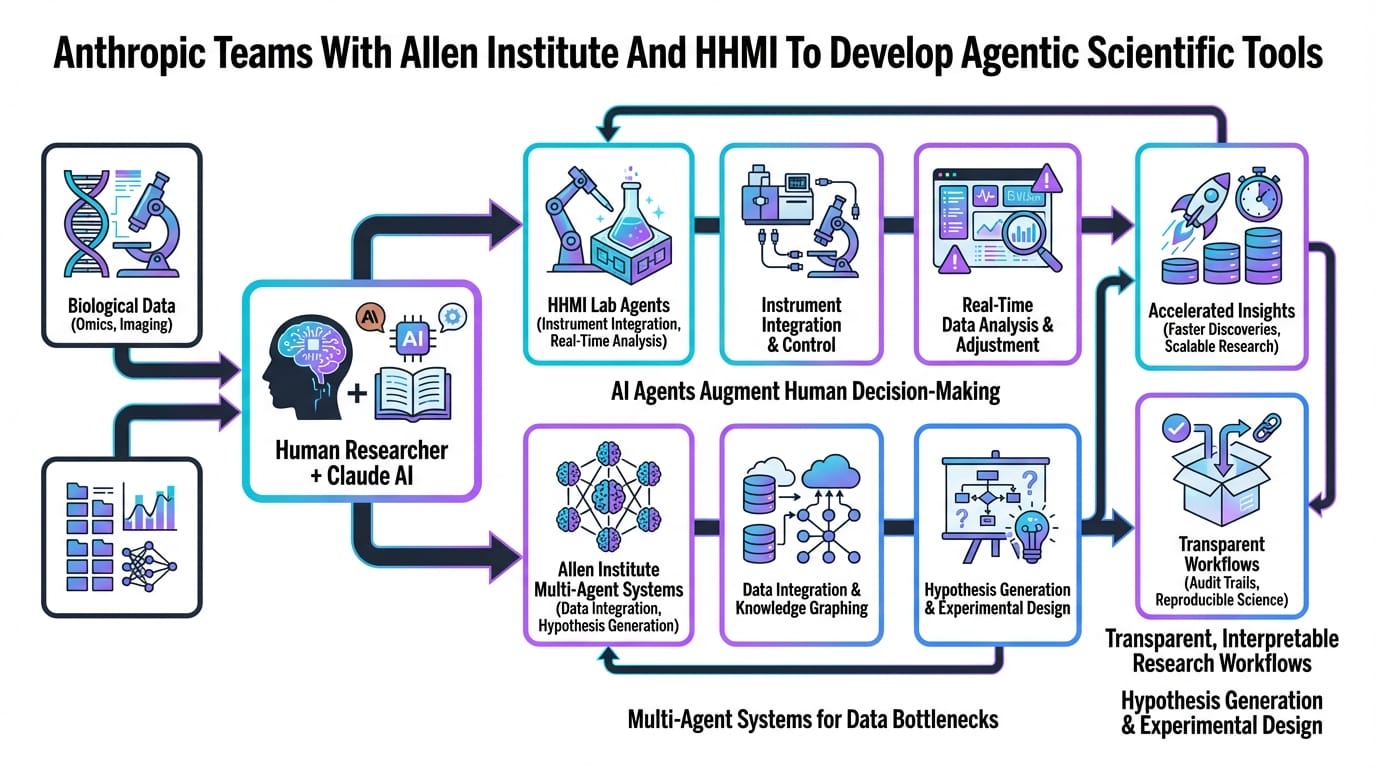
Jon: No, Lila—that’s the classic hype trap. AlphaFold was a one-shot prediction model; this is about agentic AI systems handling the gritty workflow bottlenecks: data synthesis, hypothesis prioritization, experiment coordination. Anthropic’s Claude teams with Allen Institute for multi-agent setups on brain atlases and HHMI for lab-integrated agents at Janelia Campus—compressing months of manual analysis into hours, but always with human oversight.[Key Insight: AI augments intuition, doesn’t replace it—researchers stay in the loop for validation][1][2]
Lila: What’s the macro trend here? Why now, with biology data exploding?
Jon: Biology’s hit ‘big data’ scale—single-cell sequencing, connectomics generate petabytes no human can wrangle alone. Partnerships target knowledge synthesis and experimental interpretation, where manual processes lag. Allen focuses multi-omic integration and knowledge graphs; HHMI builds agents linking instruments to pipelines. It’s trust-minimized AI: outputs must be interpretable, traceable—not black boxes.[1][3]
Lila: How does this differ from Web2 tools like centralized lab software?
Jon: Web2 is siloed, proprietary—data locked in vendor ecosystems, no ownership. These agentic systems aim for composability: specialized agents (e.g., for temporal modeling, experimental design) coordinate like microservices, but with scientific rigor. Think decentralized logic without blockchain yet—researcher autonomy mirrors Web3’s trust minimization, but centralized on Claude’s infrastructure.[1][2]
Security Note: Agentic AI in labs demands verifiability—Anthropic emphasizes legible reasoning to audit outputs, avoiding hallucination pitfalls in high-stakes biology.[1]
Lila: Give me three use cases—make one deep.
Jon: 1) Data analysis: Allen’s multi-agents handle brain map annotation, spotting gene patterns humans miss. 2) Hypothesis prioritization: HHMI agents rank experiments from 100 options to 10 viable ones. Mini Case Study—Biomni at Stanford: Goal: Unify 100s of bio tools for hypothesis/experiment design. How: Claude agent navigates databases, analyzes 450 wearables in 35 mins (vs 3 weeks human), IDs new transcription factors in embryonic data. Trade-offs: Speed vs guardrails (detects off-track reasoning). Failure mode: Improvised logic—mitigated by encoding expert workflows as ‘skills’.[5]
Trade-off 1: Speed vs Interpretability
Agents compress analysis timelines, but opaque reasoning risks bad science. Mitigation: Traceable outputs let researchers verify. So the real question is… can we scale legibility without sacrificing velocity?[1][5]
Trade-off 2: Specialization vs Generality
Multi-agents excel at niches (e.g., multi-omics), but coordination adds complexity. General models falter on lab specifics. So the real question is… how to balance agent orchestration without overwhelming researchers?[3]
Lila: Web2 vs this agentic future—break it down.
Jon: Here’s the evolution:
| Feature | Web2 Labs | Agentic AI (Anthropic Style) |
|---|---|---|
| Identity/Access | Central logins, vendor lock-in | Researcher-controlled, API-integrated |
| Data Ownership | Proprietary silos | Open datasets + traceable AI outputs |
| Governance | Vendor dictates updates | Human oversight on agent decisions |
| Analysis/Coordination | Manual, months-long | Multi-agent, hours-long |
| Moderation/Safety | Platform policies | Interpretability checks, guardrails |
| Interoperability | API friction | Tool/database unification (e.g., Biomni) |
| Hypothesis Gen | Human intuition only | AI-prioritized with confidence scores |
Mini Glossary
- Agentic AI: Autonomous systems that plan, use tools, and iterate like a research assistant—think digital lab tech chaining analyses without constant hand-holding.[1]
- Multi-omic Integration: Combining genomics, proteomics data layers; like merging puzzle pieces from different boxes to reveal the full picture.[3]
- Interpretability: Making AI reasoning transparent for audit; vending machine that shows the gears turning, not just spits out soda.[1][5]
Jon: In sum, this enables ‘compressed 21st century’ biology—faster cycles from data to insight—but risks like hallucinated hypotheses persist without rigorous checks. DeSci parallels loom: on-chain verification could decentralize this further.[2]
Lila: If Web3 meets this, what changes?
Try This Next (No Finance, Just Literacy)
- Audit an AI output: Take a bio paper, run it through Claude, trace reasoning gaps.
- Map your workflow: List repetitive tasks; sketch agentic decomposition like Allen’s multi-agents.
- Read DeSci primers: Explore how blockchain could verify agent outputs on-chain.
- Anthropic Official Announcement[1]
- Anthropic Teams With Allen Institute And HHMI To Develop Agentic Scientific Tools
- Fortune Exclusive on AI Agents in Science[2]
- Anthropic’s AI for Science Program docs
▼ AI tools to streamline research and content production (free tiers may be available)
Free AI search & fact-checking
👉 Genspark
Recommended use: Quickly verify key claims and track down primary sources before publishing
Ultra-fast slides & pitch decks (free trial may be available)
👉 Gamma
Recommended use: Turn your article outline into a clean slide deck for sharing and repurposing
Auto-convert trending articles into short-form videos (free trial may be available)
👉 Revid.ai
Recommended use: Generate short-video scripts and visuals from your headline/section structure
Faceless explainer video generation (free creation may be available)
👉 Nolang
Recommended use: Create narrated explainer videos from bullet points or simple diagrams
Full task automation (start from a free plan)
👉 Make.com
Recommended use: Automate your workflow from publishing → social posting → logging → next-task creation
※Links may include affiliate tracking, and free tiers/features can change; please check each official site for the latest details.