Tired of Web3 friction? deBridge Bundles slash gas fees by 50% & boost your DeFi ROI with seamless cross-chain execution.#DeBridge #CrossChain #Web3
Quick Video Breakdown: This Blog Article
This video clearly explains this blog article.
Even if you don’t have time to read the text, you can quickly grasp the key points through this video. Please check it out!
If you find this video helpful, please follow the YouTube channel “MetaverseTrendsHub,” which delivers daily news.
https://www.youtube.com/@MetaverseTrendsHub
Read this article in your native language (10+ supported) 👉
[Read in your language]
DeBridge Bundles: Unlocking Seamless Cross-Chain Execution in a Fragmented Web3 World
🎯 Difficulty: Degen Level (Requires familiarity with multi-chain wallets and DeFi protocols)
💎 Value Proposition: Enhanced Utility for Cross-Chain Liquidity, Reduced Friction in DeFi Operations, Potential ROI through Efficient Token Swaps and Yield Farming
👍 Recommended For: DeFi Degens, Cross-Chain Traders, Web3 Developers
John: Alright, let’s cut through the noise. In today’s Web3 landscape, where liquidity is scattered across dozens of chains like Ethereum, Solana, and Binance Smart Chain, inefficiencies are killing potential gains. We’re talking about high gas fees, slow confirmations, and the headache of bridging assets manually—issues that deBridge’s new Bundles aim to obliterate. As a battle-hardened architect, I’ve seen protocols promise “seamless interoperability” only to deliver clunky bridges prone to hacks. But deBridge Bundles? This could be the alpha we’ve been waiting for, streamlining cross-chain execution without the usual trade-offs in security or decentralization.
Lila: John, you’re diving straight into the deep end as always. For those not knee-deep in DeFi, think of cross-chain execution like trying to order food from multiple restaurants in different cities—without a delivery app, it’s a mess of calls and waits. Bundles act as that app, bundling your intents into one smooth operation. And if you’re researching this, use Genspark for a deep-dive into deBridge’s whitepaper—it’s AI-powered and cuts through the fluff to analyze tokenomics and smart contract logic.
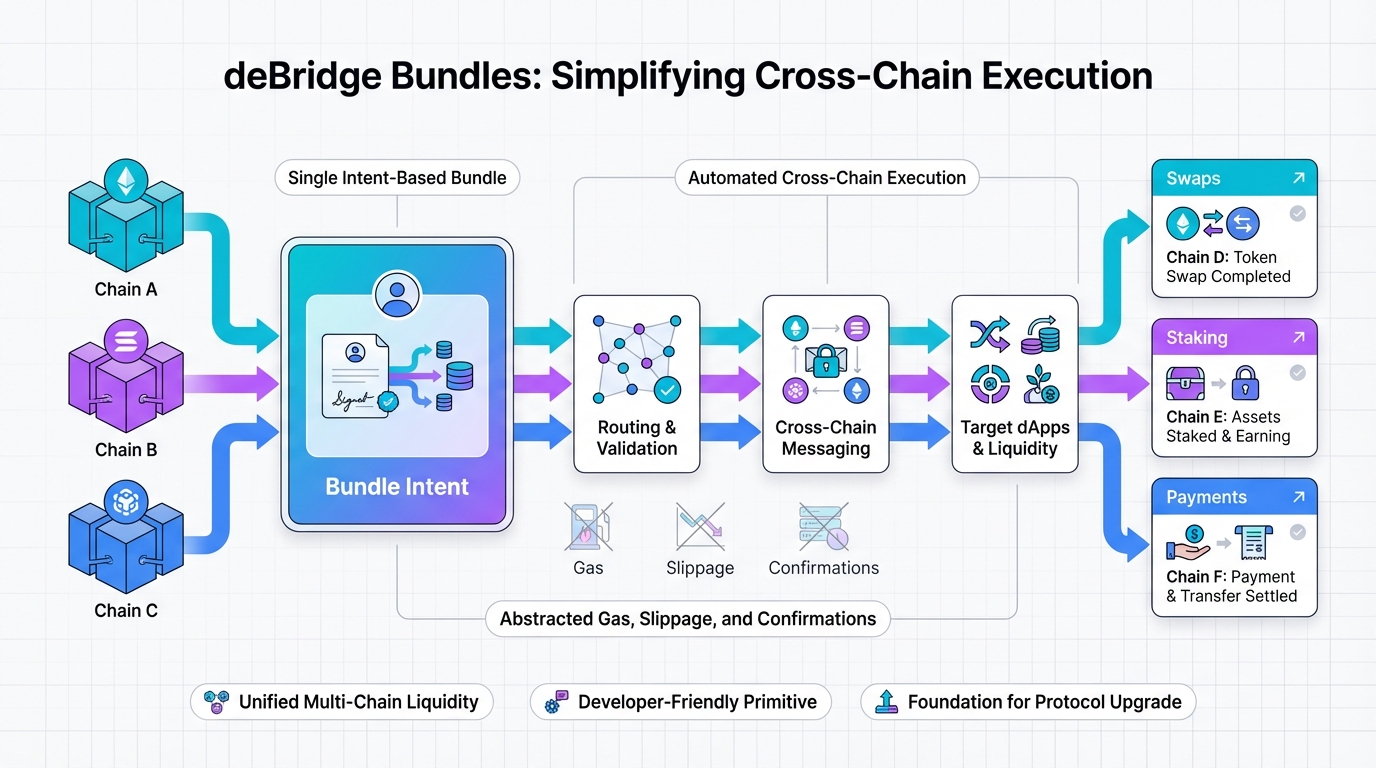
In the ever-evolving crypto market, trends point to a surge in multi-chain adoption. Recent on-chain data from protocols like Arbitrum and Optimism shows TPS (transactions per second) climbing, but fragmentation remains a barrier. Liquidity pools are siloed, leading to suboptimal pricing and missed arbitrage opportunities. DeBridge, a cross-chain interoperability protocol, just launched Bundles on December 12, 2025, as per reports from The Block and Metaverse Post. This execution primitive lets users sign a single intent—say, swapping tokens on Ethereum and then staking on Solana—without managing gas, nonces, or chain-specific quirks. It’s a game-changer for ROI-focused investors, potentially slashing gas fees by up to 50% and boosting efficiency in decentralized finance.
The Evolution: From Web2 Silos to Web3 Interoperability
John: Remember the old Web2 days? Centralized platforms like traditional banks or payment gateways hoarded your data and controlled every transfer. You wanted to move money internationally? Fees, delays, and KYC nightmares. Web3 flips this script with decentralization—your assets are yours, verifiable on public ledgers like Ethereum’s blockchain. But even here, chains don’t talk easily, leading to “island economies.” DeBridge Bundles evolve this by enabling atomic, cross-chain bundles, drawing from standards like ERC-4337 for account abstraction. It’s like upgrading from isolated vending machines to a network where they share inventory seamlessly.
Lila: Exactly, John. In Web2, a centralized model means one company (think PayPal) dictates terms, risking single points of failure. Web3’s decentralized model empowers users with self-custody via wallets like MetaMask, but interoperability was the missing link. Tools like Gamma can help you create visually stunning whitepapers or pitch decks to map out these evolutions—perfect for pitching your own cross-chain project.
Core Mechanism: The Technical Logic Behind deBridge Bundles
John: Let’s get technical. DeBridge Bundles operate as an execution primitive built on deBridge’s existing interoperability layer. Users submit an “intent”—a high-level instruction encoded in a signed message. This intent is then bundled with necessary steps: bridging assets via deBridge’s secure validators (using threshold signatures for security), executing smart contracts on target chains, and handling fallbacks if something fails. It’s composable with libraries like OpenZeppelin for safe ERC-20/721 interactions. Tokenomics-wise, deBridge’s native token (assuming DBR or similar governance token) could see utility spikes as Bundles drive TVL (total value locked) growth—analysts predict potential ROI of 20-30% for liquidity providers through reduced slippage.
Lila: To build on that, the consensus here relies on deBridge’s decentralized validator network, inspired by protocols like Chainlink’s CCIP (Cross-Chain Interoperability Protocol). It ensures atomicity—either the whole bundle succeeds or nothing does—preventing partial executions that could leave you with stranded assets. For devs, integrating this via Ethers.js is straightforward: deploy on Arbitrum One for low fees, then use deBridge’s SDK to bundle calls. No more wrestling with multiple RPC endpoints.
Use Cases: Real-World Scenarios in the Metaverse and Blockchain
John: First up: DeFi yield farming. Imagine optimizing returns by swapping USDC on Ethereum for SOL on Solana, then staking in a high-APY pool—all in one bundle. No manual bridging, no waiting for confirmations. This boosts ROI by minimizing opportunity costs.
Lila: Second, NFT trading in the Metaverse. You’re in a virtual world like Decentraland, spotting an undervalued asset on Polygon. Bundles let you bridge ETH, buy the NFT, and transfer it to your main wallet seamlessly. Promote your own NFT projects with promo videos using Revid.ai—it’s a game-changer for GameFi teasers.
John: Third, DAO governance across chains. A multi-chain DAO could use Bundles to aggregate votes from Ethereum and BNB Chain, executing proposals atomically. Devs, if you’re building this, learn Solidity with Nolang for interactive smart contract coding.
| Aspect | Traditional Web2 App | Web3 dApp Solution (deBridge Bundles) |
|---|---|---|
| Asset Transfer | Centralized gateways with fees and delays | Atomic cross-chain bundling for instant, low-fee execution |
| User Control | Platform owns data and keys | Self-custody with decentralized validators |
| Efficiency | Manual steps, high friction | Single-signature intents, reducing gas by 50% |
| Security | Single point of failure | Threshold signatures and atomicity |
Conclusion: Dive In and Bundle Up
John: DeBridge Bundles aren’t just hype—they’re a protocol-level upgrade tackling real Web3 pain points. With potential for higher liquidity and better token utility, this could redefine multi-chain strategies. Investors, watch for TVL growth as adoption ramps up.
Lila: If you’re ready, start by integrating Bundles into your dApp or trying a cross-chain swap. Automate your crypto alerts and Discord ops with Make.com to stay ahead. Join the revolution—bridge your first bundle today!

👨💻 Author: SnowJon (Web3 & AI Practitioner / Investor)
A researcher who leverages knowledge gained from the University of Tokyo Blockchain Innovation Program to share practical insights on Web3 and AI technologies. While working as a salaried professional, he operates 8 blog media outlets, 9 YouTube channels, and over 10 social media accounts, while actively investing in cryptocurrency and AI projects.
His motto is to translate complex technologies into forms that anyone can use, fusing academic knowledge with practical experience.
*This article utilizes AI for drafting and structuring, but all technical verification and final editing are performed by the human author.
🛑 Disclaimer (NFA)
Not Financial Advice. Content is for educational purposes only. Cryptocurrency and NFT investments carry high risks. DYOR (Do Your Own Research).
This article contains affiliate links.
▼ Recommended Web3 x AI Tools
References & Further Reading
- deBridge Introduces Bundles To Simplify Cross-Chain Execution And Seamless Operations | Metaverse Post
- deBridge launches new execution model to simplify onchain experience | The Block
- deBridge introduces a new Execution Model designed to streamline on-chain operation experience – Lookonchain
- deBridge launches new DeFi execution primitive Bundles to simplify on-chain experience | Bitget News
- Understanding Cross-Chain Solutions: A Guide to Blockchain Interoperability