It seems Web3 AI agents are finally enabling true autonomous digital coordination.#Web3 #AI
Quick Video Breakdown: This Blog Article
This video clearly explains this blog article.
Even if you don’t have time to read the text, you can quickly grasp the key points through this video. Please check it out!
If you find this video helpful, please follow the YouTube channel “MetaverseTrendsHub,” which delivers daily news.
https://www.youtube.com/@MetaverseTrendsHub
Read this article in your native language (10+ supported) 👉
[Read in your language]
Decoding ELSA’s Evolution: From AI Agent to Web3 Ecosystem Powerhouse
🎯 Difficulty: Advanced
💎 Core Value: Decentralization / AI Autonomy / Tokenized Governance
👍 Recommended For: Web3 developers, AI enthusiasts, crypto investors seeking deep protocol insights
Lila: Jon, with all the buzz around AI agents in Web3, this ELSA announcement about evolving into a full-scale AI agent system and planning a January TGE caught my eye. As someone who’s been in the space, what macro trends are driving this? How does it fit into broader decentralization efforts?
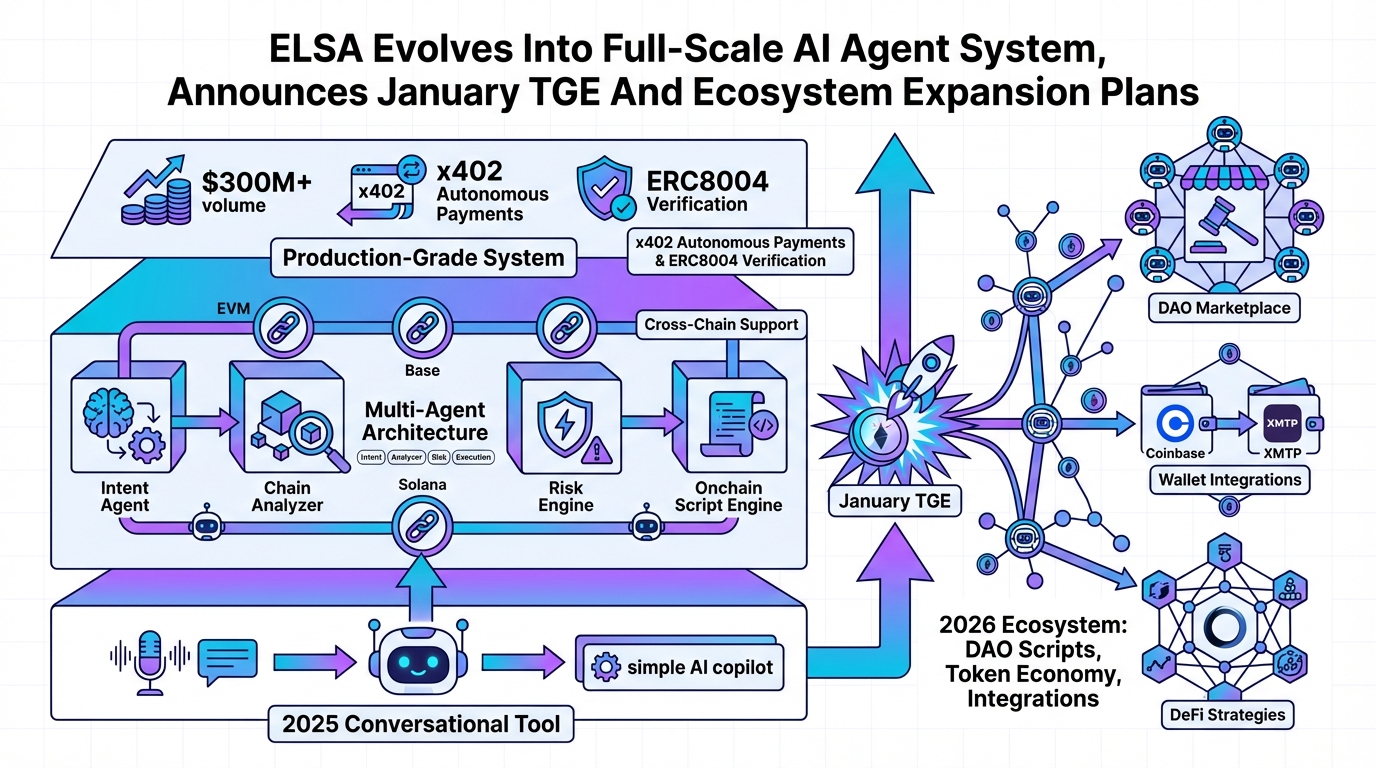
Jon: Absolutely, Lila. We’re seeing a convergence of AI and blockchain that’s reshaping trust minimization in digital ecosystems. ELSA, or HeyElsa as it’s formally known, is positioning itself as a crypto AI agent protocol. The macro trend here is the shift from centralized AI models—think proprietary systems controlled by big tech—to decentralized, agentic AI that operates on blockchain rails. This reduces single points of failure and enables trustless interactions. The January TGE (Token Generation Event) is a key milestone, likely involving token distribution to bootstrap governance and incentivize ecosystem participation. It’s about creating a self-sustaining network where AI agents can execute tasks autonomously, governed by token holders rather than a central authority.
Lila: That makes sense on a high level, but I’m curious about the evolution from Web2 to Web3 in this context. How does ELSA’s approach address the limitations of centralized systems, especially in AI?
Jon: Great question. In Web2, AI systems are often siloed, with data and decision-making controlled by centralized servers. This leads to issues like data monopolies, censorship, and lack of user ownership. ELSA’s Web3 evolution flips this: it leverages blockchain for decentralized consensus, ensuring AI agents operate on a permissionless ledger. Ownership is key—users control their data via cryptographic keys, resisting censorship through distributed nodes. Composability shines here; ELSA’s agents can integrate with other protocols via standards like ERC-20 for tokens or ERC-721 for NFTs, allowing seamless ecosystem expansion. The TGE will likely introduce tokens that enable governance, staking for security, and incentives for agent development, minimizing trust by aligning economic interests.
Lila: Diving deeper into the core mechanisms, can you break down ELSA’s token design and decentralization logic? How does the architecture support this ecosystem expansion?
Jon: Sure. At its core, ELSA’s architecture is built around autonomous AI agents that perform tasks like transaction execution or data analysis on-chain. Token design is crucial: the ELSA token, post-TGE, probably follows a utility model with governance rights, perhaps using a DAO (Decentralized Autonomous Organization) structure for decision-making. Decentralization logic relies on blockchain’s smart contracts—self-executing code that enforces rules without intermediaries. For instance, agents might use oracles for off-chain data, secured by protocols like Chainlink to prevent manipulation. Ecosystem expansion plans could involve interoperability with layers like Ethereum or rollups (e.g., Optimism), allowing agents to scale without high gas fees. Technically, this might incorporate account abstraction (EIP-4337) for user-friendly interactions, where agents handle complex transactions on behalf of users.
Lila: What about practical use cases? How might this play out in real Web3 scenarios?
Jon: Let’s explore three concrete applications. First, in decentralized finance (DeFi), ELSA agents could automate yield farming—scanning protocols for optimal returns, executing swaps via smart contracts, all governed by token holders to ensure fairness. Second, in digital identity, agents might manage verifiable credentials on-chain, using zero-knowledge proofs (zk-SNARKs) for privacy-preserving verification, expanding ecosystems by integrating with metaverse platforms for seamless user onboarding. Third, in community governance, the tokens from TGE could power DAOs where agents propose and vote on expansions, like partnering with other AI protocols, fostering a composable network where value flows freely without central control.
| Web2 | Web3 / Metaverse |
|---|---|
| Centralized AI controlled by corporations, prone to data breaches and bias from single entities. | Decentralized AI agents on blockchain, with community governance via tokens for bias mitigation and data sovereignty. |
| User data harvested and monetized without consent. | User-owned data via cryptographic wallets, with agents executing permissioned tasks. |
| Limited interoperability; ecosystems siloed by platforms. | High composability through standards like ERC tokens, enabling cross-protocol agent interactions. |
| Governance by executives; opaque decision-making. | Token-based DAO governance for transparent, community-driven expansions. |
| Scalability bottlenecks from central servers. | Layer-2 solutions and distributed nodes for efficient, scalable agent operations. |
Lila: Impressive comparisons. But with TGE and expansion plans, what risks should we be aware of in this setup?
Jon: Risks are inherent in emerging tech. Smart contract vulnerabilities could lead to exploits if not audited thoroughly—think reentrancy attacks that drain funds. Token economics might face volatility post-TGE, with potential for pump-and-dump schemes if governance isn’t robust. Decentralization isn’t absolute; if too few nodes control the network, it could centralize power. Regulatory uncertainties around AI and tokens add another layer—jurisdictions might classify them as securities. ELSA’s expansion must balance innovation with security, perhaps through progressive decentralization and community audits.
Lila: Wrapping this up, what does ELSA’s evolution ultimately enable in the Web3 landscape, and how should readers approach it?
Jon: In summary, ELSA enables a future where AI agents drive autonomous, trust-minimized ecosystems, from DeFi automation to metaverse interactions. It empowers users with true ownership and governance, but unresolved risks like security and regulation persist. The key is understanding the architecture—study protocols, not hype.
Lila: Fair point. So, rather than jumping in blindly, readers should observe how these systems develop and build their own literacy in Web3 AI?
Jon: Precisely. Focus on learning the tech stack—explore smart contracts, token standards—and watch how ELSA’s TGE unfolds. It’s about informed participation in decentralized innovation.
References & Further Reading
- ELSA Evolves Into Full-Scale AI Agent System, Announces January TGE And Ecosystem Expansion Plans
- HeyElsa plans to launch its token in January 2026 | Bitget News
- The Future of AI Agents: A Closer Look at 2026 | Medium
- Ethereum Glossary: Key Web3 Terms
- Introduction to Smart Contracts | ConsenSys