Personally, emerging crypto projects prioritizing modularity show real resilience.#Web3 #Decentralization
Quick Video Breakdown: This Blog Article
This video clearly explains this blog article.
Even if you don’t have time to read the text, you can quickly grasp the key points through this video. Please check it out!
If you find this video helpful, please follow the YouTube channel “MetaverseTrendsHub,” which delivers daily news.
https://www.youtube.com/@MetaverseTrendsHub
Read this article in your native language (10+ supported) 👉
[Read in your language]
The Shining Stars of 2026: Analyzing Emerging Crypto Projects for the Advanced Web3 Native
🎯 Difficulty: Advanced
💎 Core Value: Decentralization / Modular Infrastructure / AI Integration
👍 Recommended For: Experienced crypto developers, institutional analysts, ecosystem builders
Lila: Jon, I’ve been reading about “The Shining Stars of 2026: Best New Popular Crypto Projects” from Metaverse Post, and it highlights projects in areas like cash rails, AI compute, modular infrastructure, and information systems. As someone who’s been in Web3 for a while, I’m curious about the macro trends driving these. How do decentralization and trust minimization play into why these projects are poised to shine in 2026?
Jon: Excellent question, Lila. The macro trends in Web3 for 2026 are shifting from hype-driven cycles to institutional adoption and real-world utility, as noted in the article. Decentralization minimizes trust by distributing control across networks via consensus mechanisms like Proof-of-Stake, reducing single points of failure. Trust minimization, achieved through cryptographic proofs and smart contracts, ensures verifiable interactions without intermediaries. These projects excel because they address scalability and efficiency—cash rails enable seamless value transfer, AI compute leverages decentralized processing, modular infra allows composable blockchains, and information systems provide tamper-proof data oracles. This evolution builds on 2025’s shakeout, focusing on protocols with strong token economics and governance models.
Lila: That makes sense, but let’s contrast this with traditional systems. How does Web3’s approach to ownership and censorship resistance differ from centralized Web2 platforms, especially in the context of these new crypto projects?
Jon: Web2 relies on centralized servers controlled by corporations, where user data is siloed and vulnerable to censorship or arbitrary changes. In Web3, ownership is user-centric through cryptographic keys and blockchain immutability, enabling true digital sovereignty. Censorship resistance comes from distributed ledgers—transactions can’t be reversed without network consensus. Composability allows protocols to interoperate like Lego blocks, via standards like ERC-20 for tokens or EIP-1559 for fee markets. For 2026’s shining stars, this means modular infra projects can layer solutions on base chains, enhancing scalability without compromising decentralization.
Core Mechanisms in Emerging Crypto Architectures
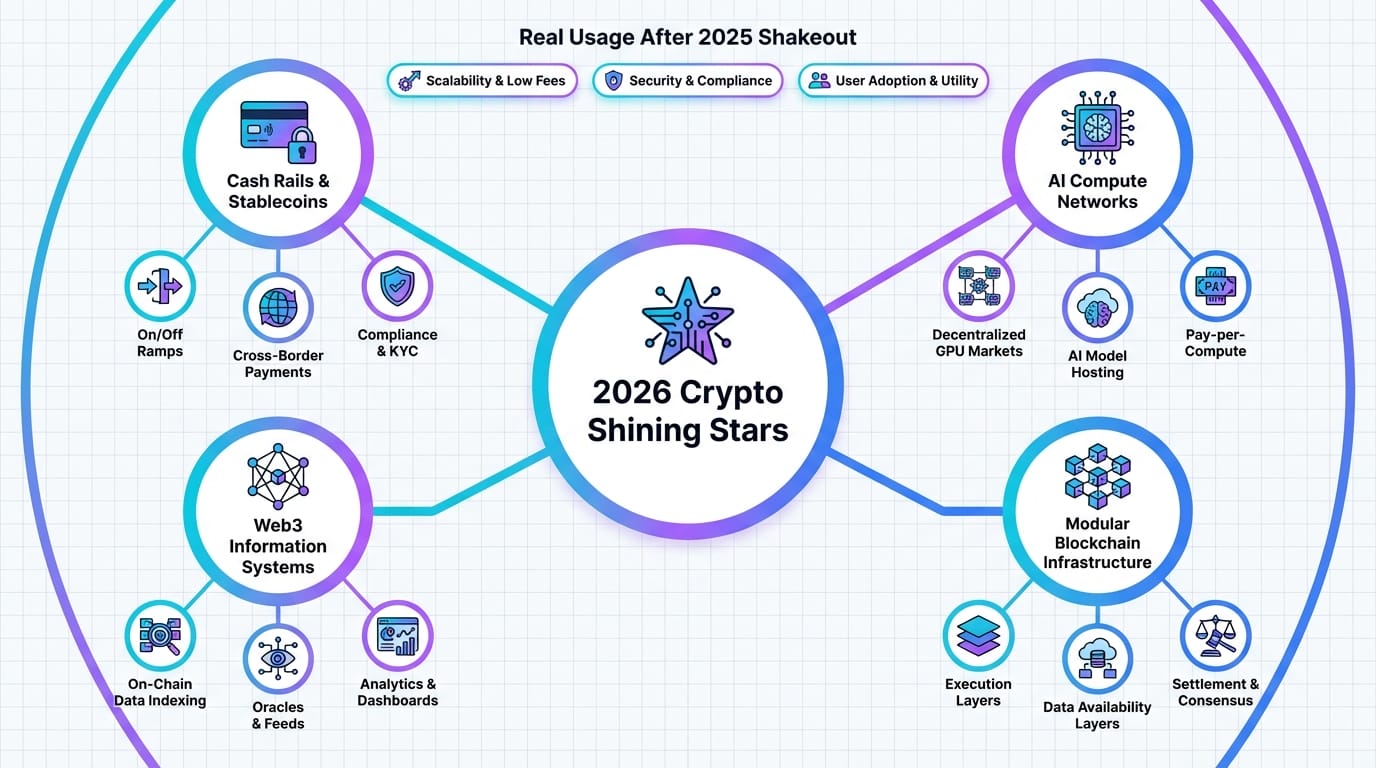
Lila: The diagram helps visualize this. Can you break down the core mechanisms? For advanced readers, how do consensus, smart contracts, and interoperability factor into these 2026 projects?
Jon: Certainly. Consensus mechanisms, such as Byzantine Fault Tolerance in modular chains, ensure agreement among nodes, enabling trustless validation. Smart contracts—self-executing code on platforms like Ethereum—automate logic with gas fees optimizing resource use. Interoperability, via protocols like Polkadot’s parachains or Cosmos’ IBC, allows cross-chain communication. In the highlighted projects, AI compute might use zero-knowledge proofs for efficient off-chain processing, while modular infra employs rollups to batch transactions, reducing costs. Token design often includes staking rewards tied to governance, aligning incentives for long-term decentralization.
Lila: Interesting. Now, what about practical applications? The article mentions essential services—could you discuss three concrete use cases from these emerging projects, focusing on their ecosystem roles?
Jon: Let’s examine three: First, decentralized finance (DeFi) cash rails, like optimized stablecoin protocols, facilitate borderless payments with automated yield farming via liquidity pools. Their role is providing efficient, low-fee value transfer, reducing reliance on banks. Second, AI compute networks distribute machine learning tasks across nodes, using token incentives for GPU sharing—ecosystem-wise, they democratize AI access, integrating with oracles for real-time data. Third, modular infrastructure for scalable blockchains, like Layer 2 solutions with custom execution environments, enables tailored dApps. These foster composability, allowing developers to build without base-layer constraints.
Lila: To clarify the shift, how do these Web3 solutions stack up against Web2 counterparts in key areas?
Jon: Here’s a comparison to highlight the architectural differences:
| Web2 | Web3 / Metaverse |
|---|---|
| Centralized data storage, prone to hacks and downtime | Distributed ledgers with high availability via node redundancy |
| Platform-controlled monetization and governance | Token-based DAOs for community-driven decisions |
| Limited interoperability between silos | Cross-chain bridges and standards for seamless composability |
| User data harvested for ads | Self-sovereign identity with privacy-preserving proofs |
| Scalability via vertical server upgrades | Horizontal scaling through sharding and rollups |
Lila: This table really drives home the advantages. Wrapping up, what do these projects enable overall, and what risks remain unresolved?
Jon: These 2026 projects enable a more resilient, user-empowered digital economy by prioritizing utility over speculation—think sustainable DeFi, accessible AI, and flexible infra. However, risks like smart contract vulnerabilities, regulatory uncertainties, and scalability bottlenecks persist. Protocols must continue evolving with audits and adaptive governance to mitigate them.
Lila: Thanks, Jon. It leaves me wondering: how can readers stay informed about these developments without getting lost in the noise?
Jon: Focus on reputable sources, observe protocol metrics like TVL and active addresses, and engage in community discussions. Prioritize learning the underlying tech to discern genuine innovation from trends.
References & Further Reading
- The Shining Stars Of 2026: Best New Popular Crypto Projects
- CoinDesk – Crypto News and Analysis
- Ethereum Whitepaper
- Polkadot Whitepaper