🎧 Podcast Episode
GenAI Bots in the Metaverse: 2026 Economy & Expert Analysis
Listen to this article as a podcast! Two hosts break down the key points in an easy-to-follow conversation.
▶ Press play to start listening
GenAI Bots in the Metaverse: 2026 Economy & Risks
Generative AI bots (autonomous AI characters that create content, trade items, and interact with humans inside virtual worlds) are no longer a future concept — they are reshaping metaverse economies right now. The question for 2026 is not whether they will arrive, but how fast they will displace human-driven activity and what new risks emerge when virtual economies run partly on autopilot.
Here is what you need to know and what you can do about it.
The Surprise That Should Have Your Attention
Roblox, the largest user-generated metaverse platform with roughly 79.5 million daily active users (approximately 2.5× the population of Canada), disclosed in its Q1 2025 earnings that AI-powered creation tools had been used to generate over 1.5 million assets in their first months of availability. Meanwhile, NVIDIA’s ACE (Avatar Cloud Engine — a cloud service for creating AI-driven non-player characters) is now integrated into multiple virtual world engines. Meta has deployed AI characters across its social platforms, with expansion into Horizon Worlds widely expected.
What does this mean in plain language? The “people” you meet, trade with, and buy from in virtual worlds will increasingly be AI. And the economy built around those interactions — worth an estimated $54 billion globally in virtual goods by 2025 according to Statista — is being fundamentally restructured.
79.5M daily users on Roblox alone, with AI-generated assets already numbering in the millions. The virtual goods market is worth an estimated $54B — and AI bots are about to become major participants in that economy.
Why GenAI Bots in Virtual Worlds Matter Now
Three forces are converging in 2025-2026 that make this topic urgent rather than theoretical.
First, large language models (LLMs — AI systems trained on massive text data to understand and generate human-like language) have become cheap to run. The cost of inference (running an AI model to produce output) has dropped roughly 90% in the past 18 months, according to analysis from a]16z. This means a game studio or platform can now afford to give every NPC (non-player character — a character controlled by the computer rather than a human) its own conversational AI brain without going bankrupt on server costs.
Second, metaverse platforms are competing on “aliveness.” Static worlds feel empty. Roblox, Fortnite (with 110+ million monthly players), and Meta Horizon Worlds are all racing to populate their environments with AI entities that make the world feel dynamic — shopkeepers who haggle, quest-givers who remember your history, and companions who adapt to your play style.
Third, the economic incentive is enormous. AI bots can generate, sell, and trade virtual goods 24 hours a day. They never sleep, never get bored, and can operate in multiple instances simultaneously. For platform operators, this is incredibly attractive. For human creators who sell virtual items, this is potentially threatening.
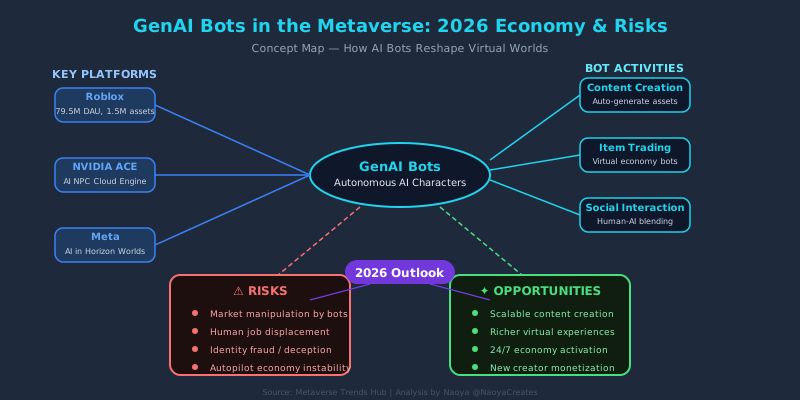
Cheaper AI, platform competition for engagement, and 24/7 economic activity — these three forces are pushing GenAI bots from novelty to necessity in virtual worlds. If you create or sell anything in the metaverse, this directly affects your livelihood.
Platform Comparison: Who Is Doing What
Not every metaverse platform is approaching AI bots the same way. The differences matter because they determine which platforms will likely grow — and which will create the biggest risks for users.
| Platform | AI Bot Integration (as of mid-2025) | Economic Impact | Key Risk |
|---|---|---|---|
| Roblox | AI asset generation tools live; AI NPC APIs in beta; AI-powered moderation deployed | Acceleration of content supply; potential downward price pressure on human-made assets | Flooding marketplace with low-quality AI assets; child safety concerns with AI chat |
| Fortnite / UEFN | Epic’s MetaHuman + AI animation tools; Verse scripting with AI assist; limited NPC AI so far | Creator economy growing ($1B+ paid to creators since UEFN launch); AI tools lower barrier to entry | IP infringement from AI-generated content; creator revenue dilution |
| Meta Horizon Worlds | AI characters on Instagram/Facebook; Horizon Worlds integration likely in 2025-2026 | Unclear — Horizon Worlds economy is still small; AI could bootstrap engagement | User confusion between AI and real people; data privacy with AI interactions |
| NVIDIA Omniverse | ACE for AI NPCs; digital twin simulations with AI agents; enterprise-focused | Industrial metaverse applications; training AI in simulation before real-world deployment | High barrier to entry; primarily enterprise, not consumer |
| Decentraland / The Sandbox | Third-party AI NPC integrations (Inworld AI, Convai); limited native support | AI bots could inflate transaction volumes; blockchain transparency may help detect bot activity | Wash trading by AI bots; artificial land value manipulation |
For everyday users, the practical takeaway is this: if you spend time or money in any virtual world, check whether the platform clearly labels AI entities. Roblox and Meta have both made public commitments to AI transparency, but enforcement varies. In blockchain-based worlds like Decentraland, on-chain data provides some visibility — but it does not solve the problem of AI bots that mimic human behavior to manipulate markets.
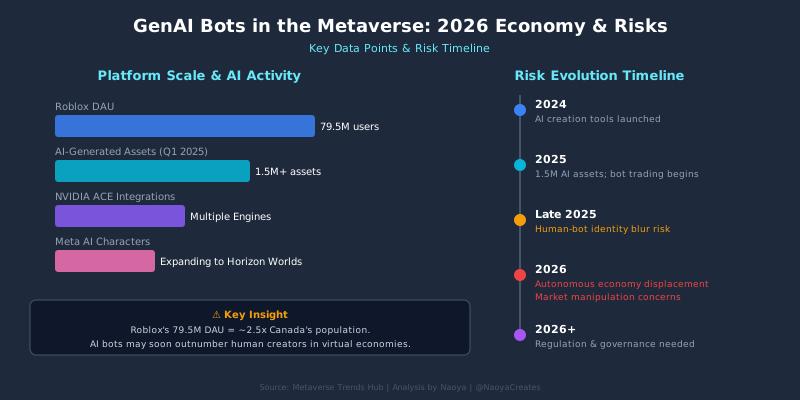
Each platform handles AI bots differently. Roblox leads in integration speed, Fortnite in creator economics, and blockchain worlds in transparency. Your choice should depend on whether you prioritize engagement, earning potential, or visibility into who (or what) you are interacting with.
The 2026 Economic Scenarios
Scenario A: AI Bots as Economic Boosters
In the optimistic view, GenAI bots act as economic multipliers. They fill empty servers, generate content that attracts human players, and handle low-value transactions that humans find tedious. Think of them as the automated market makers of virtual worlds — always available, always trading, always creating liquidity.
For a freelance 3D artist who sells avatars on Roblox, this could mean more customers (AI bots driving more traffic to the platform) even if individual item prices drop. For a brand running a virtual store, AI shop assistants could increase conversion rates without hiring human staff.
Scenario B: AI Bots as Economic Disruptors
In the pessimistic view, AI bots flood virtual markets with cheap, AI-generated goods, crushing prices for human creators. Worse, sophisticated bots could engage in market manipulation — buying up virtual land, cornering item markets, or running scams that exploit users who cannot distinguish AI from humans.
This scenario is not hypothetical. Bot-driven economic manipulation has already occurred in games like EVE Online and World of Warcraft for over a decade. GenAI simply makes these bots smarter, more convincing, and harder to detect.
Scenario C: The Likely Middle Ground
Realistically, 2026 will likely see a mix. Platforms that implement strong guardrails — transaction limits for AI accounts, mandatory AI labeling, human-verified creator tiers — will likely see healthy growth. Platforms that rush AI integration without safeguards will likely experience economic volatility and user trust issues.
GenAI bots could either boost or destabilize virtual economies — the outcome depends almost entirely on platform governance. Think of it like algorithmic trading in stock markets: powerful when regulated, dangerous when uncontrolled.
The Risk Landscape: Five Threats to Watch
Based on publicly reported incidents, platform disclosures, and patterns from adjacent industries, here are the five biggest risks GenAI bots pose to metaverse users in 2026:
1. Identity Confusion
When AI bots convincingly mimic human behavior in virtual worlds, users cannot tell who is real. This matters for social interactions, business deals, and trust. Meta’s AI characters on Instagram already triggered user backlash when people realized they were talking to bots they thought were human.
2. Market Manipulation
AI bots can execute thousands of transactions per hour. In virtual real estate markets (where some parcels have sold for over $100,000), coordinated bot activity could artificially inflate or crash prices. Blockchain transparency helps but does not prevent sophisticated multi-wallet strategies.
3. Content Saturation
If AI generates 10× more virtual items than humans, marketplaces become noisy. Finding quality human-made content becomes harder. This is already happening on stock photo sites and app stores — the metaverse is next.
4. Child Safety
Roblox’s user base skews young (over 40% are under 13, according to the company’s safety reports). Conversational AI bots that interact freely with children create moderation challenges that purely text-filter-based systems likely cannot fully address.
5. Regulatory Uncertainty
The EU AI Act (European legislation classifying AI systems by risk level) is being enforced in stages through 2026. It is unclear how AI bots in virtual worlds will be classified — especially when they handle economic transactions. Platform operators face potential compliance costs that could reshape their business models.
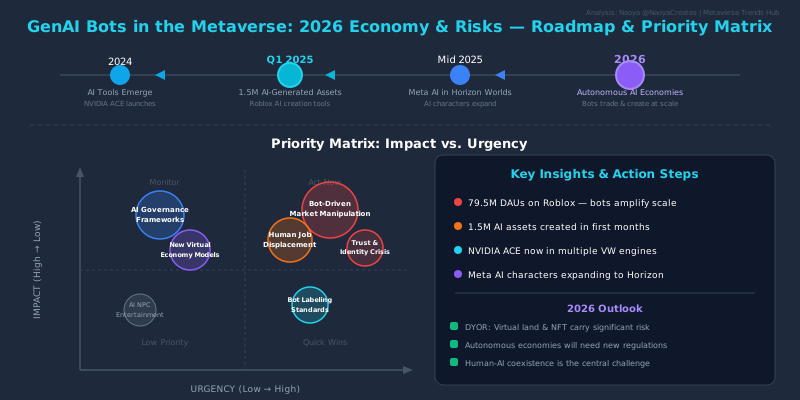
These are not abstract risks. Identity confusion, market manipulation, content flooding, child safety gaps, and regulatory ambiguity are already materializing in early forms. If you invest time or money in virtual worlds, treating these as “future problems” is a mistake.
How This Changes Your Work and Life
If you are a content creator: Start differentiating your work now. “Human-made” and “handcrafted” labels will likely become premium markers — similar to how “organic” commands higher prices in food markets. Build your personal brand around skills that AI cannot easily replicate: storytelling, community building, curation.
If you work in marketing or brand management: AI bots offer a new customer service channel inside virtual worlds, but deploying them carelessly risks brand damage. Plan for transparency — users who discover they were unknowingly talking to your AI bot will not be happy.
If you invest in virtual assets: Be aware that transaction volumes and “active user” counts may increasingly include bot activity. Demand transparency from platforms about what percentage of economic activity is AI-driven. If a platform will not disclose this, treat their metrics with skepticism.
If you are a casual user: Check platform settings for AI interaction preferences. Several platforms are adding opt-out features for AI NPC conversations. Use them if you prefer human-only interactions. Also, be cautious about virtual goods that seem too cheap — they may be AI-generated and have no resale value.
Whether you create, market, invest, or simply explore in virtual worlds — GenAI bots change the rules. The common thread: demand transparency, build human-verified reputation, and treat inflated metrics with healthy skepticism.
Summary: Three Things to Remember
1. GenAI bots are becoming economic actors. They create, trade, and interact at scale. By 2026, a meaningful percentage of metaverse economic activity will likely be bot-driven.
2. Platform governance determines outcomes. The technology itself is neutral. Whether AI bots help or harm virtual economies depends on how platforms implement guardrails — labeling, transaction limits, and moderation.
3. Human authenticity becomes a premium. As AI content floods virtual marketplaces, verified human creation and genuine human connection will likely command higher value — not lower.
Author’s Take: Having built and tested AI agents across multiple platforms, I see a clear pattern: the platforms that will win are those that treat AI bots as tools for human augmentation rather than human replacement. Roblox’s approach — giving creators AI tools while maintaining human-centric moderation — is likely the right direction, though execution remains unproven at scale. The blockchain-based metaverse platforms have a structural advantage in transparency (every transaction is on-chain), but their smaller user bases limit the data we have on how AI bots behave in those economies. My biggest concern is not the technology itself but the speed of deployment outpacing safety measures. We saw this pattern with social media algorithms — deploy first, fix harm later. The metaverse industry has a chance to do better, but only if users actively demand accountability. Do not passively accept whatever your platform rolls out. Ask questions. Check settings. And remember: in a world increasingly populated by AI, your humanity is your most valuable asset.
The metaverse is entering an era where “who is real?” becomes a daily question. Start building habits of verification now — they will pay off as AI presence accelerates through 2026 and beyond.
Next Steps: What You Can Do Today
1. Audit your platform settings. Log into Roblox, Fortnite, or whichever metaverse platform you use. Look for AI interaction settings, privacy controls, and content source labels. Many platforms have added these features quietly — most users have never checked.
2. Verify before you invest. If you are buying virtual land, NFTs, or in-game items, check transaction history for bot-like patterns (rapid-fire transactions from new accounts, identical pricing across multiple listings). On blockchain platforms, tools like Etherscan let you inspect wallet activity directly.
3. Start building your “human-verified” presence. If you create content in virtual worlds, consider linking your real identity or established social accounts to your creator profile. As AI-generated content floods marketplaces, platforms are likely to introduce verification tiers — early adopters will have an advantage.
Data Sources
- Roblox Investor Relations — Q1 2025 Earnings & User Metrics
- NVIDIA ACE (Avatar Cloud Engine) — Official Product Page
- Meta AI — Official AI Initiatives & Character Deployment
- Statista — Virtual Goods Market Size & Forecasts
- Epic Games — Fortnite UEFN Creator Economy
- EU AI Act — Official Regulation Timeline & Classification
- a16z — AI Inference Cost Analysis
- Roblox — Safety & Moderation Reports
Original Analysis: The Future of AI-Populated Virtual Worlds
Author’s Perspective by Naoya — Web3 Researcher & AI Engineer
We are at an inflection point that reminds me of when algorithmic trading entered stock markets in the early 2000s. Back then, traditional traders panicked. Regulators scrambled. Eventually, markets adapted — but not before significant disruption and several flash crashes. The metaverse is heading into a similar transition.
What most coverage misses is the second-order effect. The obvious story is “AI bots will flood virtual worlds.” The less obvious story is what happens to human behavior in response. I predict we will see the emergence of “human-only zones” — premium spaces in virtual worlds where verified humans interact, create, and trade. Think of them as the VIP section of the metaverse. Platforms that build these spaces well will attract the highest-value users and creators.
From a platform comparison standpoint, Roblox has the scale advantage but the biggest safety challenge given its young user base. NVIDIA Omniverse is the most technically sophisticated but remains enterprise-focused — it is unlikely to impact casual users directly in 2026. The blockchain-based platforms (Decentraland, The Sandbox) have the transparency advantage but need significantly more users to stress-test their AI governance.
My honest assessment: by late 2026, at least one major metaverse platform will face a high-profile incident involving AI bot manipulation — whether economic, social, or safety-related. The platforms that survive it will be those that invested in guardrails early. The rest will learn the hard way that deploying AI without governance is like building a city without traffic lights.
What I am watching most closely: Roblox’s AI labeling policies, Meta’s Horizon Worlds rollout strategy, and whether the EU AI Act’s enforcement creates a meaningful compliance standard for virtual worlds. These three developments will likely define the AI-metaverse landscape for the next two years.
Disclaimer: The information on this site is for educational and informational purposes only and should not be considered financial or investment advice. Virtual land and NFT investments carry significant risk. Always do your own research (DYOR) before making any investment decisions.
About the Author: Naoya is a Web3 researcher specializing in metaverse platforms, virtual economies, and digital twin technologies. He analyzes the latest developments in virtual worlds and delivers insights on the future of digital lifestyles.
🔗 Follow on X: @NaoyaCreates