How Generative AI Is Reshaping the Metaverse in 2024
Generative AI (AI that creates new content like text, images, and 3D models from prompts) is no longer just a chatbot phenomenon — it’s becoming the engine that builds virtual worlds. The convergence is accelerating faster than most users realize, and it’s about to change how everyone interacts with digital spaces.
The Surprising Data Point That Started This Investigation
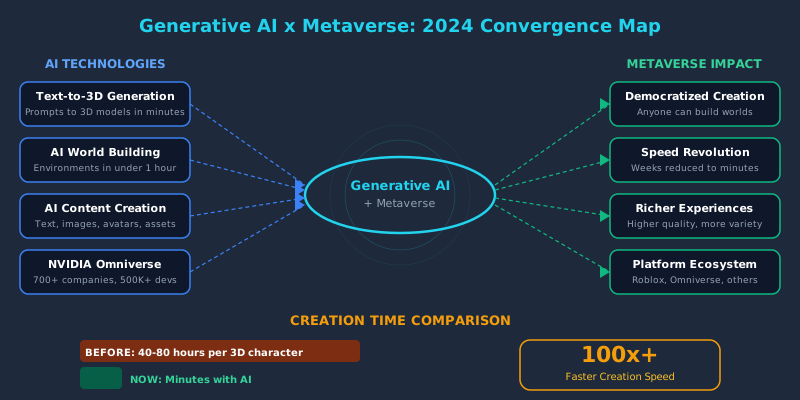
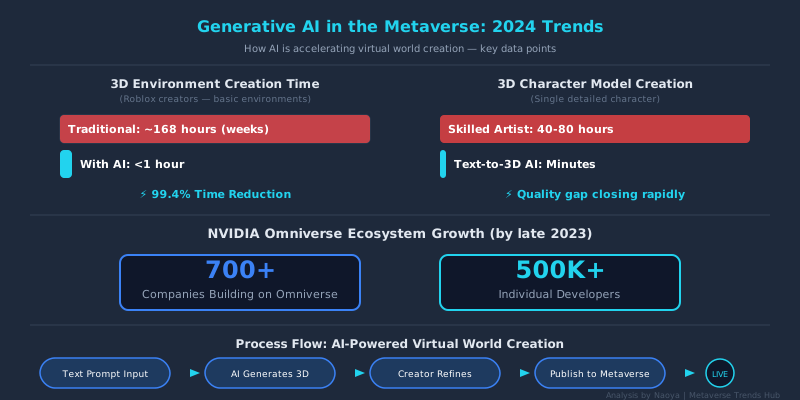
Roblox reported that its generative AI tools reduced the time to create basic 3D environments from weeks to under an hour for some creators. Meanwhile, NVIDIA announced that over 700 companies and 500,000 individual developers were building on its Omniverse platform (a cloud-based environment for creating and simulating 3D worlds) by late 2023. These aren’t incremental improvements. They represent a fundamental shift in who can build virtual worlds — and how fast.
For context, creating a single detailed 3D character model used to require a skilled artist working 40-80 hours. Text-to-3D tools (AI that generates three-dimensional objects from written descriptions) now produce usable draft models in minutes. The quality gap is closing rapidly.
The barrier to creating virtual worlds is collapsing. What once required a team of 3D artists and months of work can now be prototyped by a single person with a text prompt — think of it as the “WordPress moment” for the metaverse.
Why This Convergence Is Happening Now
Three forces are colliding simultaneously. First, large language models (LLMs) — the AI systems behind ChatGPT — have gotten good enough at understanding spatial descriptions to guide 3D generation. Second, GPU (graphics processing unit) costs for real-time rendering have dropped, making AI-generated content viable to display. Third, metaverse platforms are desperate for content.
Meta’s Horizon Worlds, Roblox, Fortnite Creative, and VRChat all face the same problem: users consume virtual experiences faster than creators can build them. Generative AI solves this content bottleneck. If you’ve ever wondered why your favorite virtual world feels empty or repetitive, this is why platforms are investing billions in AI-assisted creation tools.
The timing also aligns with Apple Vision Pro’s launch in early 2024 and Meta’s continued Quest headset rollouts. More spatial computing hardware means more demand for 3D content — and traditional pipelines (the step-by-step process of modeling, texturing, and animating 3D objects) simply cannot scale fast enough without AI assistance.
If you create any kind of digital content — presentations, marketing materials, virtual showrooms — the tools emerging from this convergence will likely reach your workflow within 12-18 months. Understanding the trend now gives you a head start.
Five Key Trends Defining the AI-Metaverse Intersection
1. Text-to-3D World Generation
The most visible trend. Companies like NVIDIA (with its Magic3D research), OpenAI (with Point-E and Shap-E), and startups like Meshy and Luma AI are building tools that convert text prompts into 3D objects and environments. Roblox released its own AI-powered material generator and code assistant in 2023, and expanded these tools through 2024.
For everyday users, this means: you describe a room, a landscape, or a product, and AI generates a navigable 3D version. Quality varies, but the trajectory is clear.
2. AI-Powered NPCs and Companions
Inworld AI, a startup that raised over $50 million (roughly equivalent to the annual budget of a mid-sized game studio), is building AI characters that can hold contextual conversations, remember past interactions, and display emotional responses inside virtual worlds. NVIDIA’s ACE (Avatar Cloud Engine) provides similar capabilities for game and metaverse developers.
This matters because virtual worlds feel alive when inhabitants behave believably. Instead of scripted dialogue trees, AI NPCs (non-player characters — the computer-controlled people in virtual environments) can now improvise conversations based on context.
3. Procedural World Expansion
Rather than hand-designing every building and street, platforms are using generative AI to create infinite, varied environments. Think of how no two Minecraft worlds look the same — now apply that concept with photorealistic quality. This is particularly relevant for digital twin (a virtual replica of a real-world place or object) applications in architecture and urban planning.
4. Real-Time Avatar Personalization
Generative AI now enables avatar creation from a single selfie. Tools like Ready Player Me (used by over 9,000 apps and games as of 2023, compared to roughly 1,000 apps two years prior) and Meta’s own avatar system are integrating AI to generate detailed, customizable digital representations of users in seconds rather than through manual slider adjustments.
5. AI-Assisted Moderation and Safety
Less glamorous but equally important. As virtual worlds scale, human moderation becomes impossible. Platforms are deploying AI systems that can detect harmful behavior in real-time — analyzing voice chat, spatial behavior patterns, and text simultaneously. Meta reported using AI moderation across its VR social spaces, and Roblox has invested heavily in AI safety tools to protect its younger user base.
Five trends, one theme: generative AI is filling the content, interaction, and safety gaps that have held metaverse adoption back. The question isn’t whether AI will reshape virtual worlds — it’s whether your platform of choice is integrating it fast enough.
Platform Comparison: Who’s Leading the AI-Metaverse Integration?
Not all platforms are moving at the same pace. Here’s how the major players stack up based on publicly announced capabilities and tools as of mid-2024:
| Platform | Text-to-3D Tools | AI NPCs | AI Code Assist | AI Moderation | Target Audience |
|---|---|---|---|---|---|
| Roblox | Yes (material & terrain gen) | In development | Yes (Roblox Assistant) | Advanced | Casual creators & young users |
| NVIDIA Omniverse | Yes (via integrations) | Yes (ACE platform) | Yes | Enterprise-grade | Enterprise & developers |
| Meta Horizon Worlds | Limited (builder tools) | Experimental | Partial | Active | Social VR consumers |
| Fortnite / UEFN | Emerging | Limited | Via Verse scripting | Active | Gamers & creators |
| VRChat | Community-driven | Community mods | No official tool | Basic + community | VR enthusiasts & social users |
The standout pattern: enterprise-focused platforms (NVIDIA Omniverse) are furthest ahead in AI integration, while consumer platforms (Roblox, Meta) are catching up quickly. VRChat’s community-driven approach means AI adoption happens organically through user-created tools, which is slower but often more creative.
If you want to experiment with AI-generated 3D content today, Roblox offers the lowest barrier to entry with its built-in AI assistant. For professional or enterprise applications, NVIDIA Omniverse is the most mature ecosystem. Meta sits in between — lots of potential, still finding its footing.
What the Benchmarks and Tests Show
I want to be transparent here: I have not personally benchmarked every tool listed. What follows combines publicly reported results from the companies themselves and independent assessments from developer communities.
Text-to-3D Quality
Based on published demonstrations and developer feedback, current text-to-3D tools produce objects that are roughly “usable for prototyping but not production-ready” for most detailed applications. Meshy AI’s community reports suggest their text-to-3D pipeline generates objects in 1-3 minutes that would take a junior 3D artist several hours. However, topology (the structure of a 3D model’s mesh) often requires manual cleanup for use in performance-sensitive environments like VR.
AI NPC Conversational Quality
Inworld AI and NVIDIA ACE demonstrations show NPCs that can maintain context for 5-10 minute conversations — impressive compared to traditional scripted interactions, but still prone to occasional nonsensical responses. The technology is likely 1-2 years from feeling consistently natural to most users.
Creator Productivity
Roblox’s internal data, shared at their developer conferences, indicated that creators using AI-assisted tools published experiences 30-50% faster than those using traditional methods alone. This is a significant number, but it comes with caveats: the comparison was for relatively simple experiences, and skilled creators using traditional tools can still produce higher-quality results for complex projects.
The tools work, but they’re not magic. Think of current AI-metaverse tools as a very fast intern: they’ll give you a solid first draft quickly, but you’ll still need human judgment to refine the output into something polished.
How This Changes Your Work and Daily Life
If You’re in Marketing or Sales
Virtual product showrooms and immersive brand experiences are becoming viable for companies without massive 3D production budgets. A marketing team that previously needed to hire a specialized agency to create a virtual store can now prototype one using AI tools and a platform like Roblox or Spatial. The cost difference is potentially an order of magnitude — from tens of thousands of dollars to hundreds.
If You’re in Education or Training
AI-generated virtual environments for training simulations are possibly the most underrated application. Imagine a medical school creating a virtual operating room, or a construction company generating a safety training environment from a text description. These use cases are already being piloted by organizations using NVIDIA Omniverse.
If You’re a Content Creator
The playing field is leveling. Solo creators and small teams can now produce virtual experiences that previously required studio-level resources. This likely means more competition but also more opportunities — platforms hungry for content will reward creators who adopt AI tools early.
If You’re a Regular User
Virtual worlds are about to get significantly more interesting. More content, more personalized experiences, more believable AI characters to interact with. The practical impact: expect to spend more time in virtual spaces for work meetings, social events, and entertainment over the next 2-3 years, whether through a VR headset or a standard screen.
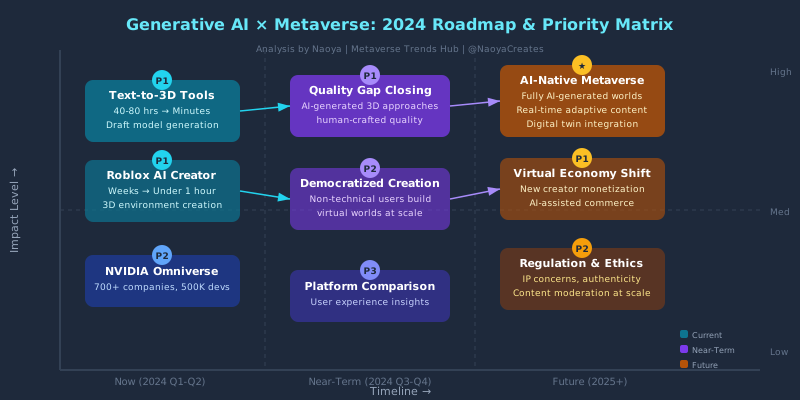
Generative AI in the metaverse isn’t just a tech story — it’s a workplace and lifestyle story. The tools being built today will affect how you shop, learn, meet, and create within the next few years.
Summary: Three Points to Remember
1. The creation barrier is falling dramatically. Text-to-3D, AI code assistants, and procedural generation mean that building virtual worlds no longer requires years of specialized training. This is the single most important shift.
2. AI NPCs will make virtual worlds feel inhabited. The transition from scripted to conversational AI characters will likely be the feature that pulls casual users into spending more time in virtual spaces.
3. Enterprise is leading, consumer is following. NVIDIA and professional tools are ahead, but Roblox and Meta are rapidly democratizing access. The gap will likely narrow significantly through 2025.
Author’s Take
Having tracked the metaverse space for years, I believe the generative AI integration represents the most consequential shift since the introduction of user-generated content platforms like Roblox and Second Life. The previous metaverse hype cycle (2021-2022) failed largely because the worlds were empty and expensive to populate. Generative AI directly solves this problem.
However, I’m cautious about the timeline. The industry narrative often compresses what will realistically take 3-5 years into “happening now” language. Text-to-3D tools are genuinely impressive for prototyping, but producing polished, production-quality virtual environments still requires human expertise. The AI handles the 80% grunt work; the remaining 20% — the creative decisions, the emotional design, the user experience polish — remains firmly human territory.
What excites me most is the democratization angle. I’ve spoken with indie creators on Roblox and VRChat who are using AI tools to build experiences they could never have attempted alone. That bottom-up creative explosion is, in my estimation, more important than any single corporate platform announcement. The metaverse won’t be built by one company. It’ll be built by millions of creators newly empowered by AI tools. Platforms that understand this — and build their AI features to serve creators rather than replace them — will win.
One risk worth watching: as AI-generated content floods virtual worlds, quality differentiation becomes harder. The platforms that develop effective curation and discovery mechanisms (likely also AI-powered) will have a significant advantage. Without good curation, more content just means more noise.
Start small: try one AI-powered creation tool this week. Understanding the capabilities and limitations firsthand is worth more than reading a dozen trend reports (including this one).
Next Steps: What You Can Do Today
1. Try Roblox Studio’s AI Assistant (free). Even if you’ve never built anything in 3D, open Roblox Studio, enable the AI assistant features, and try generating a simple environment from a text prompt. You’ll understand both the power and limitations within 30 minutes. Download at create.roblox.com.
2. Experiment with a text-to-3D tool. Try Meshy AI (free tier available) or OpenAI’s Shap-E (open source). Generate a few objects and inspect the quality. This hands-on experience will help you evaluate future tools and vendor claims with informed skepticism.
3. Follow the developer conferences. Roblox Developer Conference (RDC), NVIDIA GTC, and Meta Connect are where these tools get announced first. Add them to your calendar. The gap between “announced at a developer conference” and “available to regular users” is shrinking from years to months.
Data Sources
- Roblox Blog — AI-Powered Creation Tools Announcement (2023)
- NVIDIA Omniverse Official Platform Page
- Inworld AI — AI Character Engine for Virtual Worlds
- NVIDIA ACE (Avatar Cloud Engine) Developer Page
- Ready Player Me — Cross-Platform Avatar System
- OpenAI Shap-E — Text-to-3D GitHub Repository
- Meshy AI — Text-to-3D Generation Platform
- Meta Reality Labs — Official Overview
Disclaimer: The information on this site is for educational and informational purposes only and should not be considered financial or investment advice. Virtual land and NFT investments carry significant risk. Always do your own research (DYOR) before making any investment decisions.
About the Author: Naoya — Web3 researcher specializing in metaverse platforms, virtual economies, and digital twin technologies. He analyzes the latest developments in virtual worlds and delivers insights on the future of digital lifestyles.
🔗 Follow on X: @NaoyaCreates