Why rent in Web2 when you can own? MocaPortfolio and Magic Eden are unlocking true digital ownership and community power in Web3.
—#Web3Ownership #MocaNetwork #MetaverseTokens
—
Quick Video Breakdown: This Blog Article
This video clearly explains this blog article.
Even if you don’t have time to read the text, you can quickly grasp the key points through this video. Please check it out!
If you find this video helpful, please follow the YouTube channel “MetaverseTrendsHub,” which delivers daily news.
https://www.youtube.com/@MetaverseTrendsHub
Read this article in your native language (10+ supported) 👉
[Read in your language]
Unlocking Web3 Opportunities: Inside Moca Network’s MocaPortfolio Launch with Magic Eden
🎯 Difficulty: Beginner Friendly
💎 Core Value: Digital Ownership / Interoperability / Community Governance
👍 Recommended For: New Web3 explorers curious about token ecosystems, NFT holders looking to engage with projects, and beginners interested in metaverse communities
Lila: Jon, I’ve been hearing a lot about Web3 and the metaverse lately, but it all feels so abstract. With this news about Moca Network launching MocaPortfolio with a Magic Eden token offering, I’m wondering—what’s wrong with the way things work in Web2, like social media or online shopping? Why do we even need something like Web3?
Jon: That’s a great starting point, Lila. Let’s break it down with a simple story. Imagine Web2 as a big, fancy apartment building where you rent a room. The landlord (think big tech companies) controls everything—who gets in, what you can do, and they even own your furniture. If they decide to kick you out or change the rules, you’re stuck. Web3 is like owning your own house in a neighborhood where everyone agrees on the rules together. You truly own your stuff, and no single landlord can take it away. This MocaPortfolio launch is like opening a community toolbox in that neighborhood, giving people access to new tools (tokens) without needing permission from a central authority.
Lila: Okay, that metaphor helps. But how does this apply to something like Moca Network and their token offering with Magic Eden? I’m new to this—can you explain it like I’m five?
Jon: Absolutely. Think of Moca Network as a digital playground in the metaverse, built by Animoca Brands. It’s a place where people can own virtual items, play games, and build communities. MocaPortfolio is their new feature, like a shared treasure chest. If you hold MOCA coins or Mocaverse NFTs (which are like digital collectible cards proving your membership), you get a share of special tokens from partner projects. The first one is from Magic Eden, a marketplace for buying and selling those digital collectibles. It’s not about getting rich quick; it’s about giving community members real ownership and a say in the ecosystem, safely and fairly. Remember, always start with a secure wallet—it’s your digital backpack. Keep your keys safe, like you would a house key, to avoid losing your treasures.
Visualizing the Web3 Ecosystem
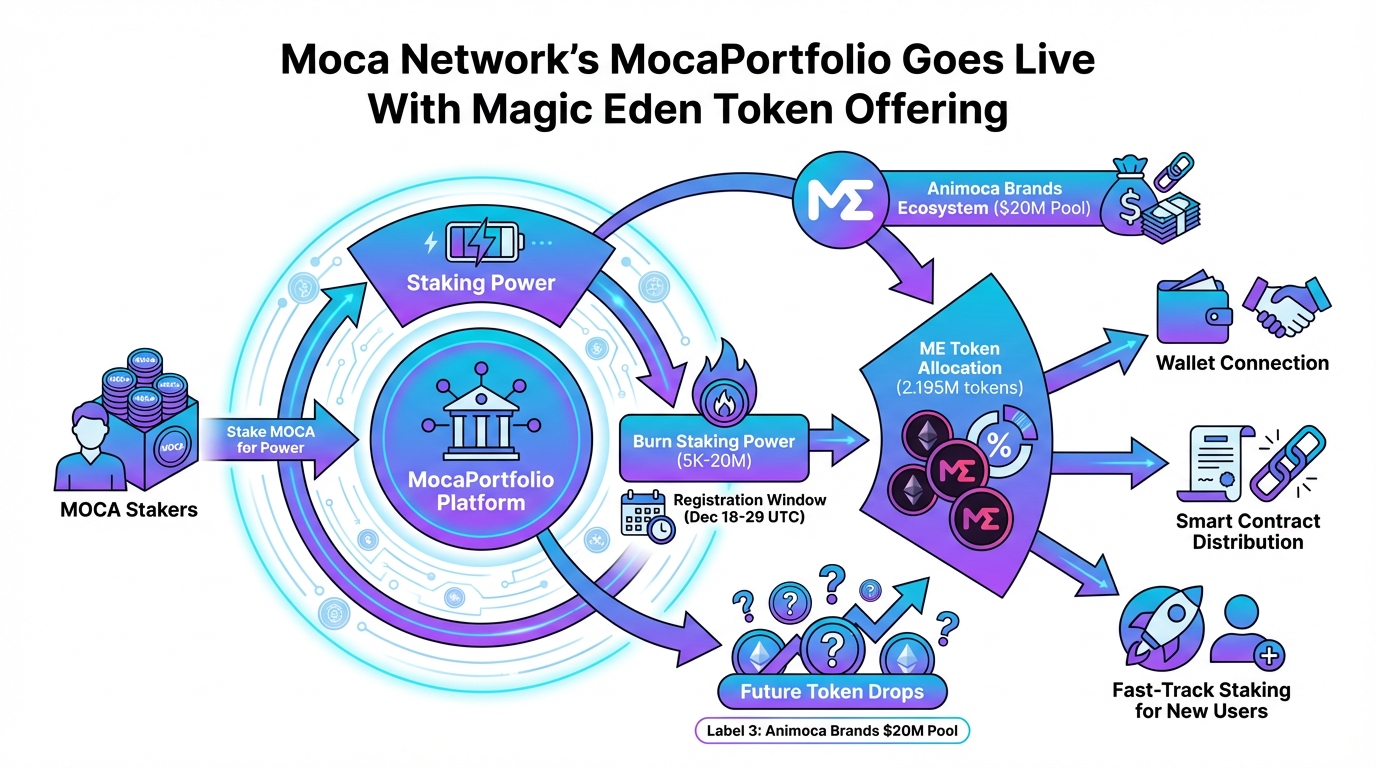
Lila: The diagram shows all these connected parts—blockchains, tokens, NFTs. But what’s the big shift from Web2 to Web3? I worry about things like data privacy or getting scammed.
Jon: Good concern—safety first. In Web2, your data is stored on company servers; they own it and can sell or censor it. Web3 flips this: everything runs on a blockchain, a public ledger like a shared notebook that no one can erase or fake. Ownership means you control your digital assets—NFTs are like deeds to virtual land or art. Censorship resistance? No single entity can shut it down. And composability is key: these pieces fit together like LEGO blocks across different projects. For MocaPortfolio, this means your MOCA holdings let you plug into Magic Eden’s token drop seamlessly, building real interoperability without a middleman.
Lila: That sounds empowering, but how does it actually work? Like, what’s under the hood for a beginner?
Jon: Let’s use metaphors. A wallet is your digital backpack—you store cryptocurrencies and NFTs there. To join something like MocaPortfolio, you’d connect your wallet (safely, via trusted interfaces) and stake your MOCA tokens, which is like lending your backpack to the community for rewards. The Magic Eden token offering is the prize: allocated tokens act as keys to new doors in the metaverse. No technical jargon yet—just remember, it’s all about true ownership. If you’re starting, practice with small amounts and learn about gas fees, which are like tolls for using the blockchain highway.
Lila: Got it. Now, what are some real-world uses? I don’t want to just theorize—give me examples.
Jon: Sure, let’s look at three concrete applications. First, in gaming: In Web3 games on Moca Network, your in-game items are NFTs you truly own. Win a sword? Sell it or use it in another game—no company can delete it. Second, digital identity: Tools like MocaProof (a beta feature from Moca) let you verify achievements privately, like a digital resume that’s yours forever. Third, community finance: With MocaPortfolio, staking your tokens gives access to offerings like Magic Eden’s, fostering shared growth. It’s like a neighborhood co-op where everyone benefits from collective investments, emphasizing learning over speculation.
Lila: Interesting. How does this stack up against traditional systems? A comparison would help solidify it.
Jon: Absolutely. Here’s a quick table to visualize the differences.
| Web2 | Web3 / Metaverse |
|---|---|
| Centralized control by companies (e.g., social media platforms own your data and can ban you) | Decentralized ownership (e.g., you control your NFTs and tokens on blockchain, resistant to censorship) |
| Limited interoperability (e.g., in-game items stuck in one app) | High composability (e.g., use assets across metaverse projects like Moca and Magic Eden) |
| Rely on trust in corporations for security | Trust-minimized via cryptography (e.g., secure wallets and smart contracts handle transactions) |
| Passive user role (e.g., consume content without ownership) | Active participation (e.g., staking in MocaPortfolio for token allocations and community decisions) |
Lila: This table makes it clearer—Web3 seems more user-centric. But are there risks? And what does this MocaPortfolio really enable in the long run?
Jon: Risks are real—volatility, scams, and the learning curve. Always verify projects, use hardware wallets for safety, and never share private keys. What MocaPortfolio enables is true digital empowerment: community members get $20 million in token allocations from Animoca’s ecosystem, starting with Magic Eden. It builds financial literacy and interoperability in the metaverse. Unresolved risks include regulatory changes or tech glitches, but the core promise is ownership and collaboration.
Lila: Wrapping up, if I’m intrigued, what’s next? Not jumping in blindly, but how to learn more thoughtfully?
Jon: Observe and educate yourself. Read about blockchain basics, explore open-source projects, and engage in communities without rushing. The metaverse is evolving—watch how launches like this shape it, focusing on understanding over action.
References & Further Reading
- Moca Network’s MocaPortfolio Goes Live With Magic Eden Token Offering
- MocaPortfolio Goes Live, Launches First Token Drop With Magic Eden (ME)
- Moca Network Unveils MocaPortfolio: $20M Token Distribution for MOCA Coin and NFT Holders
- Magic Eden and Mocaverse to Launch MagicMoca NFT Launchpad