
In my view PlanX 2026 reveals how trustless systems enable global asset mobility#Web3 #Decentralization
Quick Video Breakdown: This Blog Article
This video clearly explains this blog article.
Even if you don’t have time to read the text, you can quickly grasp the key points through this video. Please check it out!
If you find this video helpful, please follow the YouTube channel “MetaverseTrendsHub,” which delivers daily news.
https://www.youtube.com/@MetaverseTrendsHub
Read this article in your native language (10+ supported) 👉
[Read in your language]
PlanX 2026: Decoding the Architecture of Borderless Wealth in Web3
🎯 Difficulty: Advanced
💎 Core Value: Decentralization / Trust Minimization / Interoperability
👍 Recommended For: Crypto-native entrepreneurs, offshore wealth strategists, Web3 founders
Lila: Jon, with the PlanX 2026 conference in Dubai focusing on protecting and scaling borderless wealth through Web3 and the metaverse, I’m curious about the macro trends driving this. How does decentralization play into creating truly borderless financial systems, especially in a world still dominated by traditional regulations?
Jon: Excellent question, Lila. At its core, PlanX 2026 is highlighting a shift toward trust-minimized systems where individuals can manage wealth without relying on centralized intermediaries. Macro trends like increasing geopolitical instability and the rise of digital nomadism are pushing demand for borderless assets. Decentralization here means distributing control across a network via blockchain protocols, reducing single points of failure. Think of it as moving from a centralized bank vault to a distributed ledger where consensus algorithms ensure integrity. This minimizes trust in any one entity, enabling censorship-resistant wealth mobility—key for offshore strategies discussed at the conference.
From Web2 Limitations to Web3 Empowerment
Lila: That makes sense, but let’s contrast this with Web2. In traditional systems, wealth management is often siloed and vulnerable to censorship. How does Web3 evolve this, particularly in terms of ownership and composability?
Jon: Precisely. Web2 platforms, like centralized banking apps, treat user data and assets as proprietary, often subjecting them to arbitrary restrictions or data breaches. Web3 flips this by emphasizing user sovereignty through cryptographic ownership. Assets are tokenized on blockchains, verifiable via public keys, ensuring censorship resistance. Composability comes in via smart contracts—self-executing code that allows protocols to interoperate seamlessly, like building blocks in a global financial Lego set. For borderless wealth, this means scaling assets across jurisdictions without permission, a theme PlanX will likely explore through Web3 innovation.
Core Mechanisms: Smart Contracts and Interoperability
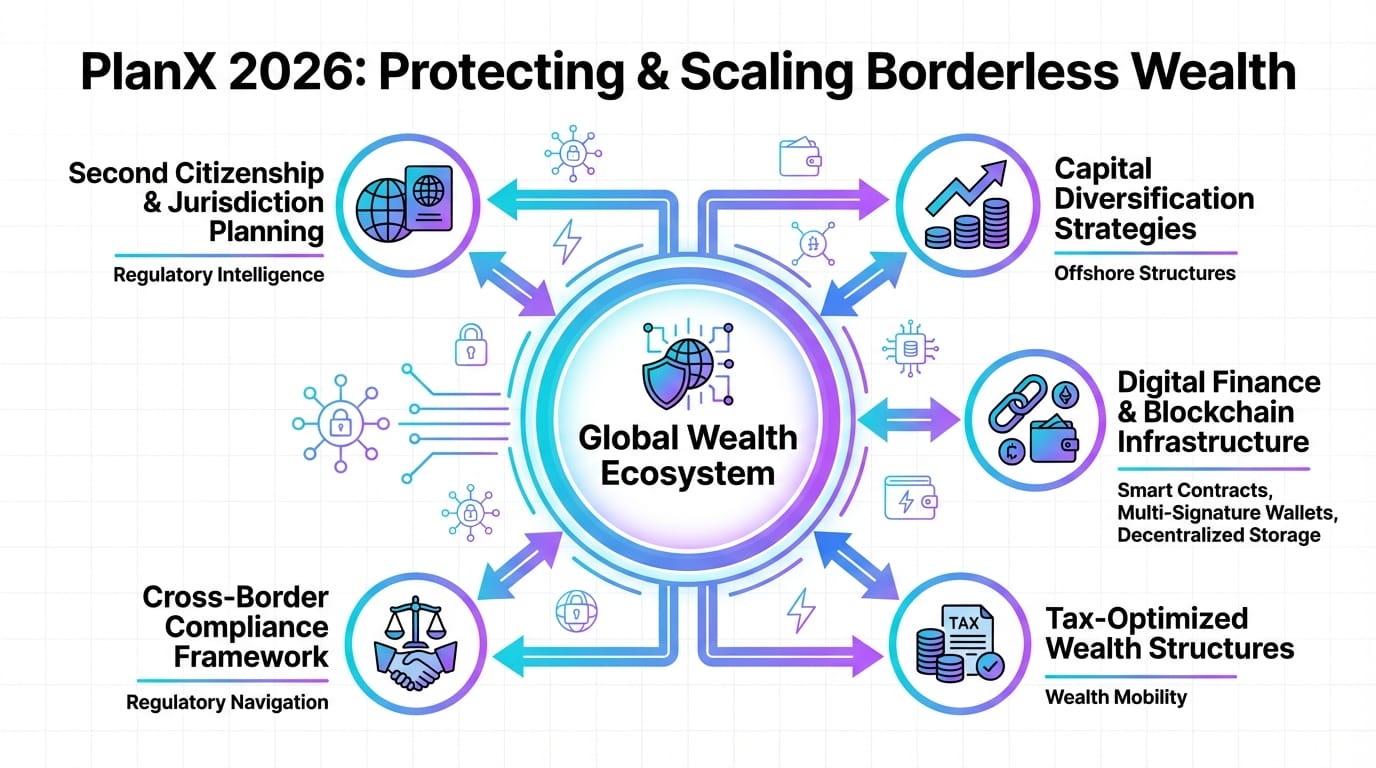
Lila: Diving deeper, what are the technical architectures enabling this at PlanX’s focus areas? For instance, how do smart contracts and consensus mechanisms support scaling borderless wealth?
Jon: Let’s break it down structurally. Smart contracts, as defined in Ethereum’s EVM (Ethereum Virtual Machine), are immutable code deployed on-chain, executing automatically when conditions are met—think of them as programmable escrow agents for wealth protection. For scaling, layer-2 solutions like rollups (e.g., Optimistic or ZK-rollups) batch transactions to reduce costs while inheriting security from the base layer. Consensus mechanisms, such as Proof-of-Stake in networks like Ethereum, ensure network agreement without central authority, crucial for trustless cross-border transfers. Interoperability protocols like Polkadot’s XCM or Cosmos’ IBC allow assets to move between chains, forming a metaverse of connected economies. This architecture underpins PlanX’s discussions on offshore wealth, where users can tokenize real-world assets (RWAs) for borderless scaling.
Lila: And what about ecosystem roles? Who are the key players in this decentralized setup?
Jon: In a Web3 ecosystem, roles are distributed: validators secure the network via staking, developers build dApps (decentralized applications) on standards like ERC-20 for tokens or ERC-721 for NFTs, and users act as governors in DAOs (Decentralized Autonomous Organizations). For borderless wealth, DAOs could manage collective offshore strategies, with token holders voting on decisions. This minimizes central control, aligning with PlanX’s emphasis on crypto-natives and entrepreneurs.
Real-World Use Cases in Borderless Wealth
Lila: To make this concrete, can you outline three specific applications that PlanX 2026 might highlight, tying into Web3’s technical strengths?
Jon: Absolutely. First, decentralized finance (DeFi) for wealth scaling: Protocols like Aave or Compound enable permissionless lending, where users collateralize assets across borders without KYC barriers, using oracle networks for real-time pricing. This protects wealth from inflation or seizures. Second, tokenized real-world assets (RWAs) in the metaverse: Platforms could tokenize passports or property deeds as NFTs, allowing seamless transfer in virtual economies, supported by interoperability standards for cross-chain verification. Third, DAO-governed offshore communities: Entrepreneurs at PlanX might discuss forming DAOs for collective investment in second citizenship programs, where governance tokens distribute decision-making, ensuring resilience against regulatory changes.
Web2 vs. Web3: A Comparative Analysis
| Web2 | Web3 / Metaverse |
|---|---|
| Centralized banks control asset custody, prone to censorship and single-point failures. | User-controlled wallets with cryptographic keys enable self-custody, resistant to censorship via distributed ledgers. |
| Data siloed in proprietary databases, limited interoperability. | Composable smart contracts allow seamless integration across protocols, fostering borderless ecosystems. |
| Wealth scaling limited by regulations and intermediaries, high fees for cross-border transfers. | Layer-2 scaling and cross-chain bridges enable efficient, low-cost global wealth mobility. |
| Governance by corporate boards, opaque decision-making. | DAO structures with on-chain voting provide transparent, community-driven governance. |
Lila: This table really highlights the shifts. But with all this potential, what risks remain unresolved in scaling borderless wealth through Web3?
Jon: Risks are inherent in any emerging architecture. Smart contract vulnerabilities, like reentrancy attacks, can lead to exploits if not audited rigorously—PlanX will likely stress best practices in security. Regulatory uncertainty persists, as governments adapt to tokenized assets, potentially imposing new frameworks. Scalability trade-offs in consensus can cause network congestion, and interoperability introduces bridge risks, such as those seen in past exploits. Overall, Web3 enables unprecedented wealth sovereignty, but it demands literacy in protocol design to navigate safely.
Wrapping Up: The Path Forward
Jon: In summary, PlanX 2026 underscores how Web3 architectures empower borderless wealth by decentralizing control, enhancing interoperability, and minimizing trust. It enables new paradigms in finance, identity, and community, but users must weigh risks like smart contract flaws and evolving regulations.
Lila: So, for someone attending or following PlanX, what’s the key takeaway? Should we just observe these trends or dive deeper into building?
Jon: Observe critically and learn the underlying protocols. Focus on understanding decentralization’s logic rather than rushing in—true scaling comes from informed participation in these ecosystems.
References & Further Reading
- PlanX 2026: Dubai Conference On Protecting And Scaling Borderless Wealth
- Ethereum Glossary: Key Web3 Terms
- CoinDesk: What is DeFi?
- Polkadot: What is Interoperability?
▼ AI tools to streamline research and content production (free tiers may be available)
Free AI search & fact-checking
👉 Genspark
Recommended use: Quickly verify key claims and track down primary sources before publishing
Ultra-fast slides & pitch decks (free trial may be available)
👉 Gamma
Recommended use: Turn your article outline into a clean slide deck for sharing and repurposing
Auto-convert trending articles into short-form videos (free trial may be available)
👉 Revid.ai
Recommended use: Generate short-video scripts and visuals from your headline/section structure
Faceless explainer video generation (free creation may be available)
👉 Nolang
Recommended use: Create narrated explainer videos from bullet points or simple diagrams
Full task automation (start from a free plan)
👉 Make.com
Recommended use: Automate your workflow from publishing → social posting → logging → next-task creation
※Links may include affiliate tracking, and free tiers/features can change; please check each official site for the latest details.