
Personally, Prediction Markets act as powerful truth engines for modern risk management.#PredictionMarkets #DeFi
Quick Video Breakdown: This Blog Article
This video clearly explains this blog article.
Even if you don’t have time to read the text, you can quickly grasp the key points through this video. Please check it out!
If you find this video helpful, please follow the YouTube channel “MetaverseTrendsHub,” which delivers daily news.
https://www.youtube.com/@MetaverseTrendsHub
Read this article in your native language (10+ supported) 👉
[Read in your language]
Delphi Digital’s Take: How Prediction Markets Could Reshape Institutional Trading by 2026
🎯 Difficulty: Advanced
💎 Core Value: Interoperability
👍 Recommended For: Crypto traders, institutional investors, DeFi enthusiasts
Lila: Jon, I’ve been reading about Delphi Digital’s report on prediction markets transforming institutional trading strategies in 2026. As someone experienced in Web3, what macro trends are driving this, and how does decentralization play into it?
Jon: Lila, the macro trends here stem from the maturation of crypto markets, where prediction markets are evolving from niche betting platforms into sophisticated financial tools. Delphi Digital highlights how these markets, built on decentralized protocols, enable institutions to hedge risks dynamically. At the core is trust minimization—instead of relying on centralized intermediaries like traditional exchanges, prediction markets use blockchain to ensure outcomes are resolved transparently via oracles and smart contracts. This reduces counterparty risk and fosters a more efficient, global marketplace. Think of it as shifting from bank-controlled derivatives to a permissionless system where incentives align participants toward truthful outcomes.
Lila: That makes sense on a high level, but I’m curious about how this evolves from Web2 systems. In traditional finance, we have centralized prediction tools like betting apps or futures markets—how does Web3 change that equation?
Jon: Excellent point. In Web2, centralized systems dominate: platforms like traditional stock exchanges or betting sites control data, user funds, and outcomes, often leading to censorship, high fees, or manipulation risks. Web3 prediction markets, conversely, emphasize user ownership through cryptographic keys, censorship resistance via distributed ledgers, and composability—meaning these markets can integrate seamlessly with other DeFi protocols. For instance, a prediction market on Ethereum could leverage ERC-20 tokens for liquidity pools, allowing automated trading strategies that interact with lending platforms like Aave. This creates a more resilient ecosystem where institutions aren’t locked into silos, but can build layered strategies across blockchains.
Lila: Composability sounds powerful. Can you break down the core mechanisms of these prediction markets in a Web3 context? How do they actually work under the hood?
Jon: Absolutely. At the architectural level, prediction markets rely on smart contracts to handle bets as conditional tokens—users buy shares representing ‘yes’ or ‘no’ outcomes for events, like election results or economic indicators. Decentralized oracles, such as Chainlink, feed real-world data to resolve these contracts trustlessly. Token design is key: often using augmented bonding curves or liquidity mining to incentivize participation. For institutional trading, this means scalable hedging—imagine a fund using these markets to offset portfolio risks via perpetual futures integrated with prediction logic. The decentralization logic minimizes single points of failure, with consensus mechanisms like proof-of-stake ensuring network security. It’s all about creating incentive-aligned systems where truth emerges from collective betting, not top-down decrees.
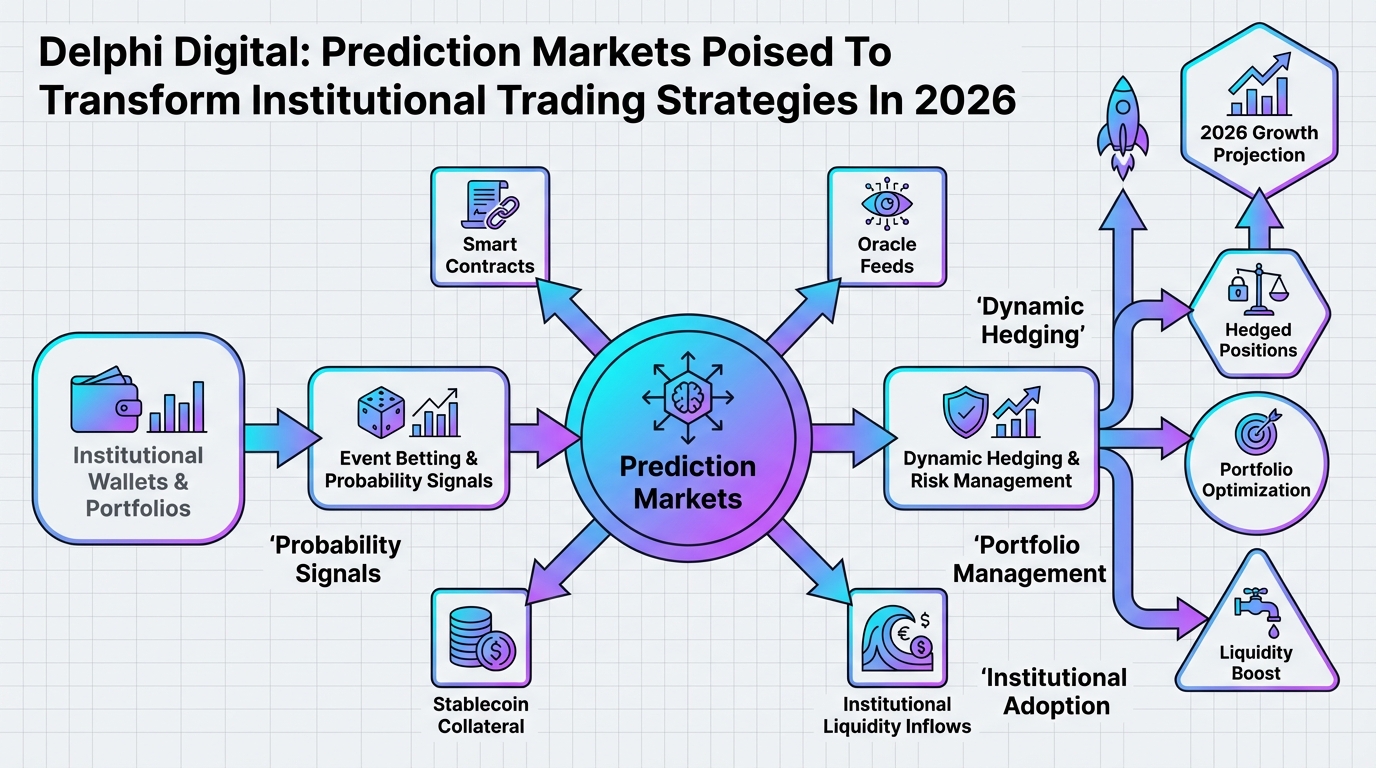
Lila: Fascinating—seeing that diagram helps visualize the layers. Now, for practical applications, what are some concrete use cases where prediction markets could transform institutional strategies?
Jon: Let’s dive into three key ones. First, in finance: institutions can use prediction markets for event-driven hedging, like betting on interest rate changes to dynamically adjust portfolios. This integrates with DeFi for automated rebalancing via smart contracts, offering better liquidity than traditional options. Second, in risk management: think supply chain disruptions—markets could predict outcomes based on global events, allowing firms to hedge against volatility in commodities or currencies through tokenized derivatives. Third, in data aggregation: these markets act as ‘truth engines,’ crowdsourcing accurate forecasts for strategic planning, such as market sentiment analysis. Delphi Digital notes this could mainstream them as derivatives, with interoperability across chains enhancing ecosystem roles for institutional adoption.
Lila: Those examples highlight the potential. To make it clearer, how would you compare traditional Web2 services to these Web3 prediction market solutions?
Jon: A structured comparison reveals the shifts clearly. Here’s a table outlining the differences:
| Web2 | Web3 / Metaverse |
|---|---|
| Centralized control by platforms like betting sites or exchanges, prone to manipulation and high fees. | Decentralized protocols with smart contracts ensuring transparent resolution and user-owned assets. |
| Limited global access, often restricted by regulations or geography. | Permissionless participation, enabling 24/7 borderless trading with composable tools. |
| Data and outcomes controlled by intermediaries, risking censorship. | Oracle-fed, incentive-driven truth discovery, resistant to single-entity interference. |
| Static hedging tools with slow settlement. | Dynamic, automated strategies via tokenomics and interoperability for real-time risk management. |
Lila: The table really drives home the advantages. Wrapping up, what does this all enable for the future, and what risks should we be mindful of?
Jon: In summary, prediction markets enable a paradigm where institutions can leverage decentralized architectures for more efficient, truthful, and integrated trading strategies, as Delphi Digital predicts for 2026. They foster trust-minimized ecosystems that could redefine finance through better hedging and data accuracy. However, unresolved risks include oracle failures, regulatory hurdles—especially around securities laws—and scalability issues on base layers. It’s crucial to approach with a focus on understanding protocol designs rather than speculation.
Lila: Thanks, Jon. This leaves me pondering: as these markets evolve, how can readers stay informed without getting lost in the hype?
Jon: Stay curious, Lila—dive into whitepapers, observe on-chain data, and engage with communities. Prioritize literacy over quick gains; the real value is in grasping the underlying tech.
References & Further Reading
- Delphi Digital: Prediction Markets Poised To Transform Institutional Trading Strategies In 2026
- Prediction Markets: A World Truth Engine in Beta – Delphi Digital
- Crypto market predictions for 2026: Coinbase Institutional highlights the next big things