
Read this article in your native language (10+ supported) 👉
[Read in your language]
Solv Protocol’s FROST2 Upgrade for SolvBTC: Institutional Bitcoin Security Without the Hype
🎯 Difficulty: Advanced
💎 Core Value: Interoperability / Digital Ownership
👍 Recommended For: Web3 Natives, DeFi Architects, Institutional Researchers
Lila: Everyone’s calling FROST2 a game-changer for Bitcoin execution, like it’s suddenly institutional-ready overnight. Isn’t this just more hype around threshold signatures?
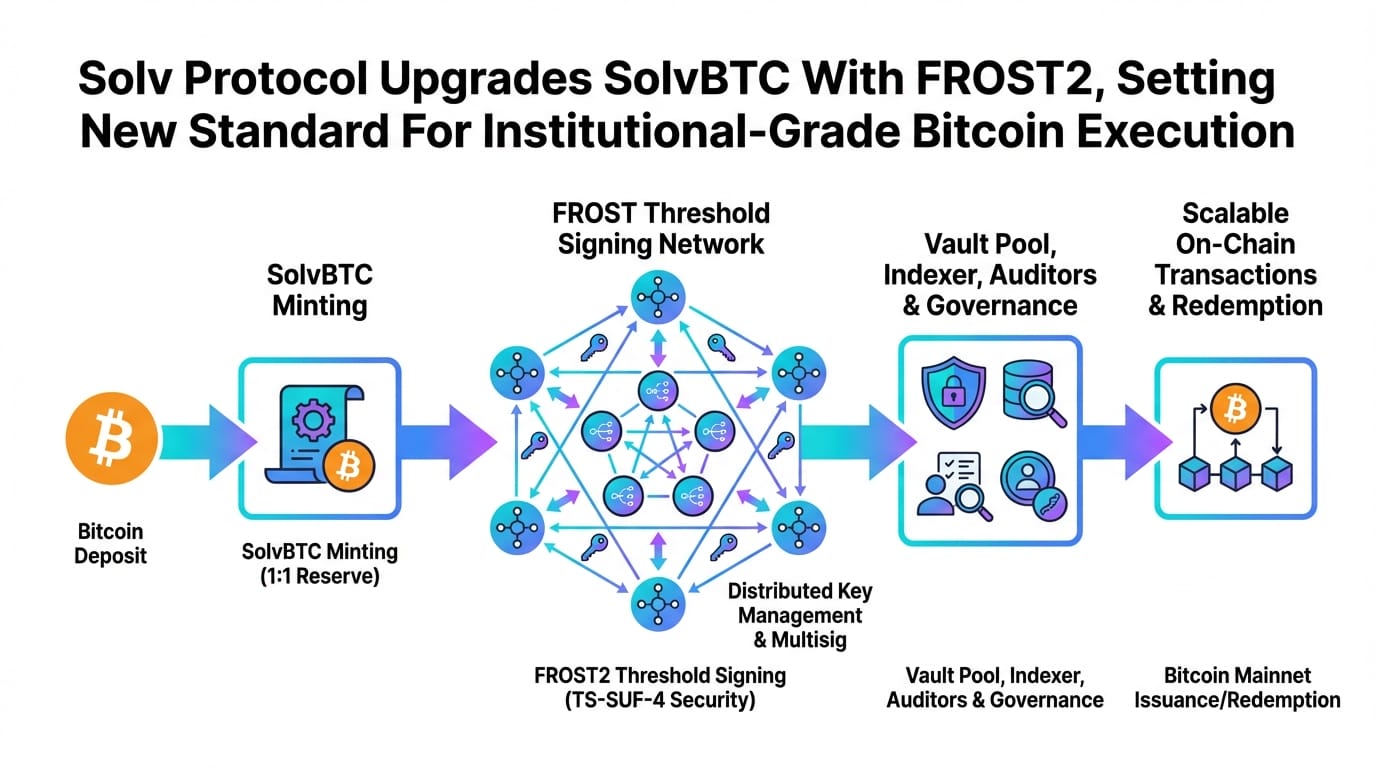
Jon: The myth is that FROST2 magically solves Bitcoin’s programmability issues—it’s not a smart contract layer, it’s a threshold signature scheme (t-of-n signing where any t parties can sign without reconstructing the full private key, originally from Zcash research in 2020). Solv Protocol upgraded SolvBTC by shifting from their Staking Abstraction Layer (SAL) to a FROST-based network with Vault Pool, Indexer, Auditors, and governed smart contracts for distributed key management and auditable Bitcoin mainnet transactions.[Important Insight] This sets a standard for scalable, governable BTC issuance/redemption without Bitcoin forks, targeting $1B+ AUM with TS-SUF-4 security.[Important Insight][1][2]
Lila: With Bitcoin’s macro trends leaning toward yield generation, how does this fit into broader decentralization and trust minimization?
Jon: Bitcoin’s non-programmable nature locks $1T+ in idle capital; SolvBTC is a 1:1 backed tokenized BTC (largest on BNB Chain, 90% utilized on ListaDAO) that bridges to EVM chains like Ethereum, BNB, NEAR for DeFi composability while anchoring custody on Bitcoin mainnet. The FROST2 upgrade enhances trust minimization via distributed signing (no single key holder), policy-based approvals, audit trails, and time-delayed upgrades—mirroring TradFi risk controls without central points of failure.[1][2][5]
Lila: Walk me through the Web2 to Web3 evolution here—centralized custodians vs. this decentralized setup.
Jon: Web2 relies on centralized exchanges for BTC yield (e.g., lending on CeFi), exposing users to insolvency risks like FTX. Web3 via SolvBTC enables composability (SolvBTC plugs into DeFi for staking/lending) with censorship resistance (on-chain Bitcoin signatures) and true ownership (redeem 1:1 to BTC). Breaks occur in cross-chain bridges or oracle failures, but FROST mitigates via multi-party computation.[1][5][6]
Lila: Since this touches Bitcoin DeFi, any reality checks on scalability or interoperability?
Jon: Bitcoin’s 10-min blocks create latency for state sync in high-throughput DeFi; FROST2 signing distributes coordination off-chain while settling standard sigs on-chain, but throughput caps at Bitcoin’s limits—mitigated by indexers for query efficiency. Interoperability standards like ERC-3525 (Solv’s semi-fungible token) enable BTC portability across EVMs, though sharding in NEAR adds async coordination challenges.[1][2][5]
Lila: What are the core mechanisms powering this upgrade?
Jon: FROST (Flexible Round-Optimized Schnorr Threshold) uses ECDSA-compatible signatures: key gen splits private key into shares across nodes; signing rounds aggregate partial sigs without key exposure. Solv’s FROST2 hits TS-SUF-4 (top security vs. subtle failures). Integrated with Vault Pool (secure storage), Indexer (transaction tracking), Auditors (compliance), and smart-contract governance for mint/burn flows.[1][2]
Lila: Give me three use cases, with one deep dive.
Jon: 1) Liquid staking: BTC holders mint SolvBTC for yield on BNB/NEAR DeFi without losing liquidity. 2) Institutional treasury: Banks use for auditable BTC ops with TradFi-like controls. 3) Mini Case Study: Cross-Chain Yield Optimization—Goal: Maximize idle BTC returns; Works: Deposit BTC → FROST-signed mint SolvBTC → Stake as xSolvBTC on ListaDAO (90% util) or NEAR; Trade-offs: Gas fees vs. yield, bridge risks; Common failure: Oracle downtime halting redemptions, mitigated by multi-oracle setups and audits.[1][5]
Design Trade-off 1: Distributed Custody vs. Signing Latency
FROST eliminates single keys but requires t-of-n coordination rounds (2-3 typically), adding 10-30s latency vs. hot wallets. Scalable for institutions via parallel signers, but real-time trading suffers.
So the real question is: Do you prioritize ironclad security or sub-second execution?
Design Trade-off 2: Composability vs. Attack Surface
SolvBTC’s ERC-3525 enables DeFi plugins, but each integration expands smart contract risks (reentrancy, flash loans). Governance scopes mitigations via auditors.
So the real question is: How much audit coverage justifies the yield upside?
| Feature | Web2 | Web3 / SolvBTC |
|---|---|---|
| Identity/Login | Email/password, KYC by custodian | Wallet signatures, no central KYC |
| Asset Ownership | IOU on exchange ledger | 1:1 BTC-backed on-chain |
| Governance/Rules | Centralized policy changes | Scoped smart contracts + FROST governance |
| Payments/Fees | Platform spreads/custodial fees | On-chain gas + yield shares |
| Moderation/Safety | Central blacklists/freezes | Auditors + multi-sig thresholds |
| Portability/Interoperability | Locked in platform | ERC-3525 across EVM chains |
Mini Glossary
- FROST2: Threshold signature protocol for multi-party ECDSA signing without key exposure; like a safe needing 3-of-5 keys, but mathematically secure.[1]
- SolvBTC: 1:1 tokenized Bitcoin for DeFi; think BTC wrapped in a portable, yield-bearing container across chains.[4][5]
- Threshold Signature Scheme (TSS): Crypto primitive for distributed signing; vending machine where partial approvals aggregate to one transaction.[1][2]
Jon: This enables resilient Bitcoin execution at scale—$1B AUM, institutional workflows via FROST2’s auditability and governance—but unresolved risks include threshold collusion or Bitcoin congestion impacting redemptions.
Lila: So where does real adoption hinge—better bridges or provable security models?
Try This Next (No Finance, Just Literacy)
- Read EIP-3525 spec to grasp semi-fungible tokens for RWA composability.
- Study FROST paper on ePrint for threshold crypto trade-offs vs. basic multisig.
- Trace a SolvBTC mint flow on BNBScan to audit custody assumptions.
References & Further Reading
- Solv Protocol Upgrades SolvBTC With FROST2, Setting New Standard For Institutional-Grade Bitcoin Execution
- MEXC News on SolvBTC FROST Upgrade[1]
- Solv Protocol Documentation[6]
- Solv Protocol Overview[4]
▼ AI tools to streamline research and content production (free tiers may be available)
Free AI search & fact-checking
👉 Genspark
Recommended use: Quickly verify key claims and track down primary sources before publishing
Ultra-fast slides & pitch decks (free trial may be available)
👉 Gamma
Recommended use: Turn your article outline into a clean slide deck for sharing and repurposing
Auto-convert trending articles into short-form videos (free trial may be available)
👉 Revid.ai
Recommended use: Generate short-video scripts and visuals from your headline/section structure
Faceless explainer video generation (free creation may be available)
👉 Nolang
Recommended use: Create narrated explainer videos from bullet points or simple diagrams
Full task automation (start from a free plan)
👉 Make.com
Recommended use: Automate your workflow from publishing → social posting → logging → next-task creation
※Links may include affiliate tracking, and free tiers/features can change; please check each official site for the latest details.