Read this article in your native language (10+ supported) 👉
[Read in your language]
Why the Next Evolution of Money Runs on State Channels and Blockchain Rails
Web3 Intel Snapshot
🎯 Difficulty: PATH B – Web3 Native (Technical architecture focus for experienced readers)
💎 Core Value: Trust minimization / Programmable settlement / On-chain transparency
👍 Recommended For: Blockchain engineers, DeFi builders, fintech architects tracking payment protocol evolution
Lila: Everyone’s hyping blockchain as the instant global money fix, but isn’t it just volatile crypto replacing slow banks with something equally unreliable?
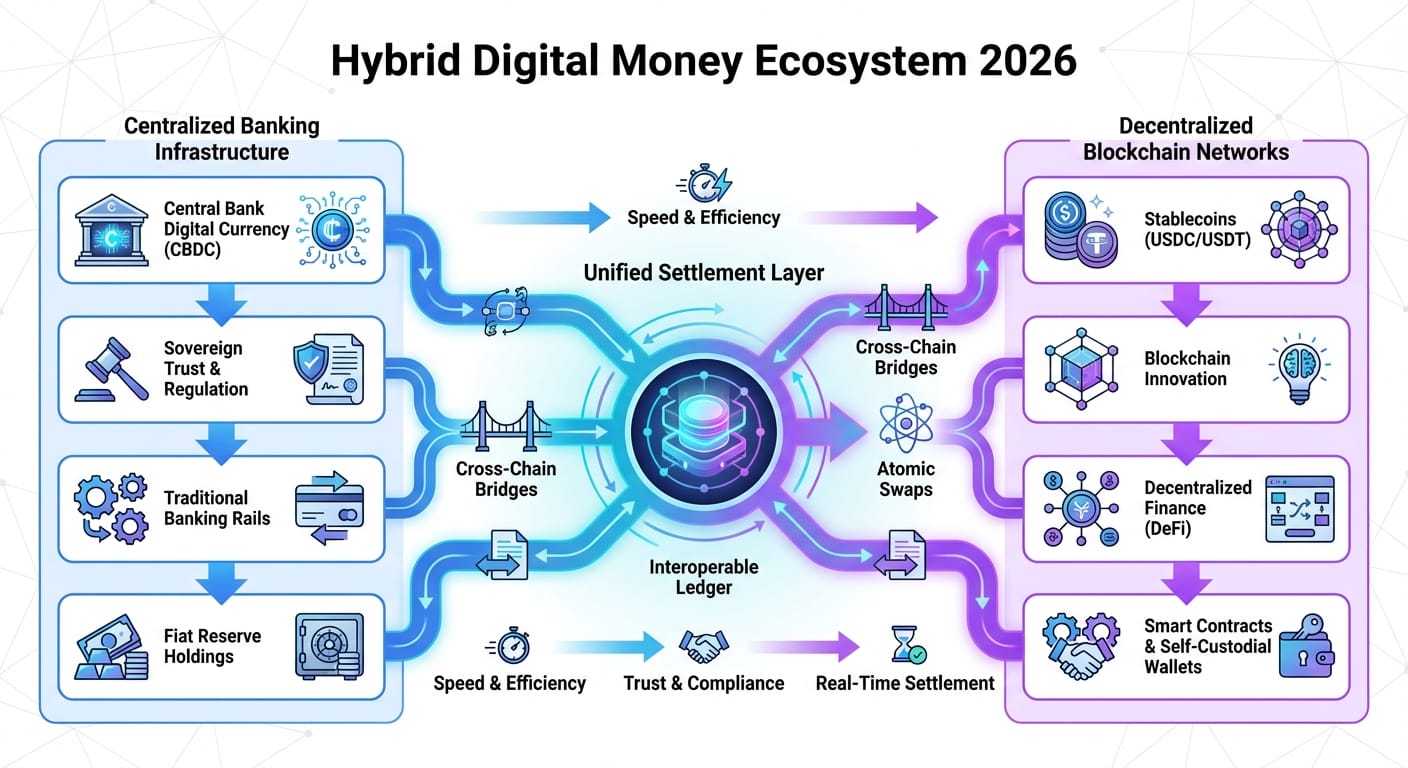
Jon: That’s the vaporware pitch, Lila—pure shill. The reality is payment rails evolving through precise protocol layers: traditional batch systems like ACH/SEPA versus blockchain’s real-time settlement via stablecoins on L1s like Ethereum or L2s like Arbitrum. The title nails it—state channels (off-chain transaction streams anchored by on-chain smart contracts) bridge sovereign “state” rails (FedNow, RTP) with decentralized ones, minimizing trust via cryptographic finality.[Important Insight: True evolution isn’t crypto hype; it’s composable rails where stablecoin throughput hits trillions annually on Solana/Base while preserving auditability]
Lila: Macro trends point to this hybrid model, but how do state rails (central bank systems) and blockchain rails actually interop without reintroducing intermediaries?
Jon: Decentralization here means trust-minimized settlement: state rails like RTP/FedNow handle fiat legs with 24/7 irreversibility, while blockchain rails (Ethereum, Solana) enable programmable value transfer via stablecoins (USDC/USDT). Architecture pivots on bridges—custodial off-ramps convert on-chain stablecoins to fiat rails, but purer designs use atomic swaps or threshold signatures (e.g., EIP-4337 account abstraction for seamless wallet-to-bank flows). The protocol stack: L1 consensus for finality, L2 rollups for throughput, state channels for off-chain micropayments settled in one tx.[1][4]
Lila: Web2 payments feel locked-in—show me where centralized rails fracture versus Web3’s composability.
Jon: Web2 relies on siloed intermediaries (ACH batching: 1-3 days; SWIFT messaging: correspondent risk); Web3 composes via shared ledgers—send USDC on Arbitrum, auto-escrow via smart contract, settle cross-chain via bridges like LayerZero. Ownership is bearer (your private key = control), censorship-resistant (no freeze like PayPal), but breaks on oracle dependencies or sequencer centralization in L2s.[4][5]
Design Trade-off 1: Throughput vs Decentralization
High-TPS chains like Solana (65k TPS) prioritize speed via Proof-of-History but risk outages from validator clustering; Ethereum L2s (Optimism: 2k TPS) trade native finality for sequencer trust, mitigated by fault proofs (EIP-4844 blobs).[4]
So the real question is: do you optimize for retail UX or institutional auditability?
Lila: For payments in metaverses or high-interaction apps, what are the hard limits?
Jon: Metaverse reality check: realtime networking/latency—on-chain state sync lags (Ethereum: 12s blocks), so state channels offload (Lightning: instant P2P, final via on-chain).[1] Identity/portability—ERC-4361 SIWE enables avatar cross-world migration (glTF standards for assets), but wallet custody fragments UX vs centralized logins.[4]
Lila: Break down the core mechanics—how do state channels fit the rails?
Jon: State channels: multi-sig smart contract locks funds (e.g., 2-of-2 on Bitcoin), parties sign off-chain state updates (infinite txs), broadcast final net settlement. Consensus via watchtowers prevents fraud; scales Lightning to millions TPS off-chain. Interop via bridges/indexers (The Graph for events).[1][4]
Lila: Real use cases—gaming payments, cross-border trade, micropayments?
Jon: 1) Gaming: streaming payments via state channels. 2) Identity-anchored payroll on stablecoins. 3) Mini Case Study: Cross-Border Freelance—Goal: instant USD payout sans FX fees; Works: freelancer receives USDC on Base L2 (0.01¢ fee), auto-converts via Circle API to RTP rail; Trade-offs: L2 liquidity vs L1 security; Failure: sequencer outage halts (mitigate: multi-L2).[4][5]
Design Trade-off 2: Transparency vs Privacy
Blockchain rails offer real-time audit trails (Arkham tracing), but public mempools leak strategies; state channels hide intermediates, yet disputes go on-chain exposing nets.[1][4]
So the real question is: does compliance trump competitive edge?
| Feature | Web2 Rails (ACH/SWIFT) | Web3 Rails (Blockchain/State Channels) |
|---|---|---|
| Identity/Login | Centralized (email/KYC via banks) | Self-sovereign (wallets, ERC-4361 SIWE) |
| Asset Ownership | Custodial (bank holds) | Bearer (private key control) |
| Governance/Rules | Central authority (Fed/Visa) | Smart contracts/consensus |
| Payments/Fees | Batch, 1-3 days, % fees | Near-instant, sub-cent (L2s) |
| Moderation/Safety | Platform freeze/blacklist | Immutable + watchtowers |
| Portability/Interoperability | Siloed networks | Cross-chain bridges/standards |
Mini Glossary
- State Channels: Off-chain protocol for infinite P2P txs settled once on-chain—like a private ledger tab closed at bar end.[1]
- Payment Rails: Networks moving value (ACH vs Ethereum)—think highways for money, decentralized ones 24/7.[2][4]
- Stablecoins: Pegged crypto (USDC to $1)—digital cash on blockchain, volatility-proof for rails.[4]
Jon: This enables global, programmable money at machine speed, but unresolved: stablecoin issuer risk, regulatory flux, L2 extraction attacks.
Lila: If rails hybridize state and chain, how do we audit trust assumptions long-term?
Try This Next (No Finance, Just Literacy)
- Trace a USDC tx on Etherscan vs Base—map sequencer vs validator trust.
- Read EIP-4337: model account abstraction’s impact on rail custody.
- Simulate Lightning channel open/close—test liveness assumptions offline.
References & Further Reading
- Why The Next Evolution Of Money Will Be Built On State And Blockchain Rails
- Lightspark: State Channels Explained[1]
- Arkham Research: On-Chain Payment Rails[4]
- Spreedly: Payment Rails Overview[2]
▼ AI tools to streamline research and content production (free tiers may be available)
Free AI search & fact-checking
👉 Genspark
Recommended use: Quickly verify key claims and track down primary sources before publishing
Ultra-fast slides & pitch decks (free trial may be available)
👉 Gamma
Recommended use: Turn your article outline into a clean slide deck for sharing and repurposing
Auto-convert trending articles into short-form videos (free trial may be available)
👉 Revid.ai
Recommended use: Generate short-video scripts and visuals from your headline/section structure
Faceless explainer video generation (free creation may be available)
👉 Nolang
Recommended use: Create narrated explainer videos from bullet points or simple diagrams
Full task automation (start from a free plan)
👉 Make.com
Recommended use: Automate your workflow from publishing → social posting → logging → next-task creation
※Links may include affiliate tracking, and free tiers/features can change; please check each official site for the latest details.