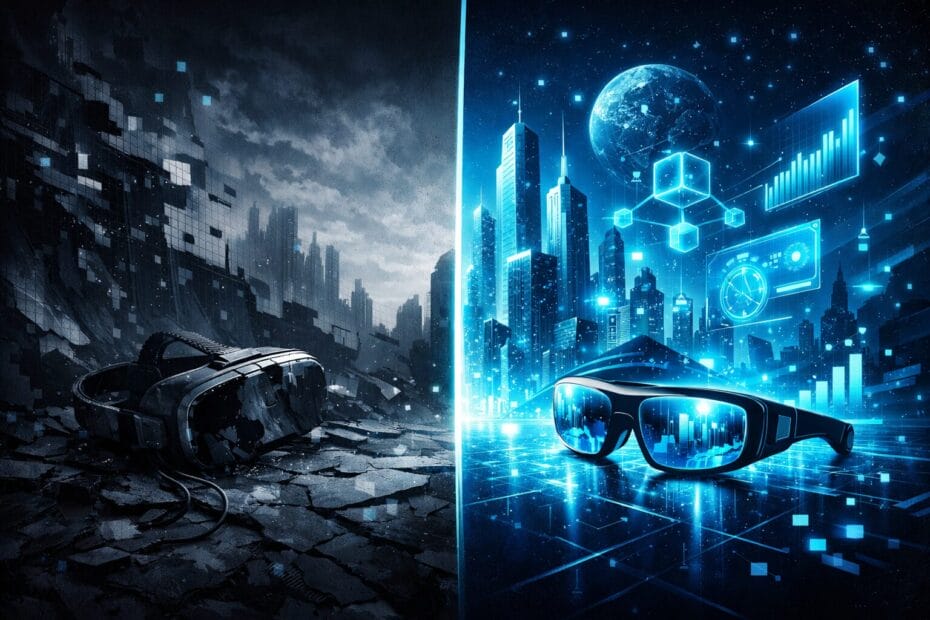
The metaverse was supposed to be the future. Then, seemingly overnight, it became a punchline. Meta slashed 1,500 Reality Labs jobs. Three first-party VR studios — Twisted Pixel, Armature, and Sanzaru — were shuttered. Horizon Workrooms, Meta’s flagship VR collaboration space, went dark. The media declared it dead.
But here’s what the obituaries missed: while one vision of the metaverse was collapsing, a far more compelling one was being built. Not in closed virtual worlds, but in open spatial computing, AI-native experiences, and tokenized digital economies. 2026 isn’t the year the metaverse died. It’s the year it grew up.
That’s why MetaverseTrendsHub is back — to track the real transformation happening beneath the headlines.
The Great Pivot: Meta Retreats, the Market Advances
In January 2026, Meta confirmed layoffs of over 1,500 positions — roughly 10% of its Reality Labs division’s 15,000-person workforce. The cuts disproportionately hit VR teams while sparing the wearables and smart glasses groups. The message was clear: Zuckerberg’s trillion-dollar bet on virtual reality was being quietly downgraded.
The three studio closures — Twisted Pixel (Deadpool VR), Armature Studio (Resident Evil 4 VR), and Sanzaru Games (Asgard’s Wrath) — removed some of the best VR content creators from Meta’s ecosystem. Meanwhile, the company doubled down on Ray-Ban Meta Display glasses ($799, perpetually sold out) and AI wearables, signaling a shift from immersive VR to always-on AR.
This isn’t just a Meta story. It’s an industry-wide realignment from the “strap a screen to your face” model toward lightweight, context-aware, ambient computing.
The Hardware Explosion Nobody’s Talking About
While the narrative focused on Meta’s retreat, 2026 quietly became the most competitive year in XR hardware history. The contenders:
Valve Steam Frame — The most anticipated VR headset of the year. A standalone, wireless device that can natively run and stream your entire Steam library. Dual 2160×2160 LCDs, 110° FOV, eye tracking with dynamic foveated rendering, and full backwards compatibility with Quest apps via OpenXR. Marked “coming soon” on Steam as of March 2026, with an estimated price of $600–$900.
Samsung Galaxy XR — The first headset built on Android XR, the platform co-developed by Samsung, Google, and Qualcomm. Launched October 2025 at $1,799, it represents the premium end of the spectrum — with Gemini AI embedded at the system level for voice, vision, and gesture interaction.
XREAL Project Aura — The first tethered AR glasses running Android XR, built in partnership with Google. A 70°+ optical see-through display powered by a dual-chip design (XREAL X1S + Snapdragon), with 6DoF tracking and Gemini integration. Expected in 2026, backed by $100 million in fresh funding.
Snap Spectacles 2026 — Snap’s boldest bet yet: standalone AR glasses with four spatial cameras, Snap OS 2.0 with AI, real-time translation, and shared AR experiences. Targeting the consumer and creative markets.
The Metaverse Landscape in 2026
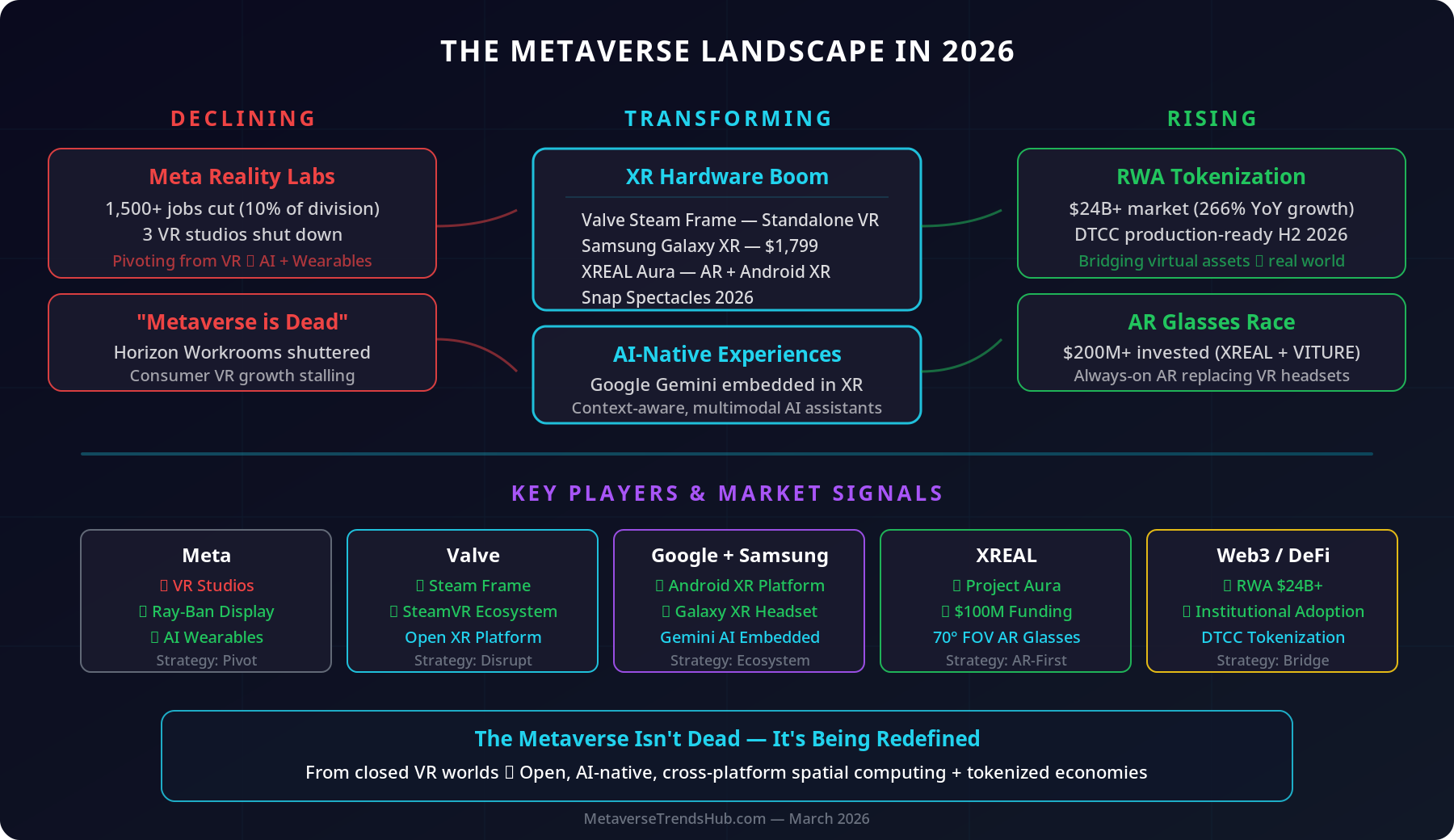
The diagram below maps the forces reshaping the metaverse in 2026 — what’s declining, what’s transforming, and what’s rising.
AI Is the New Operating System for XR
The single biggest shift in 2026’s XR landscape isn’t a new headset — it’s that AI is now the default interface layer. Google’s Android XR platform has Gemini embedded from day one. Every new device — from Samsung Galaxy XR to XREAL Aura — ships with context-aware AI that understands what you see, hears what you say, and responds with spatial awareness.
This changes the interaction model entirely. Instead of navigating menus in 3D space, you simply speak or gesture. The AI handles the rest. Real-time translation, object recognition, contextual overlays — these aren’t experimental features anymore. They’re baseline expectations for 2026 hardware.
The implications are profound: XR devices are no longer just displays. They’re wearable AI computers that understand the world around you.
Web3’s Quiet Revolution: $24 Billion in Tokenized Real-World Assets
While VR grabbed headlines (and lost them), Web3 infrastructure has been building something far more durable. Tokenized real-world assets (RWAs) surpassed $24 billion in total value by February 2026 — a staggering 266% year-over-year growth.
The DTCC (Depository Trust & Clearing Corporation) — the backbone of traditional U.S. capital markets — announced its tokenization service will be production-ready in the second half of 2026. When the institution that clears $2.5 quadrillion in securities annually embraces tokenization, it’s no longer a crypto experiment. It’s financial infrastructure.
For the metaverse, this matters because tokenization is the bridge between virtual economies and real-world value. Digital land, in-game assets, virtual fashion, and creator royalties can now be backed by, or connected to, tangible financial instruments. The metaverse economy doesn’t need to be a speculative bubble — it can be anchored to real value.
So Is the Metaverse Dead?
No. But the metaverse that was sold to us — a single, unified virtual world controlled by one company — probably is. And that’s a good thing.
What’s replacing it is something more like the internet itself: open, interoperable, and built by many. Android XR is open-source. Valve’s Steam Frame supports OpenXR. Tokenized assets move across chains. AI assistants work across platforms.
The metaverse of 2026 isn’t a place you “go to.” It’s a layer that overlays your reality — through lightweight AR glasses, AI companions, and tokenized digital ownership. It’s less dramatic than the VR utopia we were promised, but infinitely more useful.
Why MetaverseTrendsHub Is Back
This is exactly the kind of transformation that needs clear, honest coverage. Not hype. Not doom. Just the facts, the context, and the implications.
MetaverseTrendsHub is relaunching to deliver exactly that:
- Hard facts first — every claim backed by data and primary sources
- Business impact — who wins, who loses, and what it means for builders
- Technical depth — the architecture, protocols, and platforms that matter
- Cultural pulse — how these technologies are actually being used by real people
Whether you’re a developer, creator, investor, or simply curious about where immersive technology is heading — this is your daily portal to the evolving metaverse.
Welcome back. The real story is just beginning.