Personally, tokenized stock futures shift control to users via onchain self-custody.#DeFi #Web3
Quick Video Breakdown: This Blog Article
This video clearly explains this blog article.
Even if you don’t have time to read the text, you can quickly grasp the key points through this video. Please check it out!
If you find this video helpful, please follow the YouTube channel “MetaverseTrendsHub,” which delivers daily news.
https://www.youtube.com/@MetaverseTrendsHub
Read this article in your native language (10+ supported) 👉
[Read in your language]
Decoding Bitget’s Global Stock Futures Championship: Web3 Trading Architectures and Tokenized Assets
🎯 Difficulty: Advanced
💎 Core Value: Tokenized Real-World Assets / Decentralized Finance / Trust-Minimized Trading
👍 Recommended For: Experienced DeFi traders, Blockchain architects, Financial analysts exploring crypto-TradFi convergence
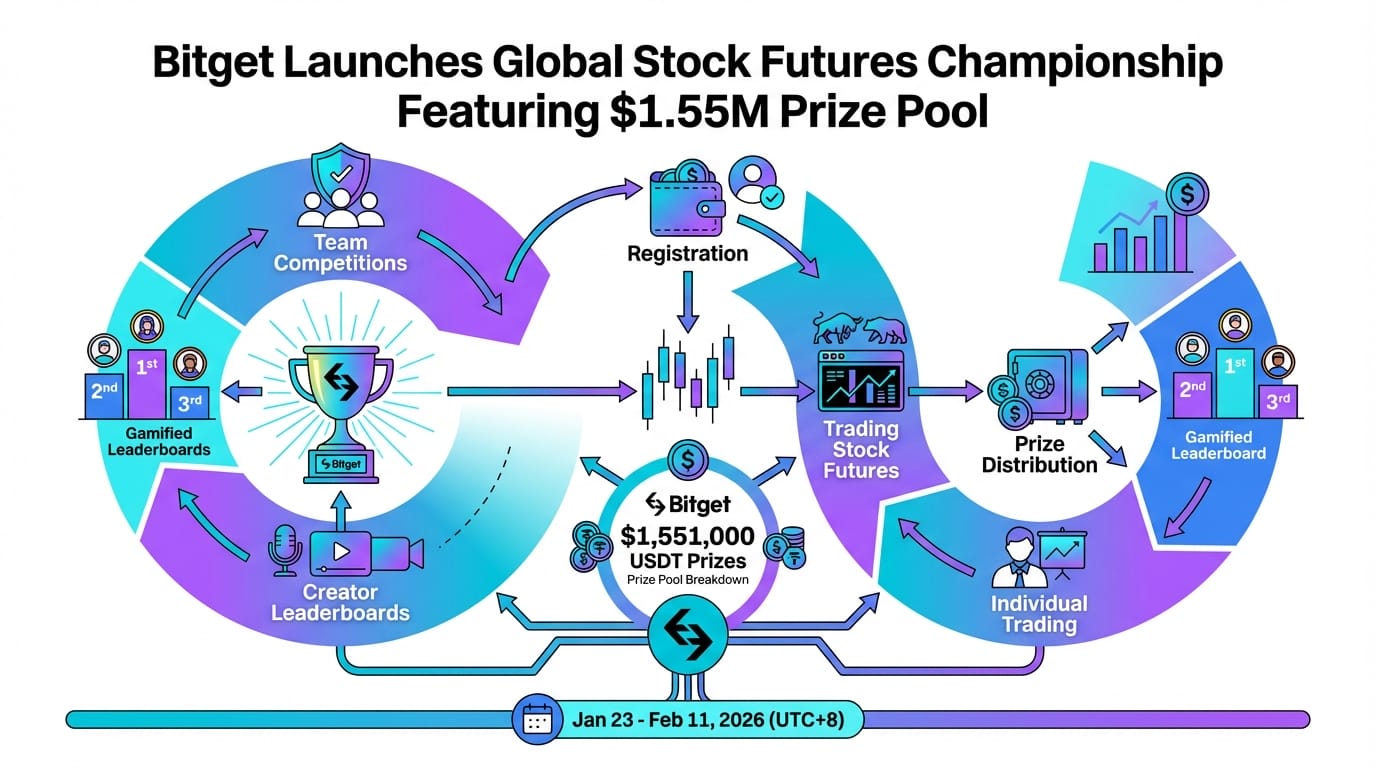
Lila: Jon, with announcements like Bitget’s Global Stock Futures Championship offering a $1.55M prize pool, I’m curious about the broader macro trends. How is Web3 facilitating the merge between traditional stock markets and cryptocurrency ecosystems?
Jon: Excellent question, Lila. We’re witnessing a pivotal macro trend: the convergence of centralized finance (CeFi) and decentralized finance (DeFi) through universal exchanges. Platforms like Bitget are pioneering this by tokenizing traditional assets, such as US stock indices, into onchain perpetual futures. This relies on decentralization logic to minimize trust—users interact via smart contracts rather than relying on intermediaries. For instance, trust minimization is achieved through protocols like automated market makers (AMMs) and oracle networks for price feeds, ensuring verifiability without a central authority. In the context of this championship, it highlights how Web3 enables global, permissionless participation in equity derivatives, potentially disrupting traditional brokerages by reducing barriers like geographic restrictions or high entry costs.
Lila: That makes sense, but how does this evolution from Web2 to Web3 change the game for trading systems? What are the key differences in terms of ownership and resilience?
Jon: The shift from Web2 to Web3 fundamentally alters system design. In Web2, centralized platforms like traditional stock exchanges control user data and assets, leading to single points of failure and vulnerability to censorship—think regulatory shutdowns or account freezes. Web3, by contrast, emphasizes user ownership through cryptographic keys, where assets are held in self-custodial wallets. This provides censorship resistance, as transactions are validated by distributed networks like Ethereum or layer-2 solutions. Composability is another hallmark: tokenized assets can be integrated across protocols, allowing for complex strategies like collateralizing stock futures in DeFi lending pools. For something like Bitget’s championship, this means participants can trade tokenized Tesla or Apple futures onchain, with settlements handled by smart contracts, fostering a more resilient and inclusive ecosystem.
Core Mechanisms of Tokenized Stock Futures in Web3
Lila: Diving deeper, can you break down the technical architecture behind these tokenized stock futures? How do they function without a central clearinghouse?
Jon: Certainly. At the core, tokenized stock futures are perpetual contracts margined in stablecoins like USDT, linked to underlying indices via oracles. The architecture involves several layers: First, token design follows standards like ERC-20 for fungible representations or ERC-1155 for semi-fungible assets, enabling seamless transfers. Decentralization logic comes from smart contracts on blockchains like Ethereum or optimized L2s (e.g., Arbitrum), where consensus mechanisms like Proof-of-Stake ensure immutability. Price data is fed by decentralized oracles, such as Chainlink, to prevent manipulation—oracle networks aggregate offchain data onchain securely. In a championship setting, this allows for automated leaderboards and prize distributions via governance tokens or DAOs, minimizing human intervention. Trade-offs include oracle latency risks versus the benefits of 24/7 trading without settlement periods, unlike traditional futures.
Lila: Interesting. What about the roles within the ecosystem? How do participants, protocols, and networks interact?
Jon: Ecosystem roles are clearly defined for efficiency. Users act as traders, providing liquidity or taking positions; protocols like the exchange’s smart contracts handle execution, using automated liquidation engines to manage leverage (up to 100x in some cases). Networks, including layer-1 blockchains and sidechains, provide the infrastructure for scalability—Bitget’s model, for example, leverages hybrid CeDeFi approaches for high throughput. This creates a composable stack where futures can be used as collateral in other DeFi apps, enhancing utility. Analytically, this architecture promotes efficiency but requires robust security audits to mitigate vulnerabilities like flash loan attacks.
Lila: Let’s talk applications. What are some concrete use cases for tokenized stock futures in Web3, beyond just trading competitions?
Jon: There are several compelling use cases. First, in decentralized finance, these futures enable hedging strategies—traders can short tokenized indices to protect against market downturns, integrated with yield farming for compounded returns. Second, for global accessibility, they democratize equity markets; users in underserved regions can access US stocks without KYC barriers, using just a wallet. Third, in institutional adoption, tokenized futures facilitate onchain portfolio management, where funds can tokenize positions for transparent, auditable reporting. Events like the Stock Futures Championship exemplify this by incentivizing participation, but the real value lies in ecosystem growth, such as surging volumes to $15B as seen in recent reports, driving liquidity and innovation.
| Web2 | Web3 / Metaverse |
|---|---|
| Centralized brokers control assets and data, with limited hours and geographic restrictions. | User-owned wallets enable 24/7 global trading via smart contracts and oracles. |
| High fees and intermediaries for settlements. | Low-cost, automated executions with composable DeFi integrations. |
| Vulnerable to censorship and single-point failures. | Censorship-resistant through decentralized networks and consensus. |
| Limited interoperability between platforms. | High composability for cross-protocol strategies. |
Lila: Wrapping up, what does this championship and the underlying tech enable in the long term, and what risks remain unresolved?
Jon: Ultimately, technologies like tokenized stock futures enable a borderless financial system, where traditional assets are democratized through blockchain architecture, fostering innovation in areas like AI-driven trading tools and onchain governance. However, risks persist, including oracle failures, regulatory uncertainties, and smart contract exploits. The championship serves as a catalyst for adoption, but true progress comes from auditing protocols and understanding trade-offs, not hype.
Lila: So, for readers interested in this space, what’s the best way to engage without jumping in blindly?
Jon: Start by studying whitepapers and open-source repos—observe ecosystem developments like volume trends in tokenized assets, and focus on building literacy in DeFi mechanics. Remember, Web3 is about empowerment through knowledge, not speculation.
Author Profile
Jon is a Web3 & AI researcher specializing in decentralized architectures. Lila is a curious interviewer bridging complex topics for broader audiences.
References & Further Reading
- Bitget Launches Global Stock Futures Championship Featuring $1.55M Prize Pool
- Bitget’s Stock Futures Surge Past $15B, Unlocking a New Era of Onchain Equity Trading
- Introduction to Bitget Stock Futures | Bitget Support Center
- A Quick Guide to Understanding Stock Futures
▼ AI tools to streamline research and content production (free tiers may be available)
Free AI search & fact-checking
👉 Genspark
Recommended use: Quickly verify key claims and track down primary sources before publishing
Ultra-fast slides & pitch decks (free trial may be available)
👉 Gamma
Recommended use: Turn your article outline into a clean slide deck for sharing and repurposing
Auto-convert trending articles into short-form videos (free trial may be available)
👉 Revid.ai
Recommended use: Generate short-video scripts and visuals from your headline/section structure
Faceless explainer video generation (free creation may be available)
👉 Nolang
Recommended use: Create narrated explainer videos from bullet points or simple diagrams
Full task automation (start from a free plan)
👉 Make.com
Recommended use: Automate your workflow from publishing → social posting → logging → next-task creation
※Links may include affiliate tracking, and free tiers/features can change; please check each official site for the latest details.