
Curious about Web3 rewards? Learn how XRP staking helps you grow digital assets in a decentralized way. Beginner-friendly guide.#Web3 #XRPStaking #DeFi
Quick Video Breakdown: This Blog Article
This video clearly explains this blog article.
Even if you don’t have time to read the text, you can quickly grasp the key points through this video. Please check it out!
If you find this video helpful, please follow the YouTube channel “MetaverseTrendsHub,” which delivers daily news.
https://www.youtube.com/@MetaverseTrendsHub
Read this article in your native language (10+ supported) 👉
[Read in your language]
Beginner’s Guide to Web3 Staking: Understand How to Earn Rewards with XRP
Imagine this: your usual bank account exists inside a big physical building, and that institution controls all of your money. But what if that building suddenly shut down? Or the rules changed and you could no longer withdraw funds freely? This is the world of Web2, the limitation of traditional internet services. On social media, for example, your posts and data belong to the platform, and if your account is suddenly suspended, everything can be lost. A simple metaphor is that Web2 is like “renting an apartment from a landlord.” The landlord holds the keys and can change the rules at any time.
🎯 Difficulty: Beginner Friendly / Wallet Required
💎 Core Value: Decentralized Finance (DeFi) / Staking Rewards
👍 Recommended For: 新しいデジタル資産に興味がある初心者、日常の貯蓄をアップデートしたい人、Web3の基本を学びたい技術好奇心旺盛な人
Beginners interested in new digital assets, people who want to upgrade their everyday savings, and tech-curious learners who want to understand the basics of Web3.
By contrast, Web3 is like “building and owning your own home.” Using blockchain technology, anyone can control their own data and earn rewards or make transactions without relying on a central administrator. In this article, staking with crypto assets such as XRP is used as the core theme to explain the basics of Web3 for beginners in a narrative, easy-to-follow style. Safety comes first, and remember: this is an educational guide to deepen understanding, not an investment recommendation.
Evolution from Web2 to Web3: Ownership and Resilience
In Web2, centralized platforms such as Facebook and Google manage user data. This brings high convenience, but also introduces risks such as censorship and data breaches. There have been problematic cases where platforms sell user data or block users altogether. Web3, on the other hand, adopts a decentralized architecture based on blockchain. Ownership shifts to the user, censorship resistance increases, and composability (the ability to combine different services) becomes a major advantage, meaning various applications can be freely connected.
Now think about this in the context of Web3 staking. When you stake assets like XRP, you contribute to the security of the network and in return earn rewards. It is similar to a savings account in Web2, but instead of a central bank, a decentralized network manages the process. The key point is that ownership remains in your hands, making you less vulnerable to sudden platform policy changes.。
Core Mechanism of Staking: An Easy Metaphor for Beginners
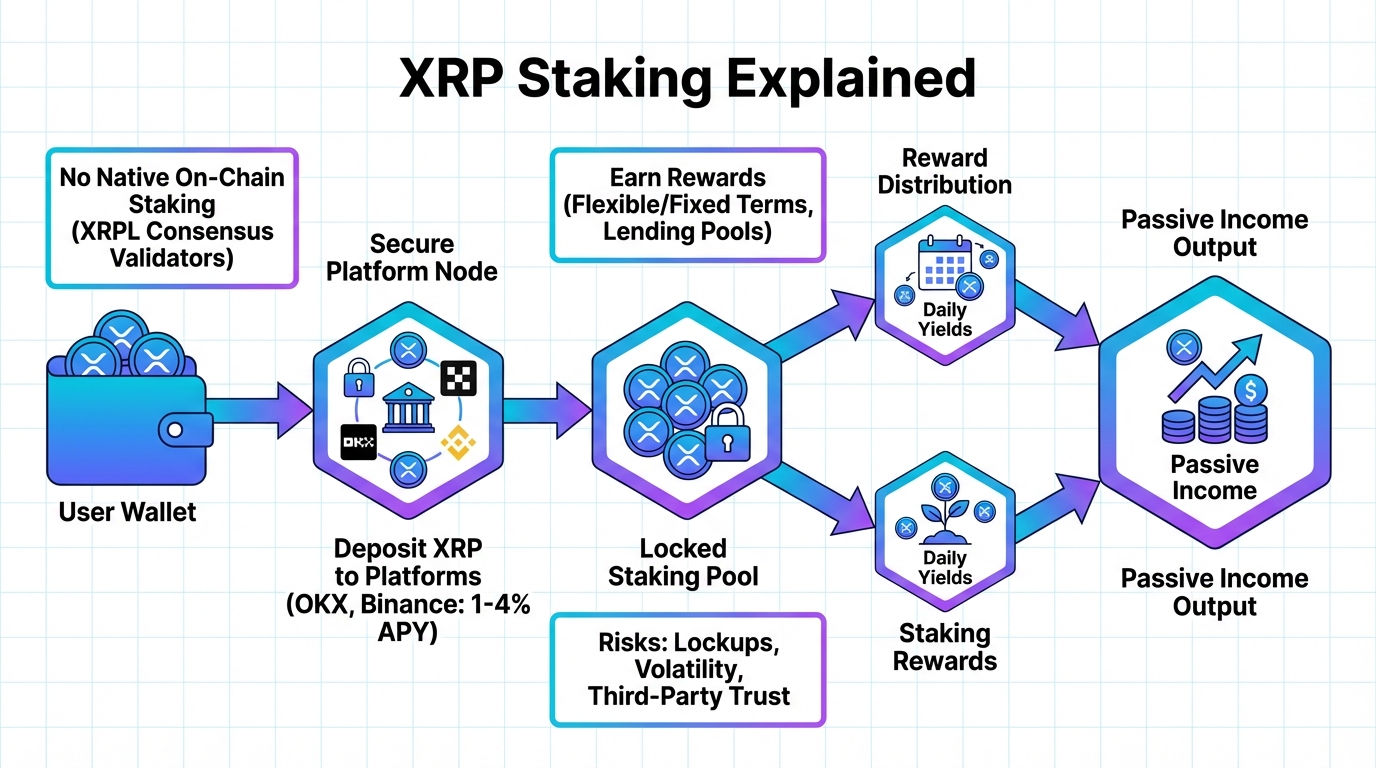
Put simply, staking is “a mechanism where you deposit your digital assets into a network and receive rewards.” Using a metaphor, your wallet is like a digital backpack that safely carries your money. In XRP staking, you lock your assets into the network, help validate transactions, and receive rewards in return. This is like planting seeds in a garden and waiting for the harvest: the seeds you plant (XRP) support the growth of the network and eventually come back to you as a harvest (rewards).。
In Web3, smart contracts—self-executing programs—manage these rules. Even without a human banker, the rules are enforced by code. Still, safety comes first: never share your wallet’s private key with anyone. For beginners, it is wise to start with a small amount. Blockchains such as the XRP Ledger enable fast and low-cost transactions, making staking more accessibl。
Web3 staking is useful in various real-world situations. Here are three concrete scenarios.
1. Financial upgrade: For people thinking about everyday savings. Traditional bank deposits often offer very low interest, but XRP staking can provide rewards in return for contributing to the network. For example, you might use XRP for global remittances and stake any remaining balance to generate additional income. This makes it possible to grow assets individually without relying on a central bank.
2. Gaming world: Ideal for game enthusiasts. In Web3 games, the Play-to-Earn model is spreading. By staking XRP, you can strengthen in-game assets and convert rewards into game currency, making it feel like you are running a digital farm.。
3. Community building: In communities such as DAOs (Decentralized Autonomous Organizations), members can stake XRP to gain voting rights and collectively decide the direction of the project. There is no single central leader; instead, ownership is shared among participants, enabling fan communities to operate in a more autonomous way.
Comparison Table: Traditional Web2 Services vs Web3 / Metaverse Solutions
| Feature | Traditional Web2 Services | Web3 / Metaverse Solutions |
|---|---|---|
| Data ownership | Owned by the platform | Controlled by the user |
| Censorship resistance | Central administrators can block users | Decentralized and more resilient to censorship |
| Reward mechanism | Mostly fixed interest only | Dynamic rewards through staking |
| Interoperability | Limited between platforms | Freely connectable across blockchains |
Conclusion: Opportunities and Risks of Web3 Staking
Web3 staking technologies, especially those using assets like XRP, can grant users true ownership and free them from centralized restrictions. This opens new paths for earning rewards and helps address issues such as censorship and dependence on specific platforms. However, there are also risks, including market volatility and security threats, and open questions remain around regulation and scalability.。
It is recommended to start by deepening your knowledge and observing the space carefully. Begin with small experiments and gradually explore the world of Web3. Take your time, prioritize safety, and enjoy the journey.。

👨💻 Author: SnowJon (Web3 & AI Researcher)
A researcher drawing on knowledge from the University of Tokyo Blockchain Innovation Program, focusing on explaining Web3, blockchain, and AI technologies in a clear and practical way.
His work emphasizes conceptual understanding, technological structure, and long-term implications rather than speculation.
*AI tools are used to assist drafting, but all final review and technical verification are conducted by the author.
References & Further Reading
- How to earn $9,000 a day? Start your path to wealth with the XRPstaking platform.
- What is XRP: A Comprehensive Guide to Ripple’s Native Cryptocurrency and Its Role in Global Payments
- Could Staking Become Part of the XRP Ledger’s Future?
- XRP Milestone Alert: XRPL Payments Engine Gets First-Ever Formal Specification